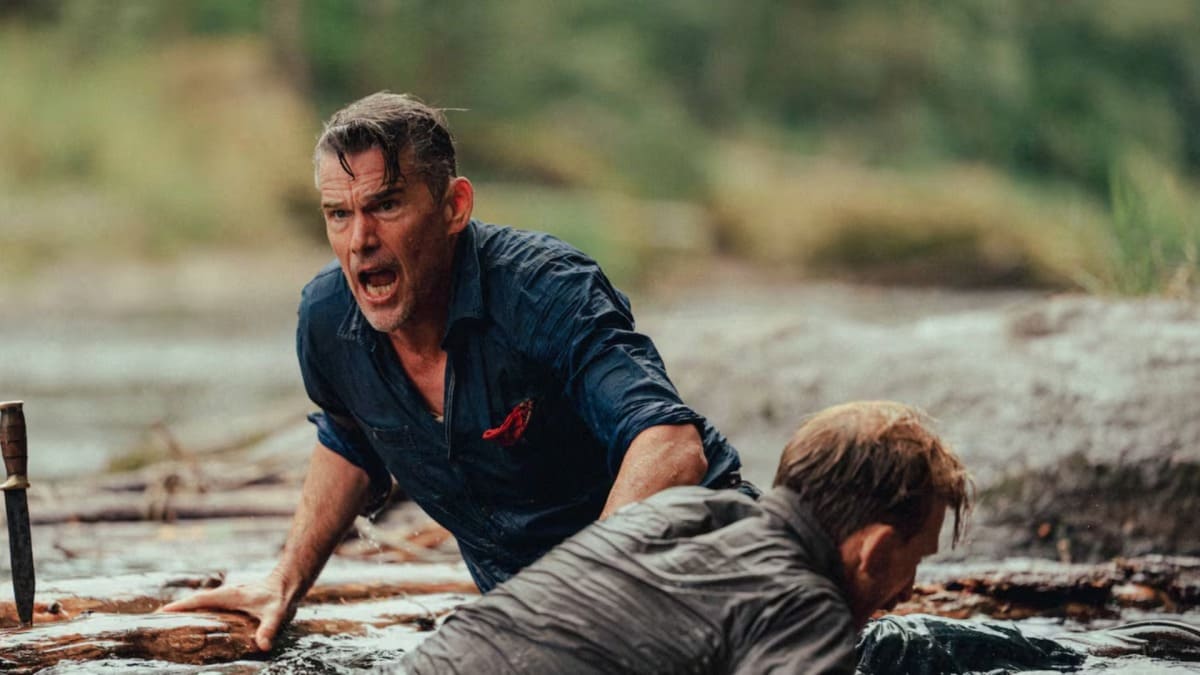
In Padraic McKinley’s The Weight, Ethan Hawke plays Murphy, a conflicted but righteous man who finds himself in dire straits during the Great Depression. Even in desperate times, he tries to do right by his little girl, but when he lands in prison far away from her, he must learn to survive the petty but deadly games the warden (Russell Crowe) and his men play with the prisoners’ lives. While Hawke has lived many lives onscreen, his performance as Murphy stands out from the introspective wanderers like Jesse in the Before trilogy or the needy insecurity of Lorenz Hart, a Broadway composer whose star is falling, in Blue Moon.
Murphy is the kind of tough-guy leading role that, while physically demanding, is also emotionally challenging, as Hawke must dig into his character’s desperation and personal grief as he survives increasingly dangerous terrain on a mission to smuggle the warden’s gold under the nose of the government. In an interview with The A.V. Club, Hawke traces The Weight‘s lineage back through literature and shares a little of what’s next for him on his series The Lowdown.
The A.V. Club: The Weight is set a few years into the Great Depression, and that sense of desperation feels timely. Was that something you thought about when developing this character?
Ethan Hawke: It was driving us. A story about how greed impresses itself on the populace, on the people, and how it pits them against each other when they’re not realizing that they’re stronger than the forces upon them if they work together. I love them arguing about Franklin Roosevelt or whatever, the details of their lives, and not realizing that their common humanity is so strong if they can find it. These people who think they don’t like each other have so much in common and so much good to do if they can pull together and do it. I love Murphy because he’s the kind of person I’d like to be: a thoughtful person who doesn’t lie, who meets their responsibility, who takes responsibility for others and himself. It’s an old-fashioned kind of masculine prototype that I’ve never gotten to play, and I don’t get to see enough of in movies—to play a man that I admire.
AVC: What was it like sharing those scenes with Russell Crowe? They’re some of the most tense in the movie.
EH: This movie doesn’t work without him. We needed a heavyweight champion to come in and box with, to be the formidable opponent for Murphy. It makes the movie so much stronger. He’s one of the top dramatic actors of my generation, bar none. We’re lucky to have him, and it’s so easy to do scenes with a great actor. There’s a new season of The Lowdown coming out, and I got to do these scenes with Tommy Lee Jones. When you get to work with these people at the top of my field, it’s just thrilling.
AVC: Speaking of intensity, there are a number of suspenseful moments that would fit right in with movies like The Wages Of Fear and Sorcerer. Were there other classic inspirations for The Weight?
EH: We’re all a bunch of cinephiles, so Wages Of Fear and Sorcerer are clearly inspirations for this movie, but so is Cool Hand Luke, so is Sometimes A Great Notion, Treasure Of The Sierra Madre. In this day and age that we’re living in, we all grew up on the same movies. Even all those movies I referenced, they’re pulling from great literature. There’s a part of me that felt like it was a Rudyard Kipling short story or a Jack London short story or something where it’s visceral, it’s simple, it’s very straightforward. It was kind of old-school, powerful storytelling—a story of greed, of how a father can reunite with his daughter, how you can beat the system.
AVC: You’re also a director. What’s it like to work with someone else to fine-tune your performance and how it shows up on camera?
EH: I love working with a great director. My favorite position in life is getting to be a performer for a director who has a really strong vision and knows how to articulate it. It’s a joy. This is Padraic’s first film. It’s a banger of a first film. I put it up against anybody’s first film, but he’s not a kid. He spent his life studying this profession. His father was an editor. [Padraic’s] one of the best editors I’ve ever seen, and it makes him a great leader. I always try to be the kind of actor that I would most want as a director. My favorite Brando quote is from his earlier days, but he said you have to spiritually marry your director—you’re an extension of their imagination. If you’re trying to make a different movie than they are, the music can’t harmonize. If you can really understand the movie they’re trying to make and become the tip of the spear, so to speak, and deliver that to the audience, that’s when acting can really pierce.
AVC: Speaking of The Lowdown, Tulsa is so central to the show. How important is it to you and creator Sterlin Harjo to get a sense of the community there?
EH: Place, setting, environment tells you so much about the people, and the people are so informed by the places we live in. One of the great gifts is that Padraic really sets The Weight in its place, in its time, in the feel of it. And Sterlin does the same thing with Tulsa and The Lowdown. The whole season one of The Lowdown ends with a big wide shot of Tulsa. I always think that it’s perfect because Tulsa’s really the main character. Lee is bouncing around the city and taking you to all these different places and all these different people and these different communities. He’s a useful tool to do a portrait of Tulsa, and that’s what the show continues to be.
AVC: Can you tell us anything about Betty Gilpin and how her character will interact with Lee?
EH: Well, we just have this phenomenal new cast, the two major new characters are [played by] Betty Gilpin and Tommy Lee Jones, and she’s a firecracker. She’s such an intelligent actress, and she’s kind of amazing to work with because she’s really funny, really smart, and really understands drama and storytelling. Her character’s just as much a hot mess as Lee is. So hilarity should ensue, I hope.
AVC: Returning for another season, it’s kind of like you coming back to Jesse for the Before movies. What’s it like to revisit a character versus creating something from scratch?
EH: It’s funny, I’ve never done [an ongoing series]. You mentioned Jesse from the Before trilogy, but those movies had nine years in between them, so it kind of felt new again. The advantage of doing a TV show is it’s a really big canvas and you really get comfortable inside the skin of the character. A lot of the fun for me is finding what he walks like, what he dresses like, what the world is. I missed that, that newness, that freshness, but the advantage is it’s really lived in, and you can go deeper and you can really get to know the character. I hope season one really just feels like the prequel to the real movie that is season two.


 Keep scrolling for more great stories.