The trailers for the new Street Fighter movie boast a more faithful, or certainly more literal-minded, adaptation of their source material, at least as far as that extends to replicating the fighting combos and signature poses that now define Capcom’s arcade and console game series. The plot, which centers on an international fighting tournament hosted by evil mixed martial arts enthusiast M. Bison (David Dastmalchian), looks to be another rehash of the 1973 Bruce Lee vehicle Enter The Dragon, just like the 1994 Mortal Kombat movie before it, and then both the 2021 Mortal Kombat reboot and its sequel from a few months ago. That stands to reason, given that both fighting game franchises take place at fighting tournaments.
Recycling such a basic high-concept scenario is also not that surprising when you consider the basic challenge of narrativizing a group of virtually plot-free fighting games, whose characters are only memorable for their costumes, physical features, and fighting styles. Even the recent Mortal Kombat movies lose all momentum whenever they pause to establish their characters’ wispy backstories. That constant drawback suggests that there’s still persistent uncertainty as to how to translate these games into movies.
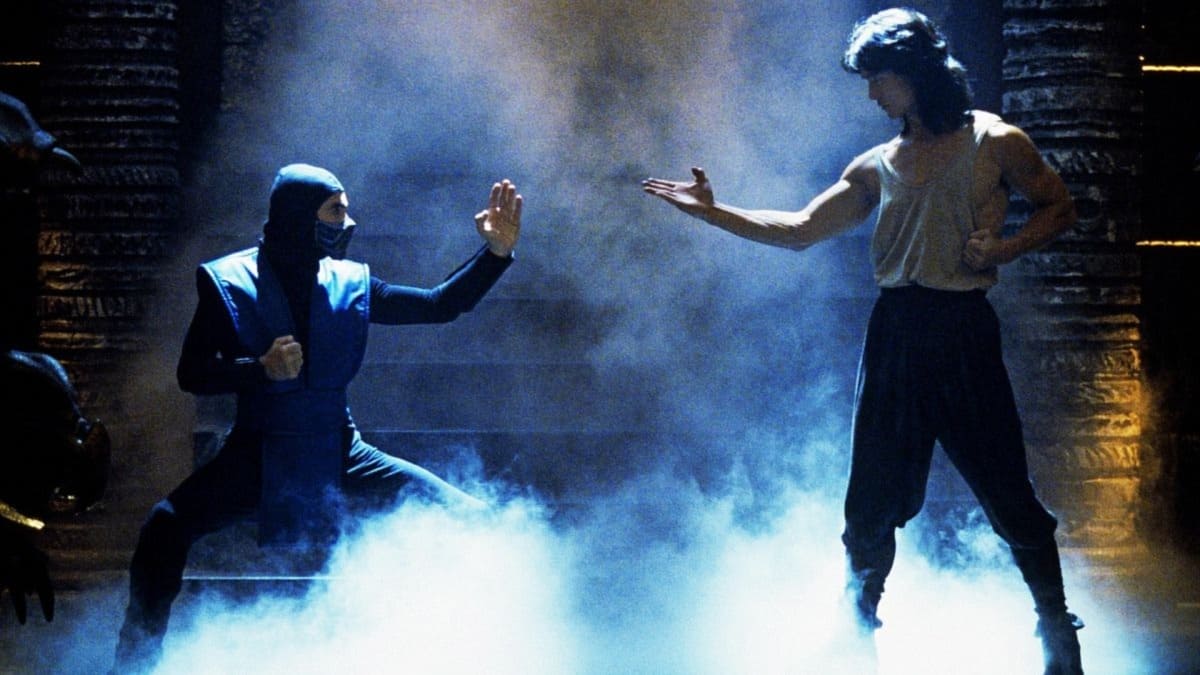
What elements from fighting games are worth adapting, and, more specifically, how much story and character depth is necessary? For some answers, rewatch the first live-action Mortal Kombat movie, an endearingly cheesy, but surprisingly well-balanced action-adventure whose combination of practical and computer-generated effects and heavy emphasis on production and art design immediately set a surprisingly high bar for its successors.
Helmed by Paul W.S. Anderson, Mortal Kombat is also more poised and better paced than much of what followed, too. Here, the games’ “Sam Goody metal album section” vibes are given a lovingly faithful expression thanks to the filmmakers’ preference for atmosphere over plot or character development. Mortal Kombat‘s also a rare AAA game adaptation whose callbacks and tributes to the games don’t derail the satisfying set pieces. And while there isn’t as much blood or gore as a standard Mortal Kombat game, Anderson’s movie features standout creature and makeup effects (Goro alone!) and some decent stuntwork too.
After its techno-fueled opening credits, Anderson’s Mortal Kombat begins with a slow-mo-heavy flashback. We see Chan (Steven Ho) get trashed by evil sorcerer Shang Tsung (Cary-Hiroyuki Tagawa, delivering just the right amount of ham). Then we join Chan’s brother, series protagonist Liu Kang (Robin Shou), before he meets magical lightning god Rayden (Christopher Lambert) and is recruited to fight Shang Tsung and his guys as one of Earth’s champions at the interdimensional Mortal Kombat fighting tournament. We learn a little more about Liu Kang’s background in a scene where he swaps some light exposition with his monk grandfather (Lloyd Kino), but for the most part, Chan’s death has just enough melodramatic weight to give Liu Kang all the motivating depth we could possibly need.
The other supporting roles are also mostly presented as cool extensions of Anderson’s music-video chic aesthetic. All you really need to know about Special Forces agent Sonya Blade (Bridgette Wilson) can be found in her opening scene, where she runs through a nightclub with a big gun looking for cyborg baddy Kano (Trevor Goddard), who has a red, glowing robot eye and talks like a soccer hooligan. “Where’s Kano?” Sonya asks repeatedly, until she joins her fellow fighters on Shang Tsung’s ghost ship to Outworld. That’s it, off we go with Sonya!
Likewise, frustrated martial-artist-turned-movie-star Johnny Cage (Linden Ashby) takes out a bunch of extras, gets upset when one of them doesn’t fall right, and then gets recruited by Shang Tsung, who disguises himself as Johnny’s mentor Boyd (Peter Jason). There are thankfully no more scenes with Master Boyd.
These mercifully brief early scenes say more about the teenage-dirtbag-friendly movie than any bathetic setup could. Why do you need to know more about Johnny Cage’s hopes and dreams when what ultimately matters is what he looks like grappling with a giant hulking Goro puppet? Isn’t the main draw of a Mortal Kombat movie the thrill of watching fights that pit one of several fish out of water against evil monsters with cool superpowers?
Well, not according to the creators of the two most recent Mortal Kombat movies, who overburden both the 2021 reboot and its sequel with a surplus of generic backstory and cliched dialogue. That’s especially disappointing when it comes to fan-favorite characters like Sub-Zero (Joe Taslim) and Scorpion (Hiroyuki Sanada), both of whom were previously defined by their lack of facial features and their different-colored ninja suits.
Most fighting game characters either thrive on or would sorely benefit from a little mystery. Who really needs to know why Sub-Zero does what he does when, as Anderson’s movie suggested, all you need to know is that he’s a slave to Shang Tsung and can shoot man-slaughtering icicles out of his palm? The rest of the movie should focus on making him cool, not learning more about his childhood!
Ironically, the one area where the original Mortal Kombat film could stand to be improved is its action scenes. Anderson at least takes his time in showcasing his stunt team’s athleticism and acrobatic skills, but the choreography’s a little basic. This, arguably, speaks to how hard it can sometimes be to build a fight around finishing moves and colorful costumes. But that’s one of the basic challenges of this type of movie. At the very least, Anderson’s repeated use of slow-motion imbues these moments with just enough dramatic weight.
The same can’t be said about either the 2021 reboot or this year’s sequel since those movies’ action scenes are over-edited and generally covered rather than directed. Even the otherwise terrible Mortal Kombat: Annihilation gives us a clear view of several stuntmen as they fly at each other and get thrown around in funny costumes. There’s even a hilariously dated computer-animated Animality fight that pits two shape-shifting fighters against each other—a dragon versus a three-headed hydra. The more recent Mortal Kombat movies look miserable by comparison, as if their creators were scared to embrace their source material’s juvenile sensibility and abiding love of cheap thrills.
A similar timidity mars the otherwise superior 1994 live-action Street Fighter movie, whose well-polished banter and game ensemble cast doesn’t offset its muddled tone. Most of the time it’s a quippy action-adventure that follows a hastily assembled group of fighters and their self-appointed mission to stop Shadaloo City warlord M. Bison (Raúl Julia) from creating a supersoldier army. But sometimes, Street Fighter‘s also a comedy about this type of movie, like when Jean-Claude Van Damme’s square-jawed military leader Colonel Guile tells nosy journalist Chun-Li (Ming-Na Wen) that “This war [against Bison] isn’t about your personal vendetta—it’s about mine.” That’s one of the movie’s better jokes, which are amusing enough and also keep the plot moving from one talky, dramatically inert set-up to the next.
Julia’s blessedly garish villain inadvertently puts his finger on what’s most obviously missing from Street Fighter when he observes, to Chun-Li, that she hasn’t thrown a single punch since she arrived in Shadaloo City. The movie seems to wink at that relative lack of action when an opening scene at a cage fight sics the masked pugilist Vega (Jay Tavare) on the hapless buddy duo of Ken and Ryu (Damian Chapa and Byron Mann). Then they get interrupted by Guile, who crashes through a wall and into the ring with an armored vehicle.
It’s strange to think how many times writer-director Steven De Souza either winks at us or stops short before a fight can break out. The funniest bit in the original Street Fighter movie might be when Bison’s ripped but dim Russian henchman Zangief (Andrew Bryniarski) yelps when he sees Chun-Li racing to blow up Bison’s weapons cache on a TV with a live security camera feed. Right before something momentous finally happens, Zangief cries out: “Quick, change the channel!”
That margarine-light humor also makes Street Fighter feel more like a movie, unlike most of the Mortal Kombat films—including the blessedly gory but otherwise dull animated features—which often alternate between pandering fan service and half-hearted infodump exposition. Now that franchise is like every other grimdark, post-Game Of Thrones fantasy, only now with lightly exoticized, design-forward characters with names like Sub-Zero and Noob Saibot.
At least Mortal Kombat II tried to add some humor in the form of Karl Urban’s fish-out-of-water take on Johnny Cage, who fakes his way through Outworld’s fighting tournament despite only playing an action hero in movies. But Urban’s more charming than the material, leaving us to try to find something to hang onto in another sequel about a magical whatsit, a dead dad, and a guy who can shoot deadly ice at you. The one thing that Mortal Kombat II gets right is its emphasis on grisly, impact-forward action scenes that are more about their gory climaxes than their presentation, choreography, or emotional stakes. That’s a rare example of a fighting game adaptation that has the same joyfully crass energy as its source material, even though those that do are exemplary, like Anderson’s Mortal Kombat and the giddy-goofy 2006 film DOA: Dead Or Alive.
DOA: Dead Or Alive is a cross between Enter The Dragon and the fizzy Charlie’s Angels reboots. Hong Kong expatriate director Corey Yuen delivers a terrific stunt showcase and makes this sunny, unabashedly corny action-comedy a standard-bearer for movies based on games where you wrestle with your opponents and then ride them like a toboggan through various fighting arenas’ “danger zone” boundaries, like guard rails or ledges.
Instead of trying to reproduce the feeling of watching a Dead Or Alive video game fight, DOA: Dead Or Alive treats viewers to a colorful, cheesy, thrilling vehicle for lead actresses Sarah Carter, Jaime Pressly, and Holly Valance, and their diligent stunt team. That focus on playful action sets an appropriately light tone for a movie that pits a disgraced ninja princess (Devon Aoki) and a father/daughter pair of pro wrestlers (Pressly and Kevin Nash), among others, against evil Eric Roberts and his nanobot-powered kung fu sunglasses. (It thankfully doesn’t make much more sense in context.)
DOA: Dead Or Alive‘s fight scenes are also well-paced and choreographed, making it hard to object too strenuously about all the Maxim-level cleavage and ogling camera, or the matching pile-on of adolescent humor. If anything, that’s exactly the right tone for this sort of movie. Better yet, the movie’s lightly horny gags are never so prominent that it distracts from a fighting game movie’s main appeal: the actual fights. DOA: Dead Or Alive stands apart because its filmmakers treat action like the vehicle for their movie’s mood, plot, and overall style. Instead of Easter eggs and fan service, the makers of DOA: Dead Or Alive deliver exactly what this genre implicitly promises—and without much insecurity about what type of entertainment they’re riffing on. Dumb sex jokes, hyper-stylized characters, eye-popping wire-fu, and hand-to-hand combat: Sometimes the formula for success really is that simple.


 Keep scrolling for more great stories.