It feels important to note that, at the time that I’m writing this column—Tuesday, November 17, a.k.a. T-minus 48 hours to the GTApocalypse—I have not played Grand Theft Auto VI. Almost no one has, outside of a handful of reviewers and guide authors who I can only imagine as The Weary Damned, desperately racing through the extraordinarily shiny streets of Vice City with a controller in one hand and a pen in the other, feverishly scribbling down points of interest and, I don’t know, “hot SMG pick-up” locations.
And yet, despite not having played it—and feeling some skepticism about grabbing it upon release, something that, deep down, I know I’d only be doing to fulfill a little scream in my head to “Stay in the conversation!”—I nevertheless feel like I’m drowning in Grand Theft Auto VI. Partly this is the fault of my inbox, which has been filling up for the last six months with PR pitches trying to wrangle some connection to Rockstar’s upcoming juggernaut into their particular marketing lanes. (Did you know Grand Theft Auto VI has cars in it? Would you like to see pictures of three dozen cars that look like they could have been in the game?! No, wait, don’t delete-!) I’m not immune to this element, either, of course: There’s a reason I’m writing about it right here, right now, instead of any number of genuinely great indie games I’ve been playing recently. (Although, while I have your eyes: Go buy and play Nicolás G. Cid Delgado’s fantastic Latin American detective game Funeral For The Sun; it’s the best new mystery game of 2026.)
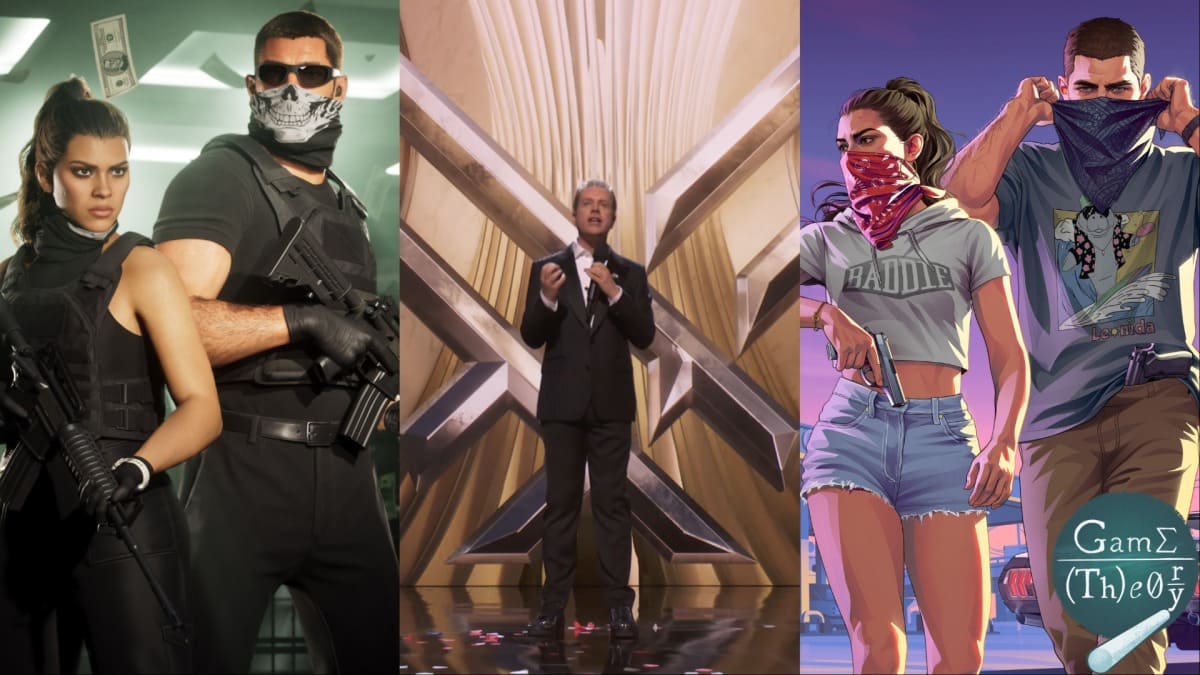
The current reason I’m feeling like a frog slow-boiling in the warm waters of a fictitious, it-took-human-beings-10-million-hours-of-computer-drudgery-to-model Florida city, though, is that other tentpole event sticking out of end of the annual gaming calendar, like a piece of rebar lodged in Phineas Gage’s head: The Game Awards. After all, it was Tuesday morning when Geoff Keighley’s celebration of video game commercials (with the occasional trophy, or dollop of supposed activism, thrown in) announced that GTA VI had been nominated for Game Of The Year, despite, again, the total number of people who’d played it at that point likely not breaking a thousand.
I’m not suggesting any kind of impropriety here, mind you; the critics who voted for the game’s nomination are probably from the major outlets that have played it—and even if they weren’t, I’m open to the idea that Grand Theft Auto VI should have a GOTY nomination locked down from this particular body, basically by default. Because, honestly, GTA and The Game Awards deserve each other.
Both are, after all, attempts—one blatant as a stripper working the pole, the other a natural consequence of its general bigness—to awkwardly impose a monoculture on the vast and diverse gaming body politic. Keighley, who launched the TGAs 12 years ago out of the wreckage of the late and unlamented Spike Video Game Awards, has never been shy about this goal: It’s the reason there’s as much of Super Bowl commercial culture to his event as there is a stab at giving this medium its own Oscars. (Even as that aspect arrives with all the natural disappointments of filtering the most mainstream tastes possible into a series of supposed “Bests” baked right into the package.) The TGAs are a self-conscious and extremely deliberate effort to make something that everyone in gaming must be aware of, even if they exist in opposition to it. (There’s a reason former A.V. Club and Paste Games Editor Garrett Martin set standing orders to ignore the event outright, as a sort of negative-space counterprogramming of Keighley’s whole project.)
You can argue, as I imagine Keighley would, that this kind of communal interest is a net benefit to gaming, creating a force of attention so large that not even our collective cultural gatekeepers can deny it. (Because, god, but is there nothing that a certain kind of gaming brain can’t stand then to be casually dismissed by The New York Times.) Meanwhile, those of us on the skeptic side can point to all the ways the TGAs do what monocultures always do, i.e., grind down massive amounts of diversity and varied experiences into a uniform nubbin while extracting as much cash from folks as humanly possible.
Grand Theft Auto VI’s infestation of people’s brains, meanwhile, feels almost algorithmic. If a developer makes bigger and bigger games—and is financially rewarded more and more for doing so, as Rockstar has very decidedly been—then at some point they will naturally make the biggest game, right? The largest world, the most expensive graphics, the most inescapable hype. I genuinely believe that GTA VI is an expression of actual design principles, even if their maximalism turns my stomach: It expresses, from its distant lighthouse perch, the idea that if you pour enough into a project—enough money, enough time, enough electricity, and, yes, enough actual human creativity and labor—you can push toward infinity.
Having not played the game (yet?) I have no idea if anyone at Rockstar has grasped the irony here, of having games that are, at their core, a satire of American excess so utterly come to embody it. (Like everybody but a handful of people at this moment in time, I have no idea what the game’s actual narrative is about, beyond the same “Crime kind of pays, sometimes” vibes that every GTA game traffics in.) Grasping that paradox would make the game a genuine artistic accomplishment, instead of just a technical one; not that that will actually matter to The Game Awards.
It would be cynical, even by my own admittedly jaded standards, to say that Keighley & co.’s Game Of The Year trophy could be easily re-titled “Most Expensive Game Of The Year.” (Just last year, The Game Awards’ assembled critics managed to hand the win to Sandfall Interactive’s relatively-small-by-the-skewed-standards-of-video-game-development Clair Obscur.) It’s always possible they’ll surprise me this year, and hand the win to one of GTA VI’s slightly teensier competitors. It never seems to pay, for instance, to write off how intense people get about the recent run of Chinese-developed action-RPGs like current dark horse nominee Phantom Blade Zero; my own personal mentions in our comments sections, meanwhile, have made it clear how, uh, vocal people can get about the mediocre-to-my-mind Control: Resonant.
But even if GTA VI doesn’t ultimately take home the GOTY trophy on December 10, it will be all but a formality; from a cultural domination point of view, Grand Theft Auto VI has been The Game Of 2026 since, basically, 2024. It is a lead weight on the rubber sheet of the gaming brain, distorting gravity and pulling all else into its orbit. It is the key that an existential hole like The Game Awards was designed to be unlocked by. It is a third, somehow even-more-tortured metaphor. For those of us disinterested in a gaming monoculture, the best thing about its release this week may simply be that we will no longer be living in the pre-GTA VI era; yes, there will be commentaries and thinkpieces and reactions to its missions and writing and gameplay and everything else in the wake of its release, probably enough to fill several whole books. But by becoming a real thing—even one being shipped in what are, basically, empty boxes—it will hopefully stop being this huge, unwieldy bolus of gaming potential. It will no longer be able to be all things to all people, occupying a quantum superposition of gaming expectations—the sort of perfect ideal of what The Game Awards has always imagined gaming to be. Instead, it will be a real thing, in (god knows how many millions of) people’s hands. Hell, I might even end up playing it myself. One of these days.


 Keep scrolling for more great stories.