Marathon is a neon light shining on the ugliest parts of human nature

Bungie’s online shooter raises questions about violence and self-interest by making its gunplay entirely “optional.”

Marathon is a neon light shining on the ugliest parts of human nature

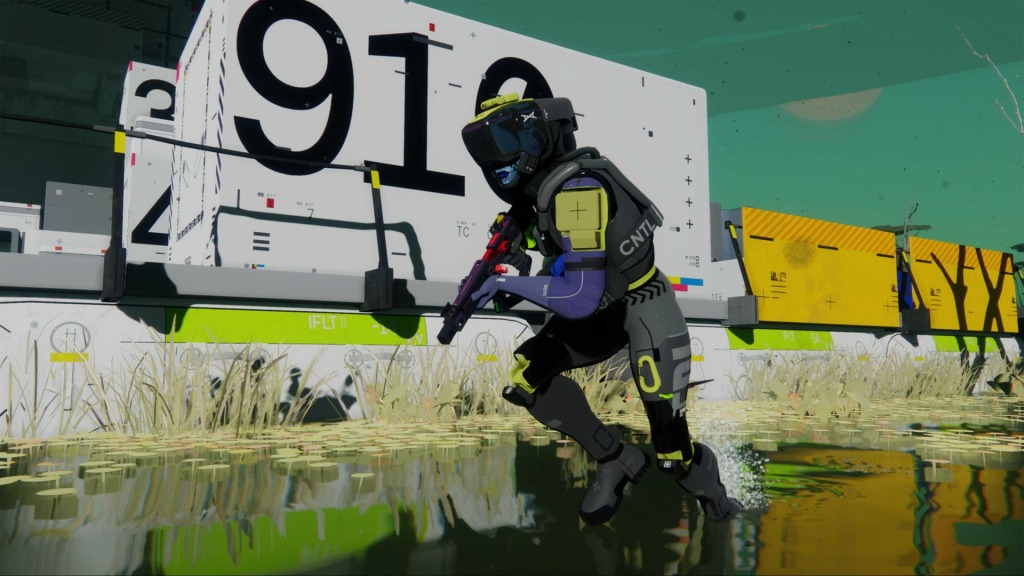
They’ll kill ya dead on Tau Ceti IV. It’s one of the first things you learn while playing Marathon—not “learn” in the wishy-washy way you’re introduced to the game’s stylish but slightly awkward user interface, or even its carefully hoarded dribbles of sci-fi dystopian lore, but in the drilled-into-your-brain-with-a-bullet, School Of Hard Knocks sense of the word. The alien world you’re stuck running errands on in Bungie’s new extraction shooter isn’t shy about dealing out death; its player base, even less so.

Which is fascinating, because there’s absolutely nothing in Marathon’s design (at least, from what I could tell in my time dipping a toe into the game’s recent season two free trial period last week) that explicitly forces players to murder each other. That’s part and parcel of the extraction shooter genre, which grew out of military sims like last decade’s Escape From Tarkov, and where a flavor of white-knuckle ambiguity is the order of the day. As the name implies, the goal of an extraction shooter isn’t to rack up the most kills, but to be the guy or gal who doesn’t die with the most stuff, instead escaping any given game’s deadly worlds—populated with both AI-controlled enemies and other heavily armed players—with a backpack full of loot you’ll lose if you catch a bullet in the brain. The “extraction” itself, meanwhile, typically arrives in the loudest manner possible, attracting the eyes and ears of all the other scavengers who would also like to exfil from the zone/planet/generic hellworld with their hauls intact. Within the mechanics of these games, there’s nothing stopping strangers from catching the bus to safety together, tensely waiting out the clock like people sharing the world’s most gun-filled elevator ride. In Marathon, that’s not what happens.

In the aftermath of those climactic moments—when you’ve been summarily ambushed, executed, and harvested by a trio of human locusts while just trying to get out of Perimeter with one lousy-ass purple shield in your gunny sack—it can be hard not to apply a moral, and even a political, valence to the Marathon playerbase’s embrace of a kill-on-sight ethos. Marathon’s story is upfront about the fact that its Runner players are members of a disposable underclass, mercenaries who put themselves into hideous debt to their corporate overlords in the hopes of striking it rich enough scavenging the bones of a dead colony that they can cover rent on their own bodies. The fact that players could all get out of every mission alive, together—and that the overwhelming majority of Runners make a conscious choice to instead snipe the crabs higher than them in the bucket, then turn their corpses into what are frequently referred to as “loot piñatas” amongst the playerbase—can begin to take on depressing real-world overtones. No one ever came off as anything but foolish or fearmongering by describing video games as “murder simulators,” but “violent self-interest simulators” can carry a more potent whiff of truth.

Thing is, this “Fuck you, got mine” attitude is not automatically inherent to extraction shooters as a whole. Indeed, there are several high-profile games in the space where interactions default to being far more ambiguous, if not outright chummy. My anxiety disorder and I may have struggled mightily with ARC Raiders’ more collaboration-minded gameplay, but it’s true that, in my short time with it, I was much more likely to run into players willing to join forces, heal another player, or serve as a guide or impromptu buddy than I did in Marathon. (Players like this are sometimes derided as “carebears” by Runners deeply invested in the Marathon mindset.) Which is part of what fascinates about Marathon, alongside its appealingly garish visuals, and its connections to the deep but disconnected stories of the company’s original Marathon titles from the ’90s: Bungie has made decisions both explicit and implicit here that have cultivated a bloodthirsty indifference to the lives of your fellow players, and trying to figure out how those behaviors were encouraged to weave themselves organically out of base materials is an intriguing exercise in the principles of emergent design—especially since some of these things speak to banal things like weapon balance or marketing, while others speak to fundamental questions of human nature.

To start with, that marketing simply can’t be discounted. Marathon bills itself as a “PvPvE” (that is, Player Vs. Player Vs. Enemies) game, and Bungie staff emphasized, in the lead-up to the game’s release, that players hoping to opt out of the “PvP” part should probably start looking for a different game. Since launch, the company has relented on this hardline stance at least a bit, presumably because, in a gaming landscape as obsessed with concurrent player counts as our current one, telling anybody to hit the road is seen as a misstep. The free trial period coincided with a new time-limited playmode where players were unlikely to encounter other humans as they tromped around a deadly marsh in the darkness, while Bungie is expected to roll out a more comprehensive “players vs enemies” mode in the coming months. 

But despite these mollifying touches—and in mild defiance of a decade-plus of the more cooperation-minded Destiny—it’s worth remembering that Bungie built a big part of its modern reputation on the strength of its competitive multiplayer modes back in the Halo days, and the company steered into that by pushing Marathon as a game without the softer communal edges of some of its competitors. Given that audiences for online games in 2026 self-select aggressively by opting out of anything that rubs them even remotely the wrong way, this initial push primed the game to be more of a violent free-for-all than many of its ilk, as players who genuinely wanted an extraction game that would serve as a tense kill-or-be-killed explosion of anarchy flocked to its banner. 

In-game, meanwhile, Bungie pushed things even harder by building the entirety of one of its story-driving factions around slaying other players. Arachne, a death cult that venerates Runners for their ability to kill, die, and then rise to kill again, is generous in rewarding player-killers for their sanguine work, doling out both story chunks and upgrades to its acolytes. It’s a strong statement of principles from the designer: Even that population of players who primarily signed on to experience Marathon for its story, its surprisingly robust battles against non-player threats, and its world design—a group that’s been plenty vocal about their desire for a less conflict-filled Tau Ceti in the months since the game’s launch, spawning schisms in the existing playerbase—have a goad to pop a few skulls from time to time. Sure, the Arachne material is all optional, but it’s also clear messaging to players that PvP activity is not just an accepted risk of the game’s extraction shooter template, but a sought-after end result, “the sacred thermodynamics of violence,” in the organization’s own cultish terminology.

Beyond all this obvious signposting, though—or the simple but undeniable economic benefits of just killing the guy next to you and taking all his stuff, for that matter—Marathon has deeper design decisions that encourage even the hesitant to kill first, ask questions never. Chief among these is the power of most of the game’s weapons, and the relative fragility of Runners. In games like ARC, where weapons are relatively weak, an errant shot exchanged between strangers can be written off as a misunderstanding; fights in that game last long enough for things like second guessing, tactical cowardice, and even outright mercy to sneak into the human equation. Marathon doesn’t fuck with that spirit of thoughtful hesitation: If someone can see you, they can probably kill you in less than five seconds, so you’d damn well better start killing them first. The game makes it clear that violence is not an opt-in system on Tau Ceti IV, creating a population of players who might think, “It’d be better if we could all just extract together,” but whose self-preservation instincts push them to ambush, kill, harvest, and move on. Anything less decisive is an invitation to be the next sacrifice.

All of which is ludonarratively fascinating, even if it sometimes makes Marathon a bummer for the less bloodthirsty in its audience to play. (Personally, I’ll be taking in its dystopian story through wikidumps and YouTube videos from here on out.) Certainly, there’s nothing wrong with making a game where people shoot each other—especially when you’re Bungie, a studio that remains top-in-class at making guns and movement abilities that shine in human-on-human battle. Players can certainly be forgiven for treating the alien planet as one giant deathmatch map when the PvP feels so inherently satisfying. But by making a game in which violence is ostensibly optional—but where the systems, the messaging, and the very nature of the world make it feel necessary—Bungie has created a very grim little treatise about the nature of the human animal. Whether it was trying to do that is largely immaterial, because the lesson is the same: They’ll kill ya dead on Tau Ceti IV—unless you kill them first.

 
Join the discussion...
Keep scrolling for more great stories.