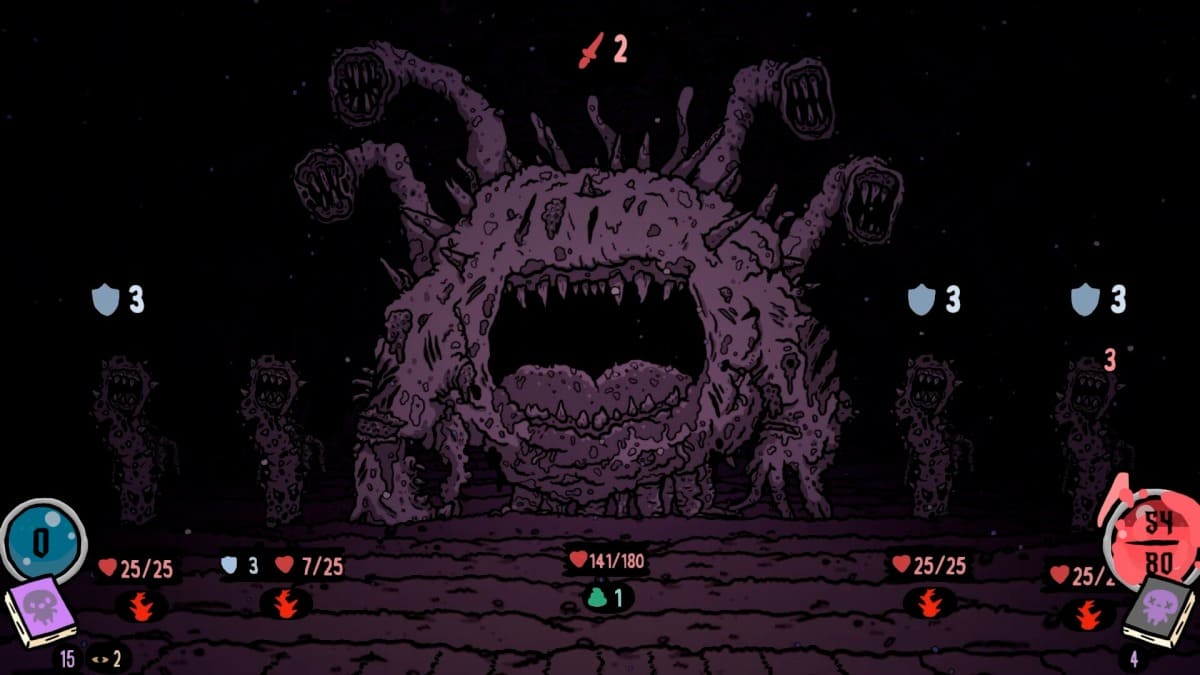
There’s a little laugh you only really get when you’ve broken something in a video game—not in the “glitching through walls” sense, but the one where you feel like you’ve gotten away with something. I’ve been getting it a lot lately, courtesy of Shroom And Gloom, the new roguelike deckbuilder from Team Lazerbeam—mostly when I’m about to deploy a card that I’ve built to do something really stupid, like deal hundreds of points of damage to one of the game’s cartoonishly hideous fungus beasts, while simultaneously drawing my entire deck and filling it with my foes’ deliciously roasted corpses. It’s a laugh that conveys a lot of different feelings, but most especially one of freedom: “I can’t believe they’re letting me get away with this.”
Shroom And Gloom—which puts players in the shoes of various unintended explorers fighting their way through a gorgeously animated fungal hell—isn’t unique in letting players break it. Card games, many taking their cue from Magic: The Gathering, have been leaning into this transgressive pleasure for years, with games like Balatro, Monster Train, and especially Daniel Mullins’ Inscryptioninviting players to upgrade and modify cards into increasingly stupid forms. But Shroom frequently feels like it’s built explicitly to create those moments when you blow up the whole board with a single carefully crafted bit of digital cardboard: It’s full of opportunities to upgrade cards that do ridiculous things like double their damage output, or cause them to draw more cards when they slay an opponent, or simply interact with every other card in your deck in ways that make them all more powerful. From the jump, it’s all but begging the player to make a card so manifestly stupid that there’s no challenge the game can then successfully put in its way.
There’s an older school of game design that used to put its foot down about this sort of thing, with the stodgy acolytes of “balance” harrumphing and stopping truly ridiculous strategies from working the way they should. (The recent Vampire Crawlers, for all that it has plenty of ways to get absurd with combos, causes cards to shatter disastrously if players get too silly with this kind of deliberately broken play.) And balance is, hypothetically, a fine thing to strive for. (If certain strategies become too optimal, the argument goes, the choice that’s key to games like this being fun gets drowned out by the push for “correct” play.) But Shroom And Gloom counters this by understanding that the breaking is the game: That looking at a series of cards and upgrade options and charting the path toward infinity is part of the fun of this kind of deckbuilding. Why build something if it can’t stomp all over the spore-slinging monstrosities in your way? Why make a thing that’s more fair, but less fun?
It’s not like Team Lazerbeam makes it easy: Upgrading your combat cards in Shroom And Gloom involves interacting meaningfully with the game’s second deck-building layer, which represents your tools for exploring the fungal abundance in between your fights. This is what gets you access to the various upgrade structures necessary to make the dumb stuff happen, but it also opens you to all kinds of threats: Players will often be left with the decision between getting a randomized card reward from one of their camp structures, and not having their campsite overrun with creatures that will pile on damage that’ll persist as they head into the next fight. This half of the game isn’t quite as breakable as the combat layer—at least, not in my first 7 hours with the game. But it still requires learning and planning in order to get your hands on the tools that let the truly silly stuff happen. Nothing about the pursuit of stupidity in Shroom And Gloom is, itself, stupid.
Just as importantly, the gameis designed so that breakage is, if not necessary, then highly encouraged: Its final bosses, especially, pull some serious bullshit that needs to be countered with the player’s own array of cheerfully broken idiocy. The goal here is to constantly be escalating: To look at your deck and try to see the crack where you can wedge in something truly broken. As a consequence, Shroom And Gloom’s not necessarily as “pure” as a less strict deckbuilder would be. But it’s also far more euphoric: When you hit that tipping point where a run goes from a struggle to a ball rolling downhill, crushing everything in its way, it’s hard not to get giddy. Games are, after all, all about interacting with rules; making breaking those rules part of the game is one of the ways the recent uptick in indie deckbuilders has made the art of deploying fake cards such a genuine thrill.


 Keep scrolling for more great stories.