By the game, I guess I should specify that I mean the thing you spend most of the 17 or so hours it took me to beat Horripilant doing: The idle game that operates at its core, which sees the player character—a miserable, darkness-trapped knight whose helmeted face perpetually stares out of the top right corner of the game window—execute a simple loop in which they mine and harvest materials, spend them to level up some rusty old pieces of armor and weaponry, and then drag their carcass down into a seemingly endless dungeon where they’ll hack and slash their way through monsters for meager gains. Here, as at all points in this package, the aesthetics attempt to serve as a saving grace, with fantastic monster designs that can be genuinely skin-crawling the first dozen or so times you see them. A pity, then, that you’ll instead be mowing each of them down in the thousands.
Some context: I play a lot of idle games, for a lot of reasons. Many of those are simplistic: I like to see a number go up as much as the next nerd, and I often find the genre’s repetitive gameplay soothing. (Sometimes to the point of somnambulism.) But idle games also tap into my deep-seated need for novelty. Because this is a space almost purpose-built for rapid iteration of ideas—all you really need is a concept, some placeholder art, and a moderately good grasp of math—idle games have mutated and evolved incredibly rapidly in the 17 years since Ian Bogost accidentally launched the whole genre with a joke game called Cow Clicker, meant to mock predatory and addictive game design concepts. (Whoops.) Lately, the tides of evolution have seen developers work to find ways to mash the core slow addiction of the idle engine into other genres, suggesting a trajectory similar to the one that ended up making roguelikes ubiquitous in the 2010s. Titles like Cauldron diversify various aspects of the basic idle design into minigames ranging from an auto-battler to a Vampire Survivors clone, for instance, while last year’s Asbury Pines bent the basic idle structure to its own end, using it as a pacing tool to tell a sprawling, time-tossed story.
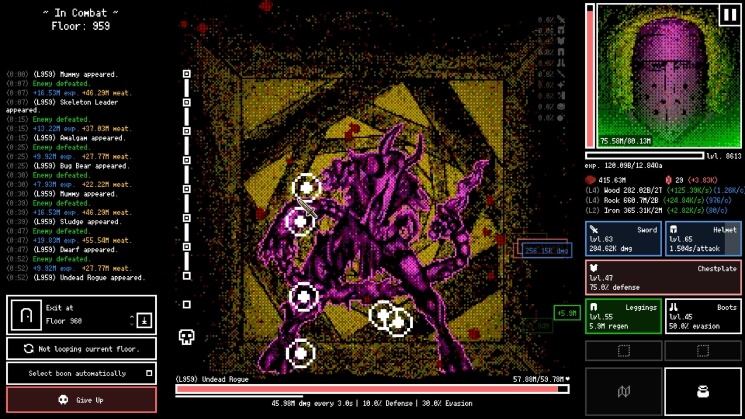
Horripilant lands at an awkward point between the various extremes it charts. It would be disingenuous to say that the game’s ugly-beautiful adventure game side and its basic, brutish idle gameplay don’t touch at all. Deeper progress into the dungeon allows the player to secure new items necessary for their puzzle solving, and—very rarely—an aspect of that exploration gameplay will reflect in some way in the combat. (Which is otherwise one of the more simplistic idle games I’ve powered through in recent memory; a good idle game makes decision-making thrilling, but Horripilant’s is a depressingly straightforward numbers grind alleviated only by the fact that the game itself isn’t very long.) The real issue is that the two sides of the gameplay make little effort to actually synergize. Instead, you have two fundamentally separate games that sometimes require waiting on the other in order to complete—whether that means the straightforward grind of killing monsters, smacking trees, and occasionally hitting a reset to get some form of prestige currency (spent on a largely lackluster spread of abilities), or the more esoteric need to recharge your brain before tackling another fairly fiendish riddle. Those few times they do rub up against each other are a delight, but if you hold to the idea that a “game” is the thing you spend most of your time actually doing while playing it, “Horripilant the game” is often disconnected from those things “Horripilant the loose collection of puzzles and creepy ideas” does best.
I’m heartened by the knowledge that this lack of cohesion is frequently a symptom of inexperience, which has an advantage over many other game design sins, in that it tends to be fundamentally self-correcting. With a glut of strong imagery and ideas (many shoved to the front, presumably to give the game’s demo an extra dose of juice), and a deeper core of puzzle-solving that I’d love to see fleshed out into something fuller, Horripilant is undeniably striking. I’ll be keeping tabs on Declos and his one-man Pas Game Studios to see what he can do with this initial toehold—whether that means finding a better bridge between the genres he’s working with here, or a decision to focus more closely on his obvious strengths. As-is, though, Horripilant represents not so much an effective effort to build a better idle game, but the sort of monstrous chimera you get when you try to staple a bad game onto a good one.


 Keep scrolling for more great stories.