In House Of The Dragon, the path to Westeros’ infamous Dance Of The Dragons hasn’t been a march to war so much as baby dragon steps. After a soaring first season, in which co-creators Ryan Condal and George R.R. Martin impressively charted two decades of Targaryen history (and the latter stepped away from the series due to creative differences), House Of The Dragon reined itself in for a more intimate, character-focused second season—an uneven but cost-conscious response to the first’s lavish sprawl.
This tradeoff left some in its expansive cast adrift in grinding subplots (hello, Harrenhal) while others were hurled straight into the dragon’s maw (RIP Rhaenys). Princess Rhaenyra Targaryen (Emma D’Arcy) assembled a new fleet of bastard dragonriders; a salty pirate queen set her sights on Corlys Velaryon; and an uneasy accord was struck between Rhaenyra and the Dowager Queen Alicent Hightower. All these incremental omens, schemings, and intrigues reached their apex just as season two, whittled down to eight episodes (as is the case this year), hit the brakes. Consider this premiere, then, the ninth episode of HOTD’s second season, a densely packed hour of TV that spends as much time tying up loose ends as it does advancing the war between the Greens and the Blacks. (The episode is so busy, in fact, that it scarcely makes time for an establishing shot.)
This renewed urgency benefits Rhaena Targaryen, whom we find cold, starving, and still pursuing the elusive rogue dragon Sheepstealer in the foothills below the Eyrie. It’s a savvy place to start the season. Rhaena’s complex desire to become a dragonrider—to elevate her standing in House Targaryen and, perhaps, earn her father Daemon’s respect—illustrates the desperate shortsightedness that has defined this war and reinforces one of the series’ most foreboding ideas. In effect, her decision to mount Sheepstealer recalls King Viserys I’s warnings years earlier, when he said that Valyrian mastery over dragons is and has always been an illusion. Rhaena learns this to her woe as she flies into the Battle of the Gullet, where the massive beast proved every bit as unwieldy and destructive as dragons are said to be.
The premiere is an episode rife with irony and preoccupied with cost. Consider the scene in which ailing King Aegon II and his unlikely savior, Larys Strong, are intercepted outside King’s Landing by Black loyalists. “Bend the knee and swear fealty to Her Grace, the one true queen,” a soldier says to Aegon’s scarred, bemused face—unaware, for a moment, of whom he’s addressing. Their next stop will be Dragonstone, where they’ll be held as hostages, though it’s hard to imagine the Lord Confessor won’t wriggle his king free from imprisonment before their captors have a chance to book passage. But will Larys’ efforts matter? Even if he manages to secure their freedom, Aegon’s problems remain unchanged. His body is broken (to the point that we can toss out his sobriquet, “The Dragoncock”), and Blackfyre is currently wielded by his brother, Aemond. He’s a king without a kingdom. And besides, is there anywhere in the Known World where Aegon Targaryen can heal safely?
Then there’s Rhaenyra herself, who, after her secret meet-up with Alicent, is so amped up about seizing the capital that she doesn’t consider for a moment that Aemond might not fall for Alicent’s Daemon-shaped lure and leave his city open to conquest. (Or that her firstborn will even let her leave the castle when the time comes.) Naturally, Aemond, inflamed by Aegon and Larys’s escape, decides to park himself and his dreaded Vhagar at home, far from where Rhaenyra deploys her new dragonriders—Ulf, Hugh, and Addam —who wait on the outskirts of Harrenhal to overwhelm the prince and end the war. Instead, they wander too close to the Isle Of Faces, where antlered green men stir alongside Alys Rivers, the enigmatic seer whose connection to the Old Gods grows stranger (and more lore-expanding) by the episode. One glimpse of both sends Rhaenyra’s dragonseeds flying home.
Rhaenyra isn’t the only one blinded by opportunity. Over in the Riverlands, Daemon looks beyond his latest victory and prepares to march his Tully army towards the God’s Eye in pursuit of Lannister forces—the very place where Alys foretold his death last season. As luck would have it, the long-awaited Northern host of warrior graybeards sent by Cregan Stark and led by Roderick Dustin (Tommy Flanagan in his House Of The Dragon debut) arrives bearing a gift: the head of Jason Lannister, and with it a momentary reprieve from what might be Daemon’s ultimate fate.
This shortsightedness takes a grimly comical turn in King’s Landing, where Alicent finally grants Aemond some maternal affection only to receive an Oedipal smooch for her trouble. “We must ever play the board before us,” she says to Aemond moments earlier, in an attempt to coerce him to Harrenhal and to the death she’s negotiated with his enemy. “I shall host a feast there in your honor,” Aemond responds with serpentine Targaryen lust. The irony of Alicent using affection to doom her child, only to be embraced as a lover might, is wild. And gross.
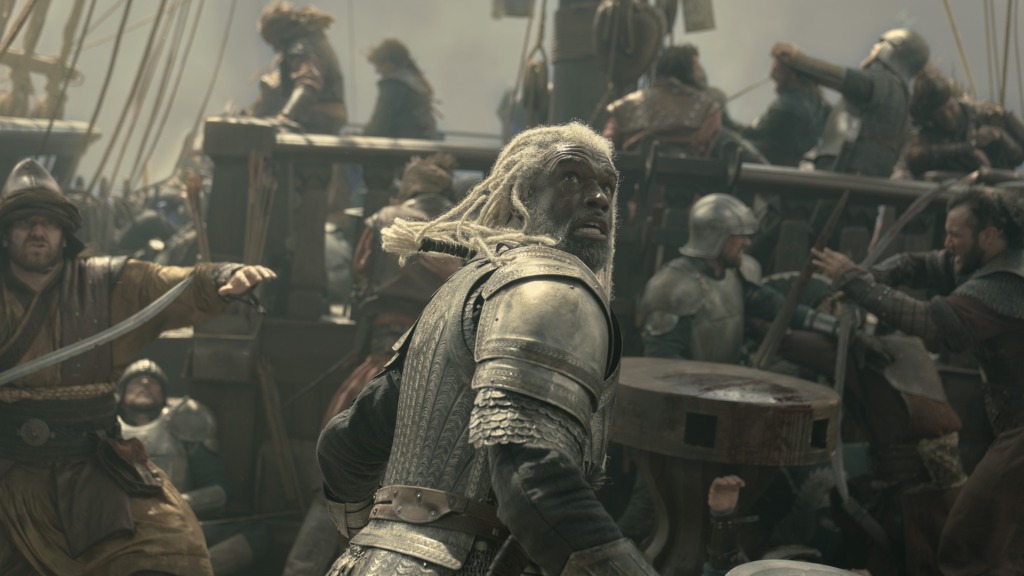
Beyond the growing ickiness in the Red Keep, cooler heads sail through the Gullet. Corlys Velaryon steals a rare moment with his brooding bastard son, Alyn, over a harsh Ibbenese liquor called “dragon water.” He offers both an apology for lost time and a warning. “Rough seas lie ahead,” he says, raising his cup, just as battle horns sound and father and son don their armor. The threat arrives as the Triarchy sails into view, with Sharako Lohar spoiling for a fight. She gets it: As Jace and Baela scorch ships on their mounts and Rhaena botches her first stint as a dragonrider, Lohar and Corlys smash ships and cross blades in a grudge match that ranks among the most chaotic and thrilling in Thrones TV history. It’s Alyn who eventually lands Corlys’s killing blow, compelled by his growing admiration for the elder Velaryon despite having abandoned him and Addam years earlier. Perhaps he and Rhaena can compare emotional scars later this season.
Despite his son’s intervention, the premiere belongs to the Sea Snake. For much of House Of The Dragon, Corlys Velaryon has been largely shunted to the margins, nursing old wounds, grimacing to the left of his chosen queen, or frowning atop a creaky port. This week, he led The Queen Who Never Was through the rocky Dragonstone Pass to ensnare Lohar, taking the wheel, navigating on instinct, and unsheathing an arakh in a messy, vicious brawl with his hated enemy, reminding us why his reputation should precede him.
And alongside him, the Battle Of The Gullet, with all its impressive moving parts and tragic payoffs, makes good on the promise of House Of The Dragon. Its drama fuses family tensions and dragon warfare into a spectacle that never loses sight of the people caught in its chaos, and better still, a thrilling glimpse of the battles yet to come. This energy is what will continue to set House Of The Dragon apart from its Westerosi brethren—its intrigues and betrayals pull us in, but its stakes and scale (or, rather, scales) reliably knock us flat.
Stray observations
- • Prince Jace died as his brother did: on dragonback, in service to his beloved mother.
- • There’s a notable percussive change to the opening bars of Ramin Djawadi’s theme this season—the drums of war thunder across a tapestry of history.
- • Space was not made this week for one conspicuously absent cast member, Otto Hightower, who remains imprisoned by an unknown malign force. This development doesn’t occur in Fire & Blood, so place his location at even odds.
- • Between Jason losing his head to the Starks and Tyland sinking to the bottom of the Gullet in his fancy leonine armor, House Lannister took a huge blow this week.
- • Sheepstealer’s gnarly design is perfect shorthand for the perils of becoming a dragonrider. All those thorns jutting from all over his neck and back make for a tricky seat for anyone who attempts to ride him; he’s basically the Iron Throne with wings.
- • Ser Gwayne Hightower continues to take Ser Criston Cole’s treasons with his sister in stride, focusing instead on informing the Lord Commander of the Kingsguard about sexual assault within his ranks. As he half-listens, Ser Criston paints his sigil on a shield: 10 black pellets representing coal over a red field. (Laying out ten perfect circles evenly in paint—no wonder he’s so pissy.) “Doom and ruin surround us,” he tells Gwayne. “We will all become beasts before our end.” Never change, Cole. Or, rather, do.
- • Ulf’s tale about losing his innocence to a Red Priest in Essos recalls a similar story told by Varys in Game Of Thrones. Ulf’s kingsblood was used in a strange magic ritual, which suggests that Lord Varys’s infamous loss of his member might have had something to do with his own mysterious lineage—a tantalizing plot thread for future books, if nothing else, should they ever come.
- • Addam: “You’d be Ser Ulf, and men would have to show you respect.” Ulf: “Men would have to show me respect ’cause of the big fuckin’ dragon!”
- • While we catch a glimpse of Tessarion the Blue Queen caged in the Hightower camps, her dragonrider, Prince Daeron Targaryen, remains maddeningly offscreen. We do, however, get to meet Daeron’s fastidious lord guardian, Ser Ormund Hightower, played by James Norton.
- • Tyland: “You will be glad of our armor when the fighting starts.” Lohar: “I know I will.”
- • Genuinely thrilled to see Corlys wield a Dothraki arakh, a testament to the man’s many legendary travels.


 Keep scrolling for more great stories.