Sharks have long hogged the spotlight in horror cinema’s “animal attack” niche. We’ve gotten Thrash, Deep Water, and Chum in 2026 alone; last year gave us Fear Below, Dangerous Animals, Into The Deep, Beast Of War, and Hot Spring Shark Attack. This is an incomplete list that only skims the subgenre’s surface, a look at how deeply Jaws afflicted pop culture with galeophobia. Other killer animal movies, like Alexandre Aja’s Crawl, have come and gone in between these shark deluges. Movies of this make and model trend toward the animal kingdom’s most obviously lethal representatives: lions, (undead) tigers, and bears, plus the occasional reptile. But filmmakers should take a note from James Nunn; where cinema typically relates the jaws of death with apex predators, he sees them on some actual killer creatures: hippos.
Nunn’s new movie, Hungry, is branded to recall a certain 1970s Hasbro board game revolving around hippopotamuses, but written in acknowledgment that hippos kill more people every year than sharks or alligators. Tracking is inconsistent as to how many folks hippos actually end annually, but data does show that 87% of hippo attacks are fatal. Compare that to around 10% for sharks. A shark bites once, then realizes its mistake—humans aren’t food, unlike fish (despite Finding Nemo‘s propaganda). A hippo, on the other hand, will run up on you not because its tummy’s a-rumblin’, but because you’re on its turf. The taste of your flesh is less a concern than your presence. Nobody wants an uninvited guest barging into their living room, hippos more than most.
Hungry‘s indulgences around hippos’ kill count fall in line nicely with animal attack horror as a subgenre. People absolutely should avoid contact with sharks, but our understanding of them as ruthless maneaters is a consequence of Jaws, in terms of both the effect named for the movie, and the way the filmmakers exploited the creature’s intrinsic fearsomeness for storytelling’s purposes. They understood that regardless of reality, moviegoers are likely to take one look at a great white and see a monster. Nunn pulls a similar move in Hungry, using Walker (Joaquim del Almeida), the narrative’s Quint stand-in, as a mouthpiece for exaggerations about hippos’ brute nature; the difference is that pop culture has only ever treated hippos as punchlines for fat jokes, or, in the case of Madagascar, voluptuous sex symbols. Hungry starts out on the back foot.
Nunn takes this as a good reason to relish the “killer hippo” image. The title of the film layers Hungry with excess unseriousness, and that’s before getting to the poster’s tagline: “This hippo isn’t playing games.” In passing, the image looks like a gag from an “inside Hollywood” satire, because who in their right mind would put that on a piece of promotional material for a real horror movie? Thankfully, it’s bait, luring audiences into expecting a silly time rather than a savage one.
There are no cheap jokes, no one in the cast yuks it up for the camera, and people you expect to die live when people you expect to live die. In Hungry, the Black character doesn’t bite it first, the best friend doesn’t make it through the first act, and the teenage boy who starts as hormonal and emerges as heroic gets an abrupt, ignominious send-off. The film takes its subject matter seriously enough to establish the sandbox Nunn is playing in as real. “Reality” here, like with any killer animal movie, comes with a little give and take; we still have to surrender our disbelief no matter what the record shows about the animal in question. But Hungry invests in the record, and that investment pays off.
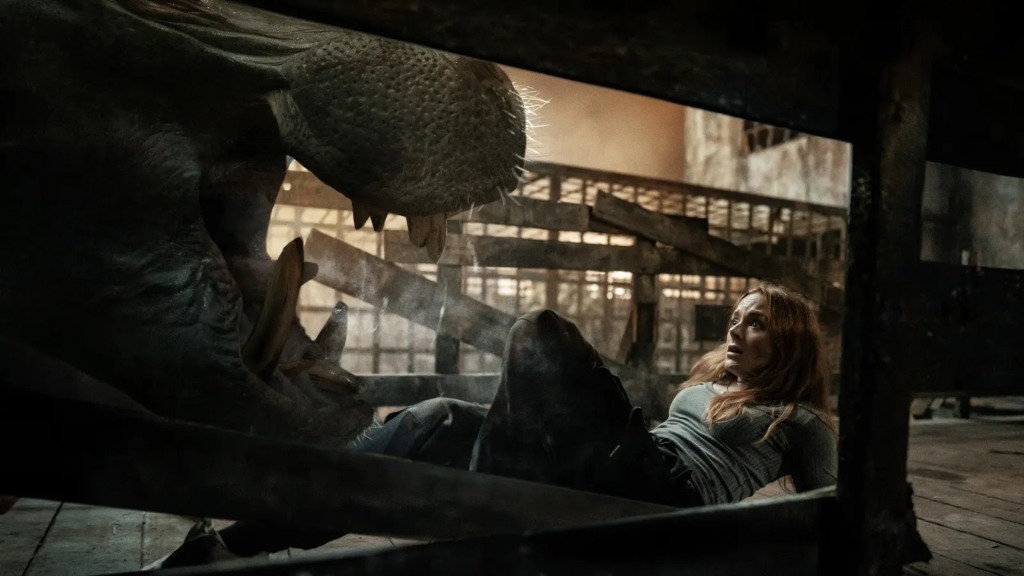
The hippo doesn’t make her grand entrance until Hungry has shown us the carcass of an alligator she tears to pieces in the film’s cold open. Even then, Nunn follows Jaws‘ wake by showing viewers as little of the hippo as possible until the sun sets, using cover of darkness as both a tension enhancer and an FX facilitator. The hippo looks pretty darn good, likely being a blend of animatronics and CGI; when the CGI doesn’t work, though it really doesn’t work, unintentionally tipping the movie closer to that “silly” designation.
But “closer” isn’t “all the way.” The decision to set a killer hippo film in Louisiana, where alligators would suffice, shows chutzpah, plus a knowledge of deep cuts from United States antiquity. Where shark movies capitalize on their natural formidability, Hungry embraces facts for narrative grist—wild hippos kill, and, surprise surprise, they almost did make it onto U.S. soil. Walker’s monologue about the time Congressman Robert Broussard submitted a bill for the importation of hippos to The Pelican State is shockingly accurate; truth being stranger than fiction, the effect of the history lesson gives the film’s animal attack plot grounding. Is it really that hard to imagine U.S. elected officials shipping hippos from Africa to gobble up invasive water hyacinths and shore up the country’s meat supply? Is it any harder to buy the notion of a hippo stalking hapless schmucks along a river for the sin of trespassing on its territory? Not at all.
Hungry sets a strong example for rethinking the animal attack film writ large by returning it to reality—as relative as that might be—seeking honesty in these kinds of movies over raw sensationalism. Nunn might fudge the numbers for drama’s sake, but stops short of spinning up his own statistics. Unlike the increasingly outlandish entries into this subgenre he and his hippos know that horror doesn’t need to embellish nature; nature is scary enough on its own.


 Keep scrolling for more great stories.