Jack Coyne is humanizing social media through trivia
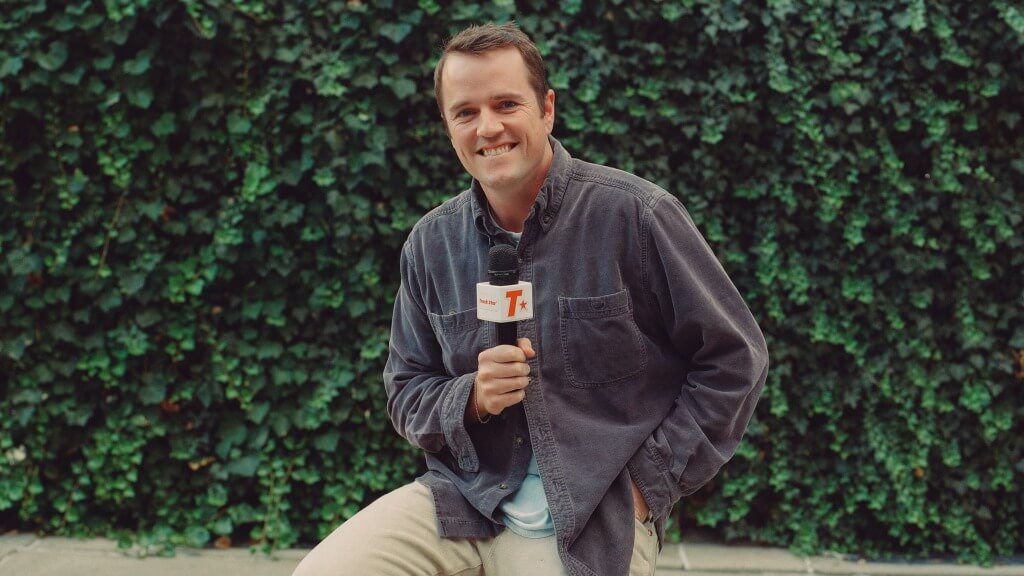
As the host of Public Opinion and Track Star, Coyne gives us access to our favorite artists, actors, and writers; teaches us about the history of New York City; and shares the stories of the strangers who live there, one TikTok video, Instagram reel, and YouTube doc at a time.
You probably know Jack Coyne by now. Maybe not by name, but you’ve seen him around, on TikTok, YouTube, or Instagram Reels. He’s the tall, wide-smiling guy chatting with everyone from famous musicians and actors to random New Yorkers on your phone. I caught on to Coyne’s first social media account, Public Opinion, in 2022, when I couldn’t stop watching him quiz tourists, born-and-raiseds, and transplants alike about the city’s history and government. In fact, I’ve learned more about New York City from Coyne than from any textbook, Wikipedia article, friend, or documentary. Without Public Opinion, I would have never known that the city changed its beloved “I ♥ ️New York” logo to “We ♥ New York,” or that only 38.3% of registered voters in the city participated in the 2022 election. For almost four years, Coyne has shown up on nearly every one of my TikTok scrolls.
It all started with Public Opinion, the media company Coyne co-founded with his brother Kieran and their friend Henry Kornaros four years ago that’s now seven employees strong. At the beginning, Coyne was capitalizing on this man-on-the-street interview craze sweeping social media, especially TikTok. But that format wasn’t new, nor was Coyne’s take on it particularly groundbreaking. Jimmy Kimmel’s been interviewing people galavanting through Hollywood Boulevard on his late-night show for years, and Billy Eichner had a very successful Funny or Die program dedicated to berating street passerbys about popular culture factoids for a dollar. Strolling citizens make excellent test subjects for just about anything, especially answering questions.
But Coyne’s decision to pay his interviewees anywhere from $5 to $100 for knowing about New York City’s infrastructure, laws, art, and politics caught on fast with a lot of people. The first-ever Public Opinion video did 7 million views on TikTok—a big deal in 2022, when the platform was still a Wild West for virality and algorithms. Coyne assumed that most of his videos’ viewers came from New York City. I say to him that I tuned in whenever I could, even when I was living in Ohio. “The reason we thought that the show worked was because people are generally interested in New York, even from outside [the city],” he replies. “Think about all the movies that are shot in New York or take place there.” The exact origin of viewership was nearly impossible to trace but, after six or seven months, the difficulty of filming Public Opinion videos got more and more obvious. “It’s hard to find people on the street who know the answers to the questions, because a lot of people that you meet in New York City are visiting,” Coyne reveals. “They’re not from there, or they’re afraid that they won’t have something to say. You have to work harder to find people with the level of expertise.”
To combat that, Coyne, his brother, and Kornaros started Track Star in January 2023, a vertical “game show” where musicians, actors, tourists, and native New Yorkers alike guess the songs that Coyne plays for them through a set of headphones. Having a topic that “more people would be able to speak to” on the street made the average interviewee all the more easier to find—and all the more compelling to watch, more so than those “name three songs by the band on your T-shirt” videos that got a lot of engagement two, three years ago. There’s a buy-in with Track Star. “Guess the artist and win $5,” Coyne says while he’s queuing up a genre you like. And the more artists you guess correctly, the more money you win—it’s double or nothing rules, which means consecutive right answers can rack up some serious cash. Some people bank their winnings, which can total well into the thousands, while others give it all away to charity—the latter choice is a popular one amongst Coyne’s more famous guests, though he says one celeb did consider taking home their winnings but opted to leave the money behind to avoid public judgement.
Track Star is emotionally similar to Cash Cab, in that you’re being entertained and you’re playing along. And, if you start getting questions right, you think you could be on the show and do better than the contestant you’re watching. Plus, maybe you’ll get a new music rec or two out of it, or maybe you’ll see a stranger you’d like to meet when you come to the city. As I was rewatching some of the oldest Track Star clips, I came across a February 2023 episode with a Queens man named Rob who flew through Bob Marley, Whitney Houston, and Elton John songs and earned himself a quick $40. Almost three years later and he’s a main character in my most recent TikTok obsession, the record store-based “Revival of the Fittest” program that I’ve dubbed a “phone sitcom.” I don’t know if Jack Coyne creates local celebrities, but I’m glad he’s put me on to a few of them. (What’s up, Oscar Raydin?)
But with Public Opinion, there’s an awareness to local issues, local histories, and local people that Coyne is actively fostering. I find the work that he and his team are doing to be a form of organizing, specifically. Track Star has evolved into a format that is anchored by an interplay between trivia and education, whether that’s coming from genre super-fans, beloved artists, or Coyne himself, but Public Opinion has mostly ditched its competition roots, focusing instead on dialogues and clips now that are accessible, easy-to-digest investigations about the city Coyne lives in. That intention comes from home, because his mom worked for the Metropolitan Transportation Authority (MTA) in New York City for decades. “She would tell us stories at the dinner table about the subway system,” he remembers. “A lot of people hate on the subway system and complain about it all the time, but we have this profound respect for how much it works and how well it works, considering the strain on it, the amount of people that use it, and the lack of resources. In order for you to be appreciative of the government, or for you to want to vote, you have to have an understanding of what the government does.”
He’s right. That changing traffic light at the end of your street is the government. Turning on a faucet in your bathroom is the government. These are vital parts of everyday life, interconnected with each other. “And I think I found, starting with asking trivia questions about New York City, I don’t have the answers,” Coyne reflects. “Like, what does happen when we flush a toilet? It’s fucking magic that that works, but the reason it works is because of the government.” Public Opinion has stayed a New York-minded operation the whole way through, but they’ve switched up their content delivery. Instead of doing the same consistent, short episodes that are in a game show format like Track Star, Coyne and his team have pivoted to telling bigger stories—multi-minute “documentaries” that do solid numbers on YouTube. Recent subjects have included “What’s Under the Street in NYC?”; “Can You Swim in NYC’s Rivers?”; and “We Traced NYC’s Weed Supply to the Source.” One of the reasons behind the switch was because the itch of doing daily content was being scratched by Track Star, Coyne explains. “We’d always had aspirations to tell more in-depth, documentary-style videos on YouTube. As that was picking up on Public Opinion, we were covering our bases in both spaces at the same time.”
Coyne, his brother, and Kornaros want to take Public Opinion beyond NYC, eventually. They’ve already planted the seeds by covering universal topics, like this video about municipal water systems. The topics, Coyne thinks, are applicable to people all over the world. Why he and his team stays home comes down to finances and resources. “We’re here, so we don’t have to pay travel expenses to do something in a different place,” he admits. “It might be interesting to talk about cycling culture in the Netherlands compared to cycling culture in New York City, but then we have to buy three plane tickets to Amsterdam and then pay for a hotel. The budget is $5,000 just to do that. We have to build our resources up a little bit and find some funding to be able to tell those types of stories.”
At one point, Public Opinion contestants began donating their winnings to various mutual aid organizations, like the Bowery Mission and the Trevor Project. It caught on and trickled into Track Star, so Coyne began encouraging it, especially when celebrities started appearing on the show. What was he going to do, give $1,000 to a fucking millionaire? “I was self-conscious about it from the very beginning, starting a show where I would just go up to people and put a microphone in their face, not expecting a return,” he says. “These people are working on your show, so they should get some value for it. It’s a cool way to pay people for their service, for being a part of your thing.”
AS TRACK STAR GREW, a hard truth emerged: Coyne could only give away so much money. On Public Opinion, contestants would often stop after three or four questions, but there are Track Star subjects who’ve done 10-20 songs and watched their total winnings catapult to four figures. What’s playing on our phones can only tell so much of the story. Not only are Coyne and his team making hour-long video compilations on Chess Records and film scores, but the YouTube versions of Track Star videos are less edited and give off a much better sense of the show’s inner workings. When Coyne is testing an Irish girl’s knowledge of Irish music, the viewer gets to see him calculating her winnings in real time and how close it’s getting to $20,000. “I’m like, ‘This is crazy, are you going to stop or are you going to keep going?’” he tells me. “And I’m anxious to the point where I’m like, ‘I don’t have that much money.’ We didn’t have that much money in the bank account. We shot that and then we had to save up money for three months to be able to pay the donation, to be able to release that video. And you see it happen. It’s fun and it’s playful and I’m joking, but Kieran’s like, ‘You fucking get her out, stop fucking around.’” One deep cut later and her round was over.
“We can’t afford to give away thousands of dollars five days a week,” Coyne tells me. “It’s coming out of our pocket, we don’t have any money, and I think the thing that resonates with people is not the game. It’s the conversation. It’s not, ‘How much money did this guy get?’ If your focus is on how much money is on the line or not on the line, we’re failing.” The important thing is the story being shared. Are the videos touching somebody? Is there an emotional connection happening between Coyne, the interviewee, and anybody who scrolls to the video on their For You Page?
I keep thinking about Robert George, a “human jukebox” that nearly bankrupted Track Star just days before my conversation with Coyne. “Technically he won $1.5 billion off us, or something like that,” Coyne laughs. “That’s where the mechanics of the thing start to fall apart. It’s like, ‘Dude, you’re amazing. We’re going to make a big donation to your charity of choice. But, now, let’s see how far you can go.’” In-between a few-dozen guesses, George told stories about being a DJ in the DMV and brokered one of the sweetest connections between Coyne and a contestant yet. But then he became impossible to stump. “At that point, I wasn’t worried about the money. I was worried about letting this go.” Coyne eventually got the upper hand on George—thanks to “Party Fears Two” by the Associates—and donated $1,000 to the American Cancer Society on his behalf.
But the point of a Track Star video is not to “stump” the guesser. Of course, any conversation will run stale if it goes on long enough, and Coyne and his brother can’t stand out in the NYC cold for three hours every day, but what he wants to do is play songs that turn his videos into snapshots of somebody else’s life. Why Track Star? Well, it’s become a middle ground for music lovers of all kinds. “It’s going to be important to you, and you can explain why that song is important to you and why you care about it,” he says. “So if it’s like, ‘Oh, I’ve never heard this song before,’ it’s like, oh, shit, that’s boring. What I’m always going for is they put the headphones on, I play a song, and all of a sudden their face lights up and they’re happy. They’re like, ‘Oh, my God, this song.’ That’s what it’s all about.”
IN 2026, TRACK STAR is mostly the same show it was in 2023. What has changed is Coyne’s “competence and ability” to pick songs, interpret someone’s music taste, and communicate with them through that. Instead of Coyne and a stranger just playing a guessing game, it’s a stranger flexing their music smarts, responding to something they love, and doing monologues about it. As Coyne told the New York Times, “We are tricking people into telling a story. They’re listening to something, they get fired up, and then they get to talk about it.” And, with a money component involved, it gives their taste and knowledge some tangible worth, even if they leave their winnings behind or ask Coyne to donate them to an organization that needs it more.
The rhythm of the Track Star editing has also improved, as has Coyne’s understanding of how to splice things together. “If anything, we’ve moved away from just saying ‘Name the artist, win five bucks,’” he admits. “That used to be the beginning of every single video. Now, we feel like people have an understanding of the show. The platforms have an understanding of how to distribute us and get us in front of people who are going to want to watch it.” In other words: the algorithm has figured out Track Star, not the other way around. Coyne and his crew can take more risks and “move outside the guardrails” of the game show format they started with. It’s not just “double-or-nothing” anymore, but an experimental storytelling vehicle that resonates with a lot of people. When he’s not making mixes for musicians he looks up to, he’s staging an emotional meetup between his mom and Ed Sheeran, or he’s learning about the most meaningful song in a stranger’s life—whether that’s New York Times editor David Remnick, Sue Molnar (a mid-fifties woman who banked $10,000, which Coyne said he’d have to pay out to her “in installments”), or a South African man who loved jazz music so much that he immigrated to New York just so he could be in the city’s jazz scene.
In any case, social media trends don’t hold a lot of weight for Coyne, because Track Star isn’t a new idea. “They were doing versions of this show on the radio in the 1930s,” he shares, grinning wide. “Call in and guess that tune, you know?” But we are in an age where social media is becoming a valuable tool to promote work, if not the most valuable tool. Actors and musicians come on Coyne’s show when they’ve got something to plug, like Jeremy Allen White when Springsteen: Deliver Me From Nowhere was entering theaters and Cameron Crowe when his memoirwas hitting bookstore shelves. And Coyne always buries the lede, letting people “choose their own adventure” without directly promoting anything. “When we have an artist appear on the show who has a new album [coming out], we don’t really talk about the new album,” he says. “We don’t say when it’s coming out. We’re not trying to advertise, we’re trying to have interesting conversations with people. It’s valuable to put this person on this show and have them resonate with a large audience, and then people might discover them.”
You have to think that publicists have bought into that content model, otherwise Jack Antonoff, Olivia Rodrigo, Common, Lucinda Williams, Ken Burns, Mark Zuckerberg, Billy Corgan, and Maya Rudolph would have steered clear of Coyne and his team. I mean, Christ, Zohran Mamdani came on the show in the middle of his mayoral campaign. Kamala Harris said to Coyne on-camera, “I love what you do.” Track Star has blown up, sitting at 956,000 followers on Instagram, 215,000 subscribers on YouTube, and 42.6 million views on TikTok. It’s like MTV for a digital age, but Coyne, his brother, and Kornaros have kept their mission airtight for three years: Track Star is driven by people, not clicks. “Part of the ethos of what we do is we treat everybody the same,” Coyne says. “Doesn’t matter if you’re fucking famous or you’re rich or you’re homeless, whatever. Everybody’s equal, and it’s important for us to showcase that.” That’s why you have ballet choreographer Justin Peck explaining movement through classical music, photographer Roberta Bayley giving a lesson on punk rock, and “retired K-pop stan” Em identifying the genre’s global domination all within a few scrolls of each other.
It’s always the people you don’t know who have the greatest stories to tell. Sure, Paul McCartney and Dolly Parton are great, exciting figures, but their lives have been talked about over and over. There’s only so many places Coyne can go in those conversations, but some random person on a street corner is a discovery that he gets to share with the world. “You get to introduce someone to the world, to someone that they don’t know,” he says. “Striking that balance is really important, and the reason that we do that through music is because music is so universal. Everybody has a song that they love. Everyone has something to connect with.” On the Public Opinion side of things, Coyne’s discoveries are even more fulfilling. “The video we’re editing right now is with a dude who works in the Department of City Planning and is building pipes underneath the sidewalk,” he says. “That guy is more interesting than Tame Impala. That conversation was more satisfying to have, because I’m learning from this guy about how the sewer system works. Tame Impala is cool. He’s famous, his music is dope, and I’m curious about some of his influences. But, it’s just as interesting to learn about how the pipes work.”
In the mid-2010s Humans of New York was, like, the biggest fucking thing. My mom had the book on our coffee table for years. Now, TikTok accounts are doing the same thing, talking to New Yorkers on the street about falling in love, fashion, and apartment prices. These videos are getting millions of views and likes. To me, that has to mean people are craving stories. It means that people are curious. And curiosity is what motivates Jack Coyne. It drives every conversation he’s having, on-camera or off. He has a desire—which is practically second-nature to him now—to pull information out of people. Before Public Opinion, he worked for YouTuber Casey Neistat. “We’d work on these vlogs about New York City, and he would be like, ‘If you go outside and you have a camera, a story is going to run and hit you in the face,’” Coyne recalls. “Having that mindset of ‘if you’re out there, on the streets, it’s going to happen,’ you’re going to meet people and it’s going to be interesting. Even if you don’t have a camera and you went and spent the day walking around, talking to people, you would have a really interesting day. Then, you’d be able to go to dinner that night and say, ‘I met this guy who was feeding birds in the park and he was a Vietnam veteran.’ That’s interesting. It feeds your soul.”
I’ve been resistant to music content creators for a long time—not because I don’t like what they do, but because their platforms are, by default design, made to take more eyes off the written word, whether that’s intentional or not. It’s easier to watch a video than to read a story, plain and simple. That’s why publications are pivoting to video, hoping that social media engagement will translate to website clicks. And, as somebody who runs one of those websites, that can be a difficult future to grapple with.
But I’ve never scrolled past a Track Star video. And, until my conversation with Coyne last December, I never really thought about why his program was the lone exception. What’s obvious to me now is that we need more folks like him, just as much as we need art critics and curators on the printed page. Take a recent Track Star guest, Audrey, who revealed to Coyne that she moved to New York for fashion school but now works as a bartender: the interaction seems superficial at first, but then it turns into this cute back-and-forth about what rock bands a 23-year-old thinks are the greatest of all time. It’s a conversation I’ve had hundreds of times with friends, and now I get to watch a stranger have it while I’m scrolling on my phone. That’s an appealing venture, because we need people who are willing to tell the story of somebody who’d never think to sit in front of a camera and talk if somebody else didn’t stop them on the street and ask them to do so. I think you become smarter and kinder that way, just by having conversations with the strangers, artists, and thinkers walking by you. You learn as much about who you are as you do other people, even if the conversation begins by simply asking what artist sang which song.
Matt Mitchell is the editor of Paste. They live in Los Angeles.


 Keep scrolling for more great stories.