James Stewart is one of classic Hollywood’s most celebrated names. An Oscar winner, a war hero, a comeback king who kept leading movies even when it looked like he was all washed up. The tall, lanky lad from Pennsylvania made quite an impression on the big screen, and in the biopic about the actor’s life, Jimmy, it’s as if the filmmakers were chasing his ghost. They so desperately wanted to give Stewart a larger-than-life retelling that it doesn’t look real or feel genuine—something Stewart himself avoided with his own audiences. In trying to do too much, Jimmy loses sight of the person at the center of its story.
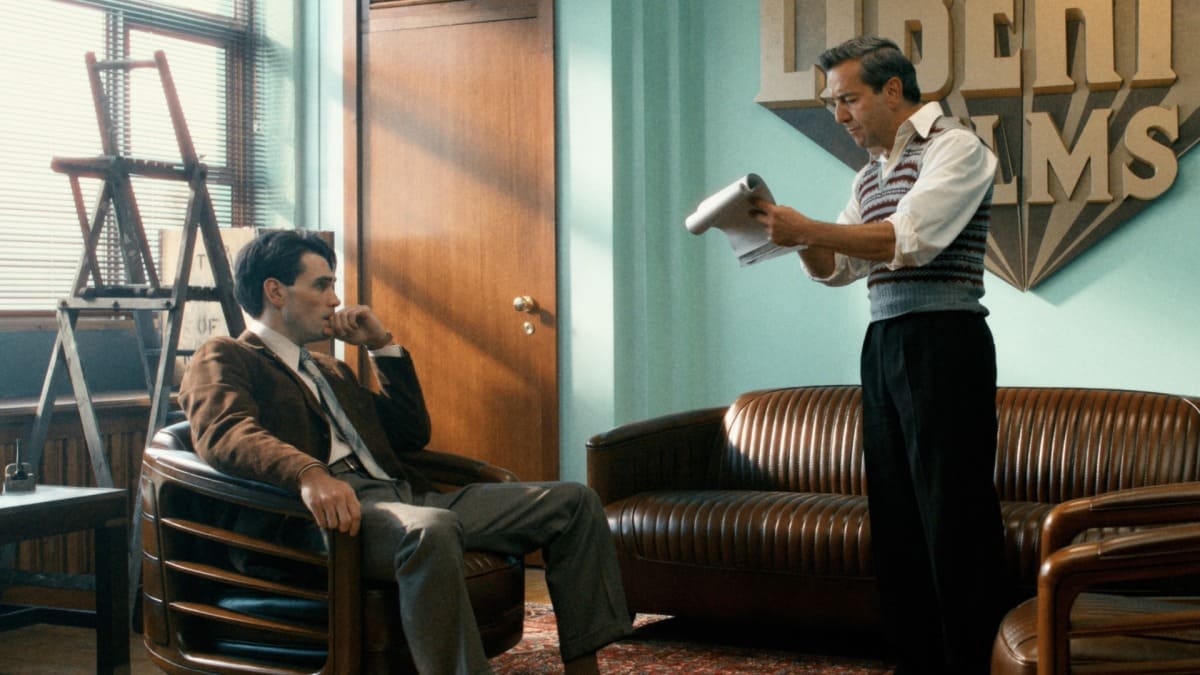
Aaron Burns’ Jimmy opens with Stewart (KJ Apa) and Frank Capra (Max Casella) discussing a new project, the movie that would become It’s A Wonderful Life. As the Liberty Studios logo is hung up behind them (a saccharine motif that bookends the film), Capra makes an impassioned pitch to his longtime friend and Mr. Smith Goes To Washington collaborator, who hasn’t yet returned to filmmaking since his time in World War II. In flashback, the story jumps back five years earlier to happier times, when Stewart had just earned an Oscar and was still trying to win over Ginger Rogers (Jemma Donovan). When Stewart gets drafted, he’s determined to serve his country just as his father did, but Louis B. Mayer (Jason Alexander) insists otherwise. To the MGM head’s discontent, Stewart ships overseas to serve as a pilot.
It’s a patriotic story, but one that Burns struggles to tell without copious globs of AI backgrounds and a cast going fully overboard. There’s no sense of visual style, as recreated bunkers and the Stewart family home give way to goofy-looking AI-generated renders of the world outside. Heartfelt moments between characters are constantly undercut by some of these choppy filmmaking decisions, as when Stewart and a made-up character for the film, Lady Julia (Kara Killmer), somehow magically whisk away from their realistic USO party to dancing in front of his bomber plane as the sun rises against a purple sky, looking every bit as unreal as it sounds. Other times, the editing and the shooting actively distract from the emotions at hand: When Stewart hops on a motorcycle to help some downed pilots making an emergency landing, it’s filmed and composited so shoddily, the impossible-to-follow scene makes it seem like Stewart was only about five seconds away from them in the first place.
Justin Strawhand’s screenplay doesn’t do Stewart much justice either. Stewart, a thoughtful performer who showed incredible range on screen, is made to say just about everything he thinks in this movie. But it’s not just Stewart—the other characters are as deep as paper dolls, even though the movie itself is trying to grapple with very real issues of war, death, and PTSD. Strawhand’s script orchestrates scenes where Stewart gives a rousing speech to his men like a coach rallying his team, complete with the swelling horn section in the score, all right out of the biopic cliche bargain bin. The script also commits the annoying sin of already knowing so well that It’s A Wonderful Life is going to be the thing that everyone remembers Capra and Stewart for—they’re all so sure of it! Jimmy even leans into that dramatic irony when the same guys who put the Liberty Studios sign up and shake hands for a job well done in the background return to take the sign back down to show the movie failed to recoup the fledgling studio’s losses.
If the copious amount of AI-generated planes spewing smoke, as if the entire U.S. Army Air Force was falling out of the sky, doesn’t get you down, the acting will. Jimmy is a community theater show where everyone is doing their biggest impressions so that everyone in the room can see and hear them. Apa sounds like Stewart later in life, playing up his “aw shucks” persona and long-limbed clumsiness with a near-campy giddiness. Things really get out of hand in the last quarter of the movie, when Stewart begins to suffer a breakdown, giving Apa free rein to lose control on screen. With a more nuanced director, Apa could have toned down his performance back down to earth, but his Jimmy is never more than overbearing mimicry.
The rest of the cast reflects this production’s unevenness, with actors like Alexander doing a comic take on Mayer-as-studio-power-player, Casella doing an overexcited impression of Capra, Donovan turning in a Ginger-less Ginger Rogers performance, and Sarah Drew making Hedda Hopper into a straw-villain stand-in for the tabloid-hungry press. Thankfully, Hopper’s given a humane makeover as Jimmy goes on, but at one point, she’s someone Stewart runs away from, with Drew leaning hard into the old-fashioned gossip columnist stereotype. While there are stiff actors in the ranks of the young military members, there’s cooler heads, like Rob Riggle as Jimmy’s colonel and Christopher McDonald as wise old mentor Lionel Barrymore. They try to tone down the temperatures of their scenes while Apa’s hellbent on making sure everyone knows he can do a Stewart voice.
Burns and Strawhand previously collaborated on a low-budget Western called Birthright Outlaw, and it provided little evidence they could take on a James Stewart-sized story. Sure, there are some interesting concepts of what the actor was going through: soldiers around him died and faced enemy fire; he wrestled with survivor’s guilt, his faith, and post-traumatic stress before there was the language for it. But Jimmy just uses them for dramatic plot points, things that are dealt with using the right pep talk—there’s even a heartwarming moment when all his dead Army buds return to cheer him on from behind the camera when he’s back in Hollywood filming It’s A Wonderful Life. Like the rest of the movie, it might’ve been funny if it didn’t feel so disrespectful and cheap.
Director: Aaron Burns
Writer: Justin Strawhand
Starring: KJ Apa, Max Casella, Jason Alexander, Sarah Drew, Rob Riggle, Jemma Donovan, Kara Killmer
Release Date: November 6, 2026


 Keep scrolling for more great stories.