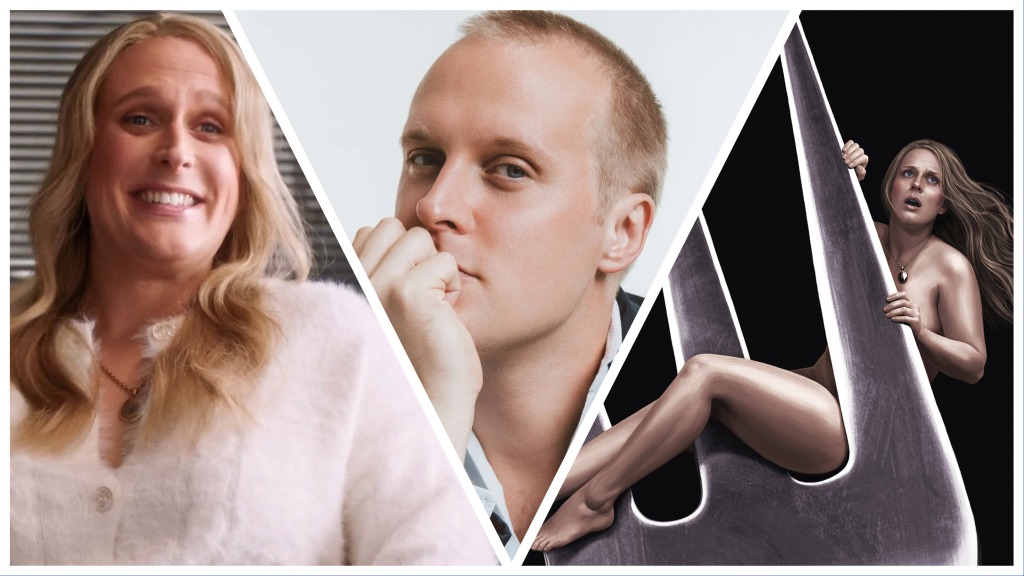
Maddie Ralph, the protagonist of John Early’s directorial debutMaddie’s Secret, is a good girl. She’s a foodie and an aspiring chef with real talent, but above all, she is proudly a trope: A naive ingénue with a tragic past. As her career rises, so does her hidden struggle with bulimia. “She likes food. She likes cooking. She is suspicious of influencer culture, and she is genuinely reluctant to be an influencer. She doesn’t actually want, like, fame,” Early tells The A.V. Club. The influencer trappings are modern, but everything else about Maddie’s Secret is brilliantly dated. Like Valley Of The Dolls or Showgirls, Early’s film is about the siren song of show business, told like a Death Of A Cheerleader-era TV movie. “I thought it was beautiful to watch someone pure of heart get corrupted by the contemporary media landscape.”
Early seems to have avoided this corruption. He’s in the midst of the biggest, or at least most diverse, year of his career. Before Maddie’s Secret, he acted opposite Lisa Kudrow and Abbi Jacobson in the third season of cult favorite The Comeback and appeared off-Broadway in Wallace Shawn’s What We Did Before Our Moth Days. The three projects—a hilariously earnest send-up of a movie-of-the-week, a cringe-comedy showbiz satire, and a grounded, monologue-heavy three-act play—don’t share a ton of obvious connective tissue. But they all feel like totally natural places to find John Early.
Maddie’s Secret, though, is Early’s baby, the product of a singular vision and a desire to write himself an ingénue role. “This is the most personal thing I’ve ever written, or performed, to the point where I have gotten—I’m fine now—very, very scared,” Early says. Artists love to call the work they’re promoting their most personal to date, but when Early talks—and when you see Maddie’s Secret—you’re inclined to believe him. “I thought I was making a fairy tale. And then, before I knew it, I was like, oh, this is just me. This is fully me.” Sure, Early is not a woman, hasn’t dealt with disordered eating, and has a fine relationship with his mother. (Kristen Johnston, who plays Maddie’s mother Beverlee, is the film’s ultimate villain.) But it’s Maddie’s naivete, optimism, and “sweet friendly values” that Early relates to. “To me, this movie is about: Can you have fun and be serious at the same time?” says Early. “I really think you can.”
Early grew up in Nashville as the son of two pastors. He doesn’t describe this world as dark or scary, but subdued. “They’re very gentle,” he recalls of his childhood church services. “It’s Protestant restraint, I would argue to the point of joylessness. It was a very loving community, but it’s not an ecstatic form of worship. It’s like, you sing quiet hymns and the sermon is, like, 15 minutes.” Like any good ingénue, he graduated and moved to the big city, enrolling in NYU’s Tisch School and studying acting.
New York was full of formative experiences—it’s where he met his longtime comedy partner Kate Berlant, who also stars in Maddie’s Secret. Before that, as a freshman at NYU in 2006, Early caught an edifying screening of Showgirls, presented at the IFC Center with screenwriter Joe Eszterhas in person. “It genuinely exposed me to a certain kind of auteur sensibility. I wasn’t busy watching movies like that,” he recalls of the once-derided Paul Verhoeven classic that rises in esteem by the day. “I was laughing so hard, and I was so moved.” In 2013, he, Berlant, and Oh, Mary! creator Cole Escola filmed an impressively accurate Showgirls homage that feels a bit like a proto-Maddie’s Secret.
Early doesn’t just embrace this sensibility, he embraces modes of performance that many comedians might find too dated or unfashionable for the 21st century. In his 2023 stand-up special, Now More Than Ever, Early blends stand-up and music in a similar manner to something like Sandra Bernhard’s Without You I’m Nothing. He spends a portion of that hour wondering where dance as an art form went. (On Bob Fosse: “He was a household name—he was on talk shows! A choreographer in America was on talk shows. That can’t happen anymore! What’s happening?”) Where it went is into his first movie; a pivotal scene comes when Maddie overexerts herself at a queer dance class. The sequence is choreographed by Danielle Polanco, who has worked with the likes of Beyoncé and Addison Rae, and who Early dubs “the only choreographer working today where her work doesn’t feel algorithmically determined.” Tonally, it’s a scene that would feel completely at home in Verhoeven’s movie.
When I observe that Early embraces styles and forms that some might call old-fashioned—elaborate, idiosyncratic choreography; lounge acts; TV movies—he takes it as a compliment. “I think we’re allowed to acknowledge that, like, the phone has destroyed the world. It’s a huge mistake,” he says. ”We don’t have to go, ‘But you have to accept the technology!’ No, no, it’s bad. It’s bad. And I don’t like the way that the phone—as a stand-in for social media, tech—has, in a very short amount of time, butchered the art forms that we all love. I don’t accept it.”
What’s perhaps the bravest about this embrace is how straight it’s played in Maddie’s Secret. “I just totally gave over to the tropes,” says Early of writing it. “I no longer had this ironic distance of, like, can you believe how audacious it is, that I’ve made this character die? Or that we’re doing this barnburner therapy scene like from these old campy movies?”
It’s that lack of ironic distance that made Maddie’s Secret so sneakily personal. “There’s clearly some unconscious need to show the parts of myself that are more open-hearted, naive, sincere,” Early suggests of writing himself as an ingénue archetype. Throughout his career, Early has frequently played narcissistic, urbane gay men, be it Elliott Goss in Search Party, Terry Goon in Stress Positions, or even a small early role as Jenna Maroney’s son in 30 Rock. “I’m a domestic prude, is the truth,” he says. “I’ve tried to create a myth of being some fucking cultured gay guy who fucks!” But with Maddie, “I’m roasting myself.”
Early speaks of his most recent role—that of Tim in Moth Days—reverentially. “Moth Days restored my belief in the magic of acting and in the mysteriousness of art.” It wasn’t just the text itself, which he calls “so beautiful that it moves you to tears when you speak,” but the process of creation that has stayed with him. Being in Shawn’s play meant undergoing an 18-month rehearsal process, which happened while Early was still working on Maddie’s Secret and The Comeback; he flew back and forth between Los Angeles, where both of those shot, and New York to rehearse the play. “I found myself unable to contain my emotion, in a way that I have never experienced,” he says of the Moth Days process. “I had to slowly become accustomed to being in a room where I was like, when I say this word, I’m gonna fucking cry. There’s nothing I can do.” And he did this over and over for a year and a half. “The repetition is the deepest part. The time spent on it is the key ingredient,” he says, comparing the rehearsals to cycling through a religious text.
This experience colors Early’s voice. “It made me trust in some innate ability to tap into something that really helped in Maddie’s Secret, because I didn’t have time to think about how the hell I was gonna go there.” Early’s film was made on the other end of the spectrum from Moth Days: Quickly, cheaply, and with little rehearsal. But everything fell into place. “I was in a kind of channeling state, which is not even something I knew I necessarily believed in,” he recalls of his “unhinged” writing process. “It was making me laugh. And then I, almost immediately, was weeping.”
The cast is filled with his comedy friends like Berlant, Conner O’Malley, Eric Rahill, Vanessa Bayer, and Claudia O’Doherty. I ask if a project as specific as this—an indie where a man plays a woman with an eating disorder—made it hard to get funding. “This is the true shock: It was easy,” he laughs. “I knew that on paper that it would seem very provocative or experimental even, but I always knew that I wanted to make something that was, at its core, traditionally entertaining and cathartic. I wanted to see, as a filmmaker, if I could make something that was propulsive, that moved really well from scene to scene. You get on the train, it doesn’t stop, and then you’re done.”
This, too, is what Maddie’s Secret has in common with Showgirls or the movies of John Waters—even if it is a bit more like Polyester, where Divine is raising a family on a cul-de-sac, than Pink Flamingos. “Polyester is cheeky. Divine and John Waters both know that it’s funny that Divine has done the things that he has done, and is now playing a pious, beleaguered housewife. They’re letting that be funny,” he says. “Similarly, I’m aware that this is funny, and kind of provocative. But I’m also not afraid of that. I think it’s okay.”
Of course, Maddie differs from Nomi Malone or from a typical Divine character. She’s a good girl with good taste. “She triumphs!” says Early, and he, a good guy with good taste, has too. It’s been 20 years since that pivotal Showgirls screening—two decades of web sketches, comedy tours, sitcoms, friend collaborations, creative risks, and form experimentation. But there’s one more lesson Early got from Verhoeven: “No one leaves Showgirls caring about the actual material of her secret. It’s just the ride.”


 Keep scrolling for more great stories.