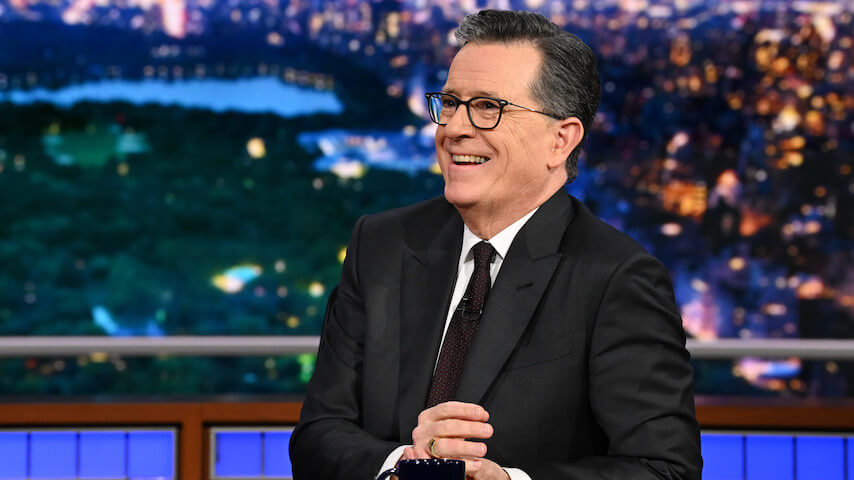
Late night with the devil: How attacks on Kimmel and Colbert brought a fading format back to life

"In September of 2025, my friends, I have never loved my country more desperately."

Late night with the devil: How attacks on Kimmel and Colbert brought a fading format back to life

The Fourteenth Floor” is hardly the best episode of The Larry Sanders Show or even the season in which it ran. (That distinction, for both, goes to “Hank’s Night In The Sun.”) Which isn’t a slight: An unremarkable outing of this remarkable series isn’t bad by any stretch. But the installment of the HBO comedy did spring to mind a few times over the past few months considering all of the stranger-than-fiction, headline-grabbing, and decidedly unfortunate drama surrounding Jimmy Kimmel, Stephen Colbert, and late-night TV as a whole.  

The episode of Sanders premiered in September 1994, a good seven years after Howard Stern (who played himself on the show) held a public rally against the Federal Communications Commission, only two after David Letterman (ditto) and Jay Leno’s spat over hosting The Tonight Show post-Johnny Carson, and good 15 before another well-publicized scrap with Leno, that one with Conan O’Brien (who didn’t appear on Sanders but was referenced, often derisively by network executives). 

The story arc and fuck-the-brass themes of “The Fourteenth Floor” are plain enough: While riffing on the programming at his network with guest John Ritter, the titular host (Garry Shandling, playing a thinly veiled version of himself) calls the executives there “idiots.” This prompts a war of sorts between the show and the network, which includes a kid (portrayed by Haley Joel Osment) hopping up on the couch for an interview as a slick-haired suit and boils over when sidekick Hank (Jeffrey Tambor), while presenting a gift basket of of Cup-A-Soups as an apology during a remote bit, trips over a secretary and injures his ankle. (This leads to the episode’s most laugh-out-loud sequence, when a pissed Hank keeps storming away down the hall—on crutches—only to return during a talk with Larry.) Eventually, to save the job of producer Artie (Rip Torn), the host apologizes sincerely, only—in classic loop-around Sanders fashion—to be spurred on by Hank in the show’s closing seconds into calling those at the network “idiots” again on the air. Artie’s phone lights up with another angry call from upstairs. End credits. 

The difference between late-night TV (or the pop-culture landscape) in the ’90s versus today is almost too obvious to point out here. Back then, lots of people ended their nights by watching these shows live. The Tonight Show With Jay Leno could pulled in more than five million viewers in a single evening in 1995. Now? Not so much, with less than 700,000 catching The Tonight Show Starring Jimmy Fallon over a week this summer. But cultural significance and attracted eyeballs aside, what really stands out about that Larry Sanders Show episode is how quaint that sort of skirmish feels. Having a disagreement with a couple of folks who make the decisions a few floors above you is nothing compared with an administration, by all appearances, relishing in the ability to take a show off the air for coverage it doesn’t like and a network seemingly canceling one in the hopes of appeasing that administration to secure a merger.  

As the year quickly winds down, it’s worth pausing to remember, however briefly, that this business with The Late Show With Stephen Colbert and Jimmy Kimmel Live! actually happened. With so much noise these days, the respective cancellation and suspension of those shows—and the frightening free-speech and First Amendment implications they suggest—can easily be at risk of being drowned out by the latest, more consequential injustice and forgotten. To put it in perspective, the Kimmel debacle reached a fever pitch in September, which was somehow only three months ago. (Also, for more end-of-the-year analysis of the mingling of politics and comedy, check out Matt Schimkowitz’s excellent piece on how some stand-ups fought back to make “the manosphere the butt of the joke.”)

“I think one of the scariest parts was seeing how effective this network of right-wing podcasts is that Brendan Carr was able to push the first diameter to make this happen completely independently of the government,” Liz Hynes, a writer for Last Week Tonight With John Oliver, said on a recent episode of the OnWriting podcast. (She was referring, of course, to the Chairman of the FCC dropping a threatening “We can do this the easy way or the hard way” in his talk with Benny Johnson after taking issue with a Kimmel comment.) “He went on a podcast,” she continued. “He said what he wanted them to do, [and] they did it as if viewers were rising up and demanding that they do this to Jimmy Kimmel. [There was] no evidence of that happening.” To quote one of Oliver’s go-to post-clip segues on Last Week: She’s right. 

But here’s the kicker: It backfired and did more than a bit to breathe new life into a format that had seen much better days. Per CBS News, Jimmy Kimmel’s return to the airwaves in September “drew an estimated 6.26 million total broadcast viewers.” (The Late Show With Stephen Colbert, according to Forbes, also had an increase in ratings, which went up 32 percent in the aftermath of the announcement of show’s cancellation in July.) Plus, at least anecdotally, the Kimmel comeback was the first time in years—perhaps even since the Tonight Show With Conan O’Brien dustup more than a decade and a half back—that tuning in live felt like a must and struck this much of a chord, a moment no doubt compounded by the recent Colbert developments. 

“This show is not important,” Kimmel remarked during that evening’s monologue. “What is important is that we get to live in a country that allows us to have a show like this. And that’s something I’m embarrassed to say I took for granted until they pulled my friend Stephen off the air and tried to coerce the affiliates who run our show in the cities that you live in to take my show off the air. That’s not legal. That’s not American. That is un-American, and it is so dangerous.”

In a short video piece published on Christmas Eve, New York Times critic at large Jason Zinoman said, “The year started with everyone assuming that late night was dying,” noting that The Tonight Show Starring Jimmy Fallon had ben cut down to four nights per week and Late Night With Seth Meyers had lost its band, among other bad signs for the format. But, Zinoman explained, that changed, with the one-two punch of Colbert and Kimmel sparking renewed interest in this American pastime. “That was one of the key moments in culture this year,” he claimed of Kimmel’s return. And it’s worth noting that he didn’t add “pop” in front of “culture” there, as this story is much bigger than two guys in suits who tell jokes and interview celebrities on TV losing their jobs. 

And that is something Colbert, during his acceptance speech for Outstanding Talk Series at this year’s Emmys (which occurred just three days before Kimmel‘s suspension and was preceded by a standing ovation), got at quite beautifully: “10 years ago, in September of 2015, Spike Jonze stopped by my office and said, ‘Hey, what do you want this show to be about?’ And I said, ‘Ah, Spike, I don’t know how you could do it, but I’d kinda like to do a late-night comedy show that was about love.’ And I don’t know if I ever figured that out, but at a certain point, and you can guess what that point was, I realized in some ways we were doing a late-night comedy show about loss. And that’s related to love, because sometimes you only truly know how much you love something when you get a sense that you might be losing it. And 10 years later, in September of 2025, my friends, I have never loved my country more desperately.”  

Or, as put far less gracefully, but no less accurately, by Towelie in this year’s Christmas episode of South Park (which premiered on Paramount+, of all streamers): “So crazy, man. You can’t write this shit.”    

Tim Lowery is The A.V. Club‘s TV editor.    

 
Join the discussion...