By 2013, Lav Diaz was already a regular on the festival circuit. He arrived at Cannes with his most conventional film to date, Norte, The End Of History, which was made with a sprawling cast and a real crew rather than just the DIY skeleton teams Diaz usually operated with. Up to that point, Diaz’s films were more talked about than actually watched, primarily because of their length: The runtimes usually bottom out around four hours on the short end (Norte is only four hours and 10 minutes), and can stretch to over 10, often landing somewhere in the middle. A second reason even seasoned critics and cinephiles might avoid posting up for the year’s new Diaz marathon session is that his films are slow—even compared to the standards of the nascent “slow cinema” that he partook in in the 2000s.
Norte stands as something of an oddity in Diaz’s filmography now; he used professional equipment and shot in 2.39 color, as opposed to his typically 1.85 or 4:3 black-and-white images, and employed subtle dolly shots instead of his signature static compositions. Norte was his attempt at a more mainstream film, still uncompromising yet easing the viewer into his aesthetic. Still, it was not quite a star-making auteurist moment for Diaz, least of all in his home country—in 2015 he remarked that, in the Philippines, “last time I checked there were only seven” people that had watched his movies. Regardless, his reputation slowly grew, and soon he would be working with Filipino stars like Piolo Pascual (on Season Of The Devil) and Charo Santos-Concio, whose central performance would help propel Diaz’s The Woman Who Left to the top prize at Venice. That slow-built recognition has eased Diaz into the broader cinephilic culture; 12 years after Norte, Diaz went to Cannes with his most buzzed-about film yet: Magellan.
Thanks to Gael García Bernal, the first international movie star Diaz has worked with, Magellan will be a first foray for many into the filmmaker’s work, but it is a starter Lav Diaz film in runtime only (clocking in at a breezy two hours and 43 minutes). Unlike Norte‘s streamlined style, Magellan is more an oneiric gallery piece representative of Diaz’s larger oeuvre, intentionally preventing plot momentum in favor of contemplation. Scenes play out in raw, undistilled time, both to present an objective plainness that doesn’t distort reality through current cinematic conventions, while also emphasizing the phenomenological aspect of experiencing the same amount of time as the characters on screen.
Moreover, Diaz establishes this relationship between the film and viewer with hostility—the film opens with an Indigenous woman being frightened by the sight of white man during the conquest of Malacca. The white man is not seen, and instead exists out of frame behind the camera, as if the audience themselves were caught in the act of voyeurism. The mere existence of the film is an intrusion into something intimate.
This stylistic example is indicative of a larger, multifaceted defiance. Since leaving the Filipino studio system, Diaz has committed himself to his own rigorous approach, but his work also reveals an ambivalence to the medium; obviously, in how his cinema stands as anathema to the commercial aspects of the industry, but also in his own role as a radical. He has a filmmaker stand-in in his early films Batang West Side and Evolution Of A Filipino Family named Taga Timog. This literally translates from Tagalog to “from the south,” which Adam Katzman says is “referring both to Diaz’s birthplace of Maguindanao and his bottom-up approach to politics and filmmaking.” That geographic element is critical to Diaz’s relationship to the Philippines—Maguindanao is in the large southern island of Mindanao, a place with one of the highest concentrations of Muslims in the predominantly Catholic country, which stoked significant religious violence during Diaz’s upbringing. Diaz’s childhood was in an extremely rural and poor part of the Philippines, but by choice of his father.
“My father was a socialist and a public school teacher,” Diaz explained. “For him, educating the tribe was a commitment, a responsibility.” Diaz adopted his father’s commitment to education through the less direct art of cinema. After being assigned to watch Brocka’s Manila In The Claws Of Light in film school, Diaz realized that the form could be for more than just entertainment, and began his journey to dig up the traumas laid upon the Philippines by 333 years of Spanish colonialism, American imperialism, Japanese occupation, and the Marcos regime. One of Diaz’s dream projects has always been to trace it all back to the beginning—to look at the man who first made contact between his islands and the West.
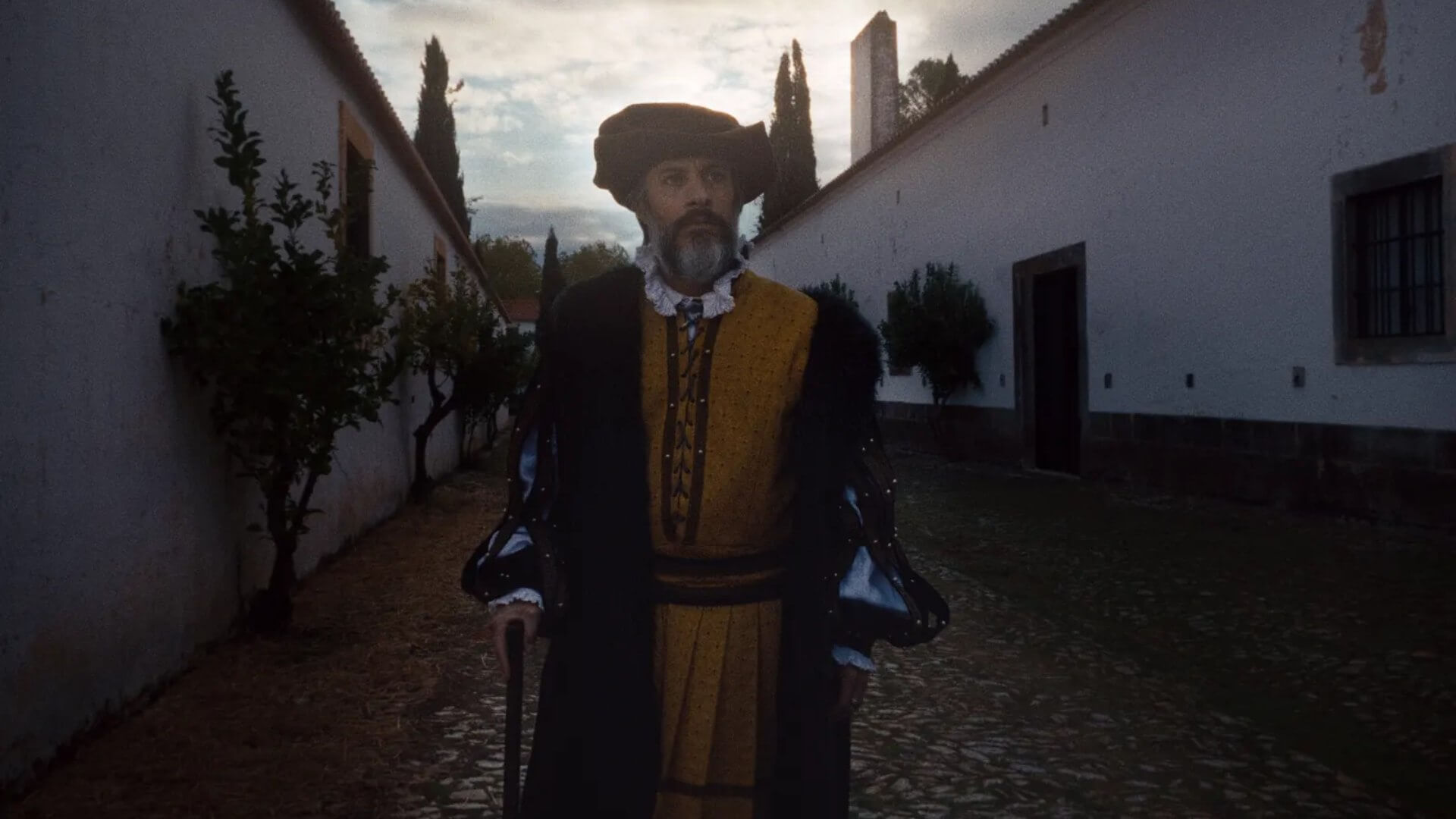
Magellan (Bernal) is first shot rising from the dead, his body resting upon a rock on a bloody beach, amid bodies on the verge of being swept away by the sea. One of his men awakens him to tell Magellan that they, despite the death all around them, have won. Magellan hobbles up, using his sword to steady himself. This first sequence takes place during the Portuguese conquest of Malacca, a critical victory in controlling the spice trade through what is now Malaysia. When Magellan and the rest of the surviving soldiers rally at a recently massacred village and return to their leader, Afonso de Albuquerque (Roger Alan Koza), they are drunk and battle-weary. Albuquerque assures them that their struggle has proven Portuguese superiority, creating a pathway for a further Christianization of the world. “Let us prepare for the end of the world. Let us prepare for Judgment Day,” Albuquerque tells his men before collapsing, and his soldiers laugh. Magellan and the others sit and drink near Albuquerque’s besotted body. All the talk of their heroic conquests for the crown and Christianity seem absurd; they are just a couple dozen tired men in a massacred village in some far-off jungle.
Diaz has often talked about how he considers his cinema as an act of journalism, that he’s closer to being a novelist than a filmmaker. Given that, it would be easy to conflate Diaz’s static style with a strict sense of realism, especially when interpreting his use of duration as a return to a kind of pre-cinematic time. But Diaz isn’t reconstructing, he’s extrapolating. When Diaz places his stories within historic settings, he builds from outside of the historic record, which, itself, is an act against Western ideas of history. It’s most starkly felt in his portrayal of Magellan’s wife, Beatriz (Ângela Azevedo). “She was just a footnote, three lines, four lines, that’s the most you can read about her,” Diaz writes in the film’s press notes. “So, it gives us this impetus to really create something around her, connecting her deeply with Magellan… Beatriz is the soul of Magellan.”
Indeed, Beatriz haunts Magellan’s voyage (much more so than what Diaz can fit into this film—he reportedly shot a nine-hour film focusing on Beatriz alongside Magellan), both metaphorically, as a piece of his soul he leaves behind, and literally, when she comes to Magellan on his journey as a ghost in his cabin in the most surreal scene of the film. Her shimmering white dress sitting above the sweat-soaked Magellan feels like something out of a dream, but Diaz’s mise en scène often leans away from realism. When Magellan first returns to Portugal, he stands on a beach surrounded by widows awaiting their husbands on a shore they will never return to. They mob Magellan, demanding to know what happened to their loved ones—to hold him, as their nearest human representative, responsible. This scene does not play like a moment from history, but rather like a nightmare from Magellan’s subconscious.
Even Magellan’s famous voyage becomes distinctively Diaz-ian; it feels like Magellan’s ship almost never moves. It’s like a wooden prison lost on a flat sea, its sails at half mast and its crew barely standing. Even when the boat gets hit by a storm, it never feels like they’re going anywhere, just trapped. It harkens back to the slow traversals of Diaz’s early masterpiece, Heremias: Book One—The Legend Of The Lizard Princess, wherein a merchant in a carabao caravan breaks off from his group. Heremias opens its staggering nine hours with a 15-minute shot of water buffalo-pulled carts traversing a squiggling mountain road, starting all the way in the background and slowly moving towards the camera until they are all out of frame. While Magellan does not exercise such an extraordinary level of duration, it stays within Diaz’s rigorous temporal paradigm, letting almost every sequence play out in single, fixed shots and rarely cutting for continuity.
This is a style Diaz has been crystallizing ever since Batang West Side and Evolution Of A Filipino Family, where Diaz broke from his brief stint with the Filipino studio system in the ’90s and broke, too, with the constraints of how long a movie is supposed to be. In Batang and Filipino Family, Diaz’s production was limited only by how much 16mm film he could acquire, until he finally switched to digital to finish Filipino Family. He has subsequently championed that format for its radical potential, both in terms of its low overhead costs and its ability to record continuously for much longer than celluloid.
Magellan—while not taking the same cinematic leap as Filipino Family and Heremias, or welcoming new viewers through the stylistic departure of Norte—is a continuation of the larger project Diaz set out on over 25 years ago, condensed into a single film. What is different is the possibility of how far Diaz can go back. While he’s shooting simply with a prosumer camera, the period and scope of the film requires much more financial backing than what he usually scrounges together for his microbudget epics. He needed a 16th-century Portuguese city, pre-contact Austronesian villages, and a caravel. He needed much more money than usual to make Magellan, but his usual mastery of craft is on display first and foremost. It requires money to get a Renaissance-era ship, but it takes acumen to make it look like the sails never have wind in them.
But when Magellan lands on Cebu, the wind is relentless, as if the heavens didn’t want the Europeans to make it there and are now crying out. What Magellan finds is a culture already on the verge of desolation, ripe for Christian exploitation. The Cebu leader, Humabon (played by Diaz regular Ronnie Lazaro), has a sick son who Magellan offers to cure through Christ’s salvation, leaving him a statuette of Santo Niño. When the boy does miraculously recover, Magellan converts the whole village to Christianity and forces them to burn the idols to their own gods. Upon eventually realizing the severity of their mistake, Humabon uses the legend of the vampiric Wakwak Lapu-Lapu as a way to scare the Europeans and get them to leave. Magellan dismisses Lapu-Lapu as an old folktale, and refuses to leave, causing Humabon’s men to slaughter the Europeans.
If a decade ago less than 10 people in his home country had seen Diaz’s movies, that certainly isn’t the case now; Magellan‘s final sequence speaks directly to people in the Philippines and has already caused a stir there. Lapu-Lapu is commonly understood to be a real, historic figure, rather than a myth the locals told themselves, which both negates the complexity of their relationship to Magellan and serves as a foundational national myth. Diaz takes an axe to that first moment—the moment of contact that would give birth to the Philippines as it exists today by beginning its history of colonialism—and splits it apart, revealing the layers hiding underneath all the stories that have been told and twisted through the last five centuries. Lav Diaz’s cinema is the history of the Philippines relived. And as Magellan’s journey sets in motion Filipino history, Magellan is Lav Diaz looking at the origin of his own cinema. There’s no better time to do the same.


 Keep scrolling for more great stories.