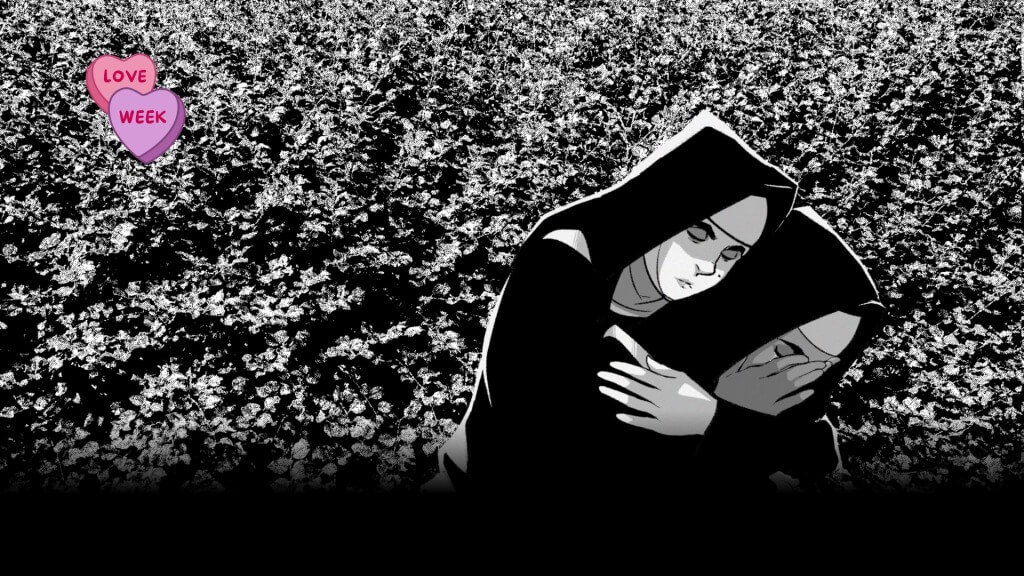
Hedwig has a lot on her plate. After more than a decade in isolation as an anchoress at Linbarrow Abbey, she was given a grave mission well beyond her powers: discover who murdered Sister Catherine, one of her peers at the convent. While she feels unqualified for the task and is terrified that leaving her sanctified enclosure could mean eternal damnation, she eventually accepts her Mother Superior’s conscription. After all, despite never seeing her face, she had built a strong bond with Catherine through the narrow slit in her stone cell, as they discussed scripture, literature, and more worldly topics that went over her head. It was a relationship that went well beyond friendship and one she didn’t fully understand.
It’s only when Hedwig is exposed to the outside world that she begins to “get it.” She’s attracted to women. On top of likely having romantic feelings for Catherine, she’s drawn toward many others in the convent, forcing her to grapple with the kind of internalized homophobia and self-hate built up over a lifetime of religious devotion.
This is the setup for Misericorde, a visual novel set in the 15th century. Written by Xeecee, the first volume begins almost entirely focused on its central murder mystery, before slowly exposing more of its unreliable narrator protagonist’s entrenched beliefs. Her confusion builds until the second volume portrays a full-on crisis of conscience from her “wayward” desires. Despite the story taking place 500 years ago, her internalized repression is uncomfortably salient, especially as these same conservative impulses have led to a wave of censorship that has affected video games as a whole.
As for Hedwig, a twenty-something woman who lived most of her life in a small room studying scripture, she has unsurprisingly created an idealized version of both religion and her fellow nuns. To her, anything less than living church doctrine to the letter, Liturgy of the Hours and all, is a grave failing. There is an uncomfortable rawness to Xeecee’s prose as they capture Hedwig’s social awkwardness and struggles with cognitive dissonance, and many of her initial issues stem from her naïve views crashing headfirst into messy human reality. It turns out everything is a bit more complicated when the world isn’t contained in a 10-square-foot space. Still, she can’t shake that she’s upset with everyone around her, and most of all herself, for wanting to give in to “vice.”
In the first volume, Hedwig is put off when her sisters engage in mild blasphemy, like talking during church service, cursing, or imbibing a little too readily. But by the second, she discovers what was once a barely guarded secret at Linbarrow: Most of her fellow sisters have been in a romantic or sexual relationship with at least one other nun at the Abbey. Hedwig first faces this reality when Sister Adela, whom she admits being attracted to, makes a pass at her, causing our protagonist to stumble away in a flustered huff. Unsurprisingly, her reaction is laced with traditionalist bigotry; she falls back on Thomas Aquinas’ homophobic writings, and while she can’t think of a doctrine that explicitly condemns sapphic attraction (most of what she read on the subject was instead focused on attacking gay men), she still concludes it must be “wrong” somehow.
The slow build-up to this encounter with Adela only further sells Hedwig’s surprise. The first game featured vague allusions to her sexual attraction because she lacked the vocabulary or experience to understand her own feelings. Her fellow nuns were always covered in their concealing habits, and despite passing glances, our protagonist was focused on the task at hand. By contrast, in the sequel, Hedwig constantly finds herself around naked bodies as her desires bubble to the forefront. Considering few games engage with sex or nudity in thoughtful ways, it’s as much of a shock to the player as this in-the-closet nun.
But as the stress of the investigation mixes with several life-or-death encounters, including a scuffle with what initially appears to be a literal beast from hell, Hedwig’s true self leaks through her carefully constructed facade. It’s a presence she explains as a doppelganger, a separate person altogether. She describes her desires as like “being tugged on by a string,” assuming it must be the work of the devil or some other malevolent force. To a modern reader, it’s obvious that she’s simply rationalizing who she is. These unsuccessful attempts to ignore her own queerness only result in misery and embarrassing moments she wishes she could take back. She is desperate to fit back into the narrow space she used to reside in, when she literally lived in the dark.
Eventually, Hedwig forms a bond with the most outwardly mean member of the convent, Angela, one of the few nuns who knows her true goal: spying on the other sisters to discover the murderer. But Hedwig finds a different side to her, and while Angela has her own deeply troubling views (she looks down on her peers as “sluts”), the two have an increasingly physical relationship before finally having sex. Even after Hedwig works through enough of her self-loathing to take this kind of leap—or perhaps more accurately because she simply can’t suppress what she wants any longer—she still isn’t comfortable. The morning after, she nervously flitters off before trying to distance herself from this relationship, something that only causes more interpersonal mess.
Hedwig more or less holds the reader hostage, telling this story from her perspective so that we feel the coarseness of her self-loathing. Specifically, the framing device for the first two volumes is that she is retelling everything that happened after returning to her cell, ultimately having been completely consumed by her prejudices (at least for now); the third and final volume hasn’t been released yet. Hedwig’s story makes us feel the full weight of how religious dogma toward queerness can crush spirits, burying victims under layers of guilt.
This kind of backwards sentiment hasn’t died out in the half-millennium since this story takes place, especially when it comes to this game’s own medium. Misericorde Volume Two: White Wool & Snow was released at the end of 2024, right before video games were swept up in a wave of puritanical backlash that has led to widespread censorship across the medium.
For those not caught up on the news, the short version is that due to pressure from payment processors, digital distribution storefronts like Steam and Itch.io have revised their rules, leading to many games with adult content being removed from search results or banned from these services outright. Steam’s updated wording is vague and unhelpful: “[What you shouldn’t publish on Steam:] content that may violate the rules and standards set forth by Steam’s payment processors and related card networks and banks, or internet network providers. In particular, certain kinds of adult only content.”
The changes were reportedly influenced by an Australian activist group called Collective Shout, and while the organization claims they were only targeting censorship of games that depict sexual assault and minors in suggestive situations, Steam already had policies in place around those topics. Even putting aside the baseline harm that censorship can have on artistic expression, by Steam’s own rules, a lot of the games caught up in the bans don’t make much sense. For instance, there’s VILE: Exhumed, a horror game that critiques male entitlement. It certainly deals with harsh subject matter like implied sexual assault and violence, but does so almost entirely via fake message boards and text prompts, with only occasional blurred photos shown. Despite this, the game wasn’t allowed on the platform.
Whatever the supposed intentions, it’s clear that Valve’s rules are both Draconian and obtuse, stifling games that thoughtfully engage with this kind of subject matter. And even if VILE’s content wasn’t well-considered, the inherent problem with this kind of censorship is that it allows an unseen bureaucracy to make choices about what is “socially acceptable” on our behalf, often based on a code of conduct we may not agree with. Historically, systems like this have disproportionately affected marginalized voices, like Hollywood’s Hays Code and its de facto ban on queer romance. Valve’s vague ban against “adult content” threatens to do the same, especially at a time when queer stories are wrongly considered inherently “adult” by many conservatives.
Of course, the ability to censor these kinds of stories seems at least partially by design. Vice’s reporting on Collective Shout found that the organization had sent an open letter to payment processors which had been co-signed by members of conservative religious organizations in the U.S., like Exodus Cry and the National Center on Sexual Exploitation (NCOSE). NCOSE is a right-wing activist group (previously known as Morality in Media) that has campaigned against same-sex marriage, sex education, decriminalization of sex work, and media it deems profane or indecent. Exodus Cry is an anti-porn organization with ties to Donald Trump and the evangelical movement.
While Misericorde surprisingly wasn’t one of the games swept up in this ongoing ban—and hopefully its next episode also won’t fall prey to it—the game clearly overlaps with those that were: It features sexual content and queer characters. If it wasn’t self-evident that this type of vaguely defined censorship is bad, the game demonstrates the type of compelling stories that are at risk. Is a studio as likely to make a game about lesbian or gay characters if Valve can arbitrarily deny them a spot on the medium’s biggest digital distribution platform? There’s a chilling effect that extends well beyond what is explicitly barred, threatening to stifle an already small chunk of games that want to wrestle with the nuances of marginalized perspectives. Here’s hoping that whenever Misericorde Volume Three releases, the right-wing advocacy groups and credit card companies that currently dictate our media landscape decide that its story of religious repression in the face of queer love is “socially acceptable.”


 Keep scrolling for more great stories.