The familiar My Hero Academia: All’s Justice doesn't seem to go beyond its predecessors

We got to preview this popular anime’s latest arena fighter adaptation, and so far, it seems like more of the same.

The familiar My Hero Academia: All’s Justice doesn't seem to go beyond its predecessors

Last year, My Hero Academia completed its stupendous comeback. After a downward turn in the show’s middle seasons and negative buzz around the manga’s conclusion, the anime closed out about as strongly as it could have, empowered by excellent animation and cathartic conclusions. With these kinds of good vibes in the air, it feels natural to wonder if the series’ video game adaptations—which so far include the tepidly received Battle Royale, My Hero Ultimate Rumble, and a pair of serviceable (albeit unremarkable) arena fighters, My Hero One’s Justice 1 and 2—could similarly turn things around.

Unfortunately, that may be a bit too much to ask of My Hero Academia: All’s Justice, the next arena fighter in the series from Byking Inc., the studio that developed all of the previously mentioned titles. At least based on a three-hour hands-on session with the game, the latest installment’s impressive roster and numerous modes don’t appear enough of a power-up to overcome so-so central battles that emphasize volume over depth.

Still, there’s no denying the game has more “content” than its predecessors, with several ways to engage with this animanga’s world: a Story Mode, Team Up Missions that take place in a small open-ended sandbox, the Hero’s Diary that presents original slice-of-life scenes, and of course, versus modes to duke it out against CPUs or online opponents (we saw the former but not the latter, so can’t comment on the multiplayer functionality).

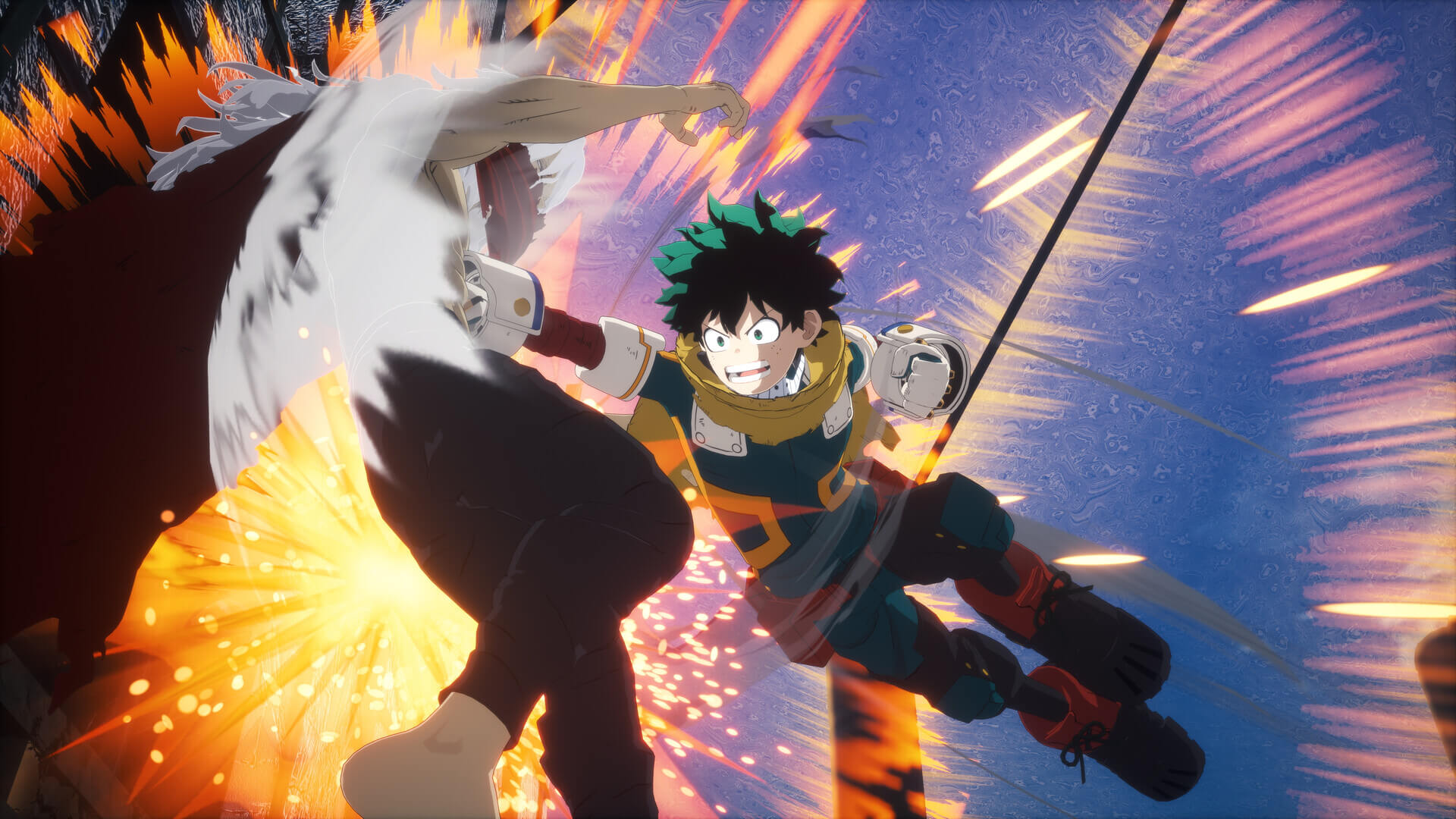
As for the Story Mode, it retells the final arc of the narrative, switching between colorized, partially animated panels from the manga and sequences that have you play out these battles yourself. It’s a perfectly acceptable way to re-experience this climax, but doesn’t add enough of its own charm to stand out. While these moving comic cutscenes look decent, they feel lackluster compared to the anime’s explosive execution of the same moments (especially because these striking sequences aired so recently). As for the game part, the handful of duels in the preview were more irritating than exhilarating. For instance, a late-stage encounter against All For One proved a bit too comic-accurate; this all-knowing foe parried incoming close-range strikes with ease (perhaps because the AI was reading player inputs). As a result, the easiest way to clear the fight was to stand at a distance and blast this big bad with Bakugo’s missile-like explosives, which wasn’t exactly as exciting as the anime’s incendiary portrayal of the same encounter. For those desperate to play out these pivotal scenes, you could certainly do worse, as most scrapes likely won’t be this grating, but it wasn’t the best introduction.

As for the Team-Up Missions, these are an example of the game’s all-original material that aren’t seen in the show or manga. That said, calling what we saw “original” is maybe a bit of a stretch: at least one of the two missions was a VR recreation of a previous battle in the story, admittedly with a twist. Canonically, these levels seem to be part of a training regimen for the UA students, and between this limiting conceit and a relatively bland mini-open world that housed these objectives, this was some of the least exciting material in the preview. The last of the story-focused modes we saw was the Hero’s Diary, which presents slice-of-life vignettes centered on Class 1-A. These scenes are low-stakes, but they do a good job of letting us spend time with these characters in all-new scenes, all while sprinkling in occasional battles.

That’s a lot of modes, but perhaps the game’s single biggest selling point is the sheer size of its roster. It features over 60 characters, ranging from those everyone will want to play, like All Might, Deku, and Mirko, to freaks like Mineta, that dude who eats cupcakes to power up, or the aptly named Muscular. Each has unique special moves and an additional set of moves that can be accessed after entering a powered-up state. To be frank, regardless of the quality of everything else, the ability to play as this wide range of heroes and villains that span the entire series will be enough for many superfans to justify the admission fee; this is sort of the raison d’etre of the whole game.

For players who need a little more, My Hero Academia: All’s Justice’s central arena fighting may prove unconvincing, as it isn’t unique or polished enough to win over genre doubters. Like other arena fighters, the game has combatants square off in a closed 3D battlefield, letting players use simple combos, special moves, dashes, and more to wail on each other. Like other entries in the space, the central gameplay is relatively simple and straightforward, seemingly lacking the depth needed to pull in dedicated fighting game enjoyers, but easy enough to pick up and play for those who want to mash buttons and see cool things happen. Specifically, the game lets you spam a single attack button to perform a highly damaging autocombo—this can be turned off, and it’s quite possible players will find better ways to dish out damage, but compared to other games with one-button combos, this one seems particularly powerful.

As for what sets All’s Justice apart, tying into the massive roster, this is a tag game, meaning you pick three fighters and switch between them on the fly mid-battle. While there’s a cool-down after tagging out, you can switch mid-combo to deal more damage or trade places with a partner to line up a more advantageous matchup. Properly utilizing this feature is a big deal, as it allows for some truly gnarly, high-damage combos where you switch between your full team before chaining together super attacks for health-bar demolishing damage.

Another essential mechanic is the Rising feature, a temporary power boost that ups a character’s damage and lets them access an additional moveset. While some fighters’ Rising states are stronger than others—Fumikage Tokoyami summons a hulking shadow bird with nigh-unblockable attacks that will end friendships—these enhanced skills generally feel different and empowering enough that properly managing your Rising-related resources seems like it will be quite important. The other main elements of tactical depth include a universal unblockable attack, which is slow and telegraphed but can lead to big damage if it lands; a universal counterattack, which is an obvious answer to the unblockable move; and the ability to perform a parry-like block with proper timing.

All of this said, at its core, All’s Justice is a bit too similar to the numerous arena fighters before it, with brawls that don’t live up to Bandai’s best efforts in the space, like Dragon Ball: Sparking! Zero, Pokkén Tournament, or Mobile Suit Gundam: Extreme Vs. It’s not that the central combat is outright miserable; it can certainly be fun to let loose Mirko’s Devil May Cry-style aerial combos or send a foe flying with All Might’s Detroit Smash.

However, the game’s central movement isn’t particularly quick or responsive, which is often one of the main elements that sets the best arena fighters apart. Some characters’ attacks have an appropriate sense of weight and impact, but others don’t, and this isn’t helped by a visual style defined by flat coloring and stiff animations—there’s definitely a cost to having 60 characters, and it’s that development time couldn’t be spent on tightening the gameplay. Once the novelty of beating down your little brother with three different versions of Deku wears off, these duels aren’t gratifying enough to make up for the seeming lack of depth.

Of course, this appraisal isn’t definitive: the game will likely be a bit more refined when it comes out on February 5 (for PC, PlayStation 5, and Xbox Series X/S), and it’s possible that more time playing it could reveal additional depth or that its single-player modes might have more appeal than this first impression implied. Still, it seems likely that My Hero Academia: All’s Justice could go the way of its predecessors: a perfectly decent action game, but one whose shortcomings limit its appeal exclusively to die-hard fans willing to dish out $59.99 MSRP so they can wield All For One for themselves. That’s great for those who desperately want to enroll at UA, but for the rest of us, superpowered thrills may be better found elsewhere.

 
Join the discussion...
Keep scrolling for more great stories.