After nearly a decade, My Hero Academia’s tumultuous journey has finally come to an end. Beginning with a slowly-paced first season buoyed by heart and excellent action direction from its animators, the ensuing years brought ups and downs: Season two and the first half of season three were great, but this was followed by some meandering middle years before things finally began to pick back up again with the much more cohesive sixth and seventh seasons. And now the eighth and last batch of episodes has completed this comeback tour in earnest with a hypercharged finale defined by explosive battles and emotional declarations. It’s yet another case of an anime adaptation delivering that extra bit of oomph that puts it above its manga source material.
For those who’ve missed the long-running series until now, the short version is that this is a superhero story. Set in a world where an increasing number of people are born with “Quirks,” special abilities that range from mundane to earth-shattering, the story follows the formerly Quirkless Izuku Midoriya as he inherits the powers of the number one-ranked hero, All Might. As Midoriya attends the prestigious U.A. High School for Japan’s up-and-coming heroes, he and his classmates become involved in increasingly dangerous plots masterminded by this world’s big-bad, the Quirk-absorbing supervillain All For One and his destructive apprentice Shigaraki. This season begins midway through the climactic final encounter with these foes.
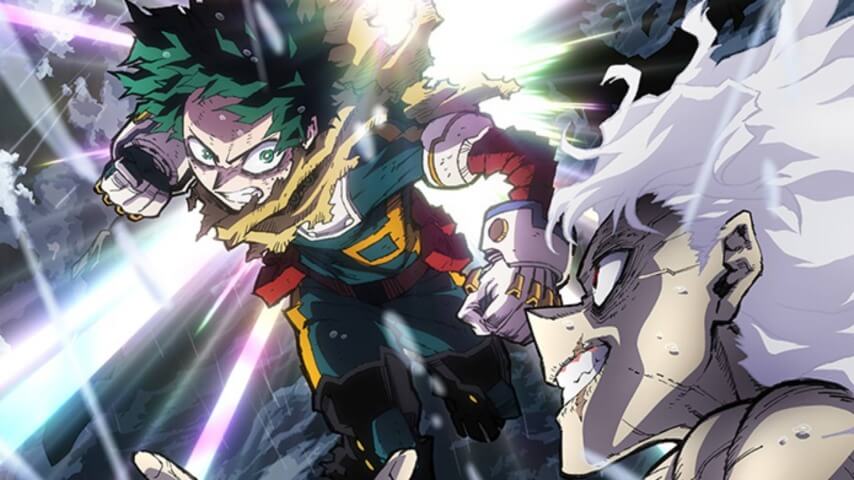
Considering that season eight begins mid-fight and doesn’t let up until its last few episodes, it goes without saying that convincing action animation is a prerequisite for this stretch, and thankfully, Bones Film very much delivers. As Midoriya and his allies engage in grueling, extended throwdowns, their efforts are rendered in showstopping action cuts: One particular highlight is an incendiary sequence from key animator Yuki Sato that, on top of being flashy, acts as a cathartic reminder of how far these characters have come. While some battle shonen (like Jujutsu Kaisen’s second season) are subsumed by overlong battle scenes that lack underlying weight, here, each punch fulfills years of build-up, as character moments are skillfully woven throughout.
Many of these sequences are so visually impressive that they make a strong case for why animation arguably remains the best place for superpowered smackdowns, as its 2D animation enables shot compositions and imagery impossible in live action. Of course, this kind of execution can only be achieved with tremendous time, effort, and skill, but thankfully, Bones has built up a rolodex of formidable animator contacts over the years, who very much showed up in a big way for this last hurrah (besides the series’ most well-known animator, Yutaka Nakamura, but hey, it’s hard to complain about what we got).
More than just satisfying the base-level thrills of seeing dudes wail on each other, these sequences also sell the underlying principles these characters are fighting for; namely, our protagonist’s deeply held belief in the power of forgiveness and redemption as it relates to the big bads he’s fighting against. At the same time, this battle hammers home the series’ longstanding conflict between those fighting for a collective good versus those trying to seize everything for themselves. These are broad strokes, sure, and the kind that could easily come across as weightless platitudes, but what makes it work is the delivery, which ties us into a wider world where the impact of these heroes’ selflessness becomes evident.
We see children and adults watching these battles caught on camera with concern and deep investment—often these are characters who were helped by those in the thick of it—which captures exactly what these heroes fight for. Similarly, as this very large ensemble cast rallies for the ultimate battle, the series accomplishes the impressive task of giving nearly every side character a role in this scuffle. It’s not an accident, and it ties in with a poignant notion this last stretch keeps returning to: Making the world a better place shouldn’t be the work of a single exceptional individual, but a collective effort (take that, Ayn Rand; more like Atlas Sucked). It’s an optimistic outlook, but one the series conveys in a beautifully rendered closing sequence that improves on its source material through the fundamental power of well-executed animation (and better pacing)—even “power of friendship” skeptics will likely be impressed by this last push. In general, the anime builds on the whip-bam finale of the manga by providing a little extra room to breathe, especially in the epilogue episodes that offer a much-needed chance to say goodbye, while making the protagonist’s endpoint much more fulfilling.
Admittedly, all of this good doesn’t necessarily erase the series’ lowlights; as a whole, the show still comes with some caveats due to a weak 48-episode middle act full of way too many low-stakes school tournament arcs, which basically all pale in comparison to season two’s excellent take on this classic battle-shonen trope. There is also some thematic weirdness around how the narrative handles its allegories about minority rights, even if it’s mostly coming from a good-natured place. While the epilogue partially addresses this issue, and there are overtures towards change, the story still handwaves some of the flaws of this commercialized superhero society in a way that’s a tad frustrating.
But judged in a vacuum, this final season serves as an excellent capstone to this 170-episode journey; compared to many serialized Western superhero comics trapped in endless retreads, it is very satisfying to get a definitive finale where this world moves forward rather than fighting the same villains over and over in an unchanging city. While straightforward and earnest, this season’s high-flying animation takes its characters to the brink of ruin before slingshotting them back towards the fundamental hopefulness embodied by its main character, Midoriya, a kid finally able to surpass his idol as he shows others a better way forward (with his fists and his friends, of course). It’s no small feat that, in the end, My Hero Academia proved to be 10 years well spent.


 Keep scrolling for more great stories.