[Editor’s note: This piece contains spoilers for Primal.]
We’re living through an entertainment era when revival has become both an expectation and a virtue. 2026 will be bookended by the awards-season presence of yet another bite of the Frankenstein apple and the release of Avengers: Doomsday, a project in which every passing new detail makes it feel less like a movie than a rushed $400-million strategic brand asset renewal. Somehow, Steve Rogers returned; Dexter thawed out, both literally and metaphorically; states of life and death in Hawkins seemed awfully fungible; and, five years ago, even something that felt as close to righteous course-correction as Fast & Furious bringing back Han was, in practice, a retcon resurrection.
Most character revivals are done either in the service of creating a brooding psychological atmosphere or as a means for a triumphant return. These are choices often rooted in juicing public attention or recapturing a thrill that was once undeniable but has since dissipated. Against these reverse-engineered returns and contrived franchise maintenance fatigue, there’s Primal season three, a batch of episodes for Genndy Tartakovsky’s Adult Swim series that’s tearing this trend apart from the inside.
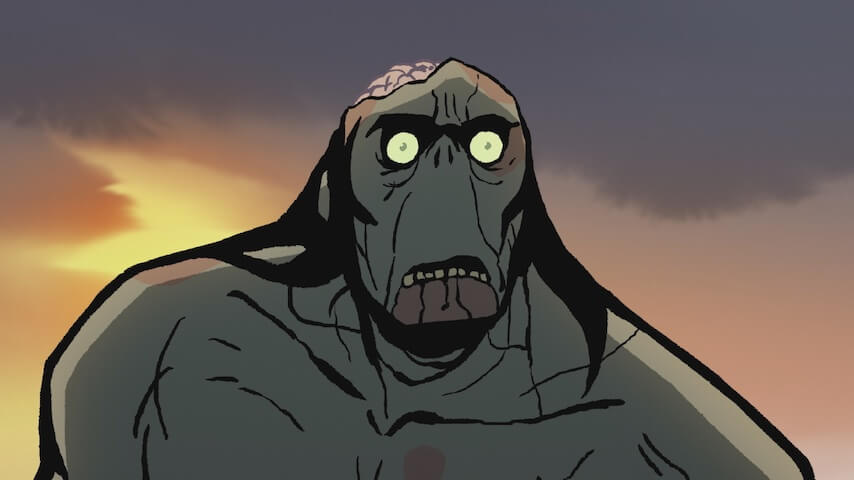
A dialogue-free animated show set in a largely prehistoric past, Primal remains a beautiful exploration of characters surviving a violent, unforgiving world. Its first two seasons centered on Spear and Fang, an unlikely duo of Neanderthal and dinosaur who bond wordlessly over shared grief, becoming travel companions through a landscape built to try to destroy them at every turn. The end of Primal season two felt like a coda to the entire project. Spear died in an act of selfless sacrifice, with the implied farewell message that the human and dinosaur companions he left behind will endure in his absence. But the show’s new episodes begin with a jarring corrective to that plan. An elderly sorcerer revives Spear by using the reanimated corpse as an avatar to exact revenge on his enemies. The Spear of old, sturdy and steadfast, is revived as a henchman, an ambling weapon of vengeance.
When Spear’s new task is cut short after a bloody five-minute rampage (the sorcerer who green-lights this reboot is offed by—what else?—a spear right through the chest), Primal engages in a profound cycle of “now what?” that few stories like it have the forethought, cachet, or narrative sense of purpose to pull off. Where many shows and franchises turn to a dead character simply because no one else is up to the task of replacing them, Primal makes its audience feel the weight of being brought back from the dead, of being incapable of fully returning to the way things used to be.
In season three, Spear does make lumbering shuffles toward the man he once was. There’s the constant haze of an imagined Fang just over the horizon. Spear dreams that he confronts himself in his former long-haired, chiseled-face glory. Yet there’s also the pain of seeing someone become the thing that they were fighting against. Though Spear has only ever had odd grunts and growls and pronounced facial expressions to convey it, Primal has painted him as a character trying to find a way to survive without perpetuating a cycle of violence. His past self was not afraid to behead or de-limb those creatures who would attack him, but there was never the sense he was relishing the process of taking life after life in order to preserve his own. It’s a bold choice to see the undead Spear brought back to exist as something closer to an outright weapon, mindlessly stabbing a stream of oncoming challengers.
Another core idea of Primal is that it’s impossible to save everyone. In this world, all can be predators and all can be prey, depending on the size of the group or the novelty of their supernatural upgrades. This prehistoric food chain hasn’t fully straightened itself out yet. Survival for the larger swarms of Spear and Fang’s attackers, be they rabid boars or roving nomads or impish humanoids that look vaguely like the alien miners from Galaxy Quest, inherently requires sacrificing a few from the herd in order to come out victorious. Spear and Fang exist in opposition to that, knowing that after losing families of their own, they see no one as expendable.
So there’s an inescapable weight to the idea that the person we’ve seen revived is the one whose death was given the most meaning. While there are surely many fans who will delight in the possibility of getting the man/dino gang back together, the audience also knows this is happening to a character who once lost a wife and children he would happily send back to the land of the living in his place.
Amid the more dour notes of this season of Primal, Tartakovsky & co. also realize that there’s inherent comedy in the idea of cheating death. Primal has always had the noticeable charm of a show surprised by what it’s managing to get away with, even under buckets of blood. This time around, there are plenty of pauses with a slack-jawed Spear blankly staring into the middle distance, sometimes while pawing at what’s left of his own exposed brain. At one point, his liver slips out from his open chest and lands on the floor with a splat. These feel like tiny, defiant choices to embrace the more absurd parts of death along with its more severe ones. (That mischievousness extends to certain story beats, too: One episode of this season finds Spear slaying both a sandworm and a scarred lion stylized an awful lot like another certain animated villain, twin stabs at the heart of entertainment empires that refuse to let their beloved franchises die.)
Season three has now reached the point where Spear’s collision with his old way of life has curdled somewhat. He’s arrived at Fang’s location to find that not everyone is eager for a tearful, redemptive reunion. Fang is fully in the mode of a protective mother, not letting this new zombified Spear anywhere close to the babies he once died to help spare. Spear’s growing awareness of what he left behind arrives hand in hand with his closest companion retreating from him.
Maybe that’s because his body is quickly degrading as his mind is beginning to return. Spear doesn’t bother to try to replace the chunk of his skull that’s been sliced away. The flesh of his hand is gone, dragged off to become a meal for some unnamed foe. If the goal of some revival stories is redemption or reclaiming a past self to be made whole again, Primal flips that by presenting a character incapable of physically healing. It’s the precise opposite of bringing someone back solely in order to preserve them.
TV is no stranger to the undead. But from walkers to cordyceps to The Returned, so much of the narrative understanding of who those people used to be is built in flashbacks. Those who’ve watched the prior 20 episodes of Primal have gotten to know this character completely separate from the idea that he could be brought back in this way. In its current season, the show presents a justification and warning that those looking for more time with a dead character may not always like what they find. Fortunately, this series takes a chance on offering us something much more compelling.
Steve Greene is a contributor to The A.V. Club.


 Keep scrolling for more great stories.