After checking in, my group entered a room that looks like a cross between an Apple store and a minimalist Calabasas home. We watched a short informational video that laid out the premise of the experience: Basically, the tech that the storyline centers on is a type of brain implant. This is what seemed AI-generated; the woman in the video had that uncanny sheen, and it seemed like her movements were looping and that her mouth was not aligned with the words that were coming out of it. If I’m giving this element the benefit of the doubt, I would say that the technology presented in the experience—as in most episodes of Black Mirror—is obviously meant to be received skeptically. Perhaps this wasn’t meant to be an endorsement of generative AI “actors,” but it certainly stops short of condemning them. In any case, I didn’t notice anything like it again.
When asked to choose a couple of life goals that the device I was about to be fitted with was supposed to help me achieve, I chose pursuit of fame, because it was the most obviously vain and thus most likely to give me the most sinister Black Mirror ending possible. The introductory phases were a little tedious, and seem designed to avoid a bottleneck of people getting their VR headsets optimized. I had to agree to let the machines behind the experience use my data, which feels unintentionally pretty Black Mirror. I’ll be honest: At this point I was starting to question my choice of how I was using my time. But once I did get the headset on and we started the actual game, it was a pretty good time.
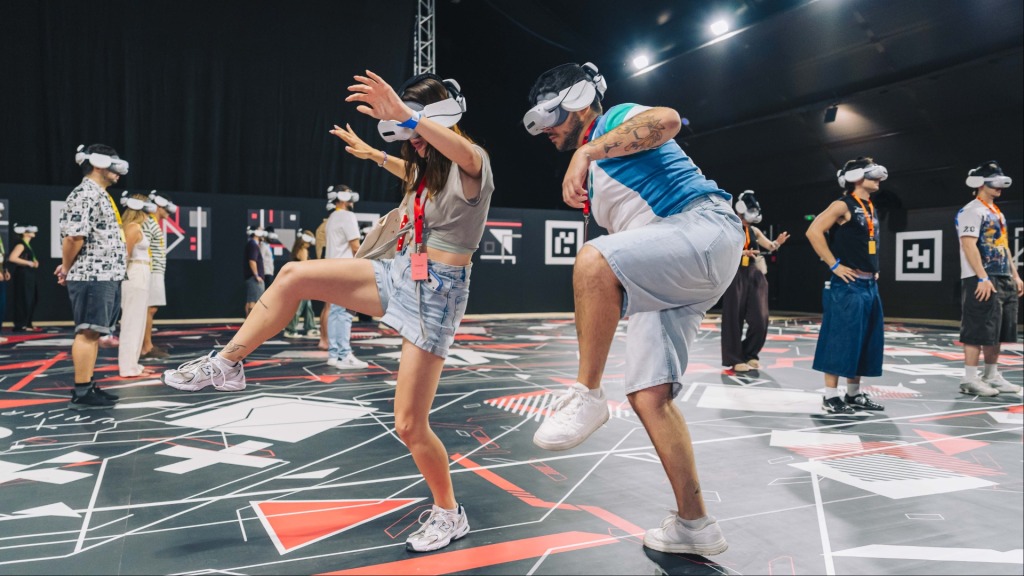
We went through a series of minigames which purport to psychologically examine you to create a kind of personal hologram that will maximize your potential to achieve your goals… or something. Again, the plot was fairly negligible and most of my attention was focused on following the instructions given to me by the VR headset, which are purportedly there to help you train your digital double. At one point, I spoke to the ghost of Sigmund Freud, who was presented like Oz The Great Powerful, a touch that I enjoyed for being silly and bizarre. Then, you’re granted a digital avatar that wears a scan of your face over a featureless, gray body, sort of like a Sim without any defining outfit or body type. They basically always look disturbing, but at first they’re a little more charming. My friends and I watched our doubles dance. But if you’ve ever seen an episode of Black Mirror, you can probably guess the direction your digital double goes in. It will stop at nothing to achieve the goals you set for it, even if it comes at the expense of its creator.
At this point, the experience became more of a point-and-shoot theme park attraction than a Black Mirror episode, which was ultimately for the best. It’s goofier, less convoluted, and more fun. There’s still some sense of narrative, albeit a much more straightforward one stripped of any metaphor or commentary; you just have to get from point A to point B. It doesn’t really seem to have much to do with the themes that were set up in the first half of the experience, but the objective of the experience is finally somewhat coherent. I would never willingly sign up for an obviously evil Black Mirror-esque technology, but I would certainly be willing to fight my way out of one. Finally, my character had some motivation.
There’s an obvious tension at play here. Like its namesake series, The Black Mirror Experience wants to offer some kind of critique about our modern technological landscape, but, being a (somewhat AI-generated!) VR experience, it’s very much part of that landscape. Any kind of message that the experience might want to impart is muddled to the point of nonsense. By the time you’re going through a maze of lasers and monsters, the experience has seemingly completely given up making meaning, and it’s better for it. Let’s be honest—we don’t need to put on a VR headset to have an experience that would be at home in a 2010s episode of Black Mirror. We know how scary big tech is, and The Black Mirror Experience doesn’t really do that problem justice. But I’d be lying if I said that the idea that evil AI can be defeated by shooting plasma from your hands like Iron Man didn’t tickle me a bit. As a Black Mirror episode or even as a piece of immersive storytelling, it doesn’t really hold up, but as a high-tech arcade game, it does alright. This is a Black Mirror that can be defeated in 50 minutes—an improbable, ridiculous, but still seductive idea.


 Keep scrolling for more great stories.