
Long before Maggie Gyllenhaal, The Bride was somehow all about Sting
1985's The Bride is a take on My Fair Lady weirdly uninterested in its title character.
Photo: Columbia Pictures
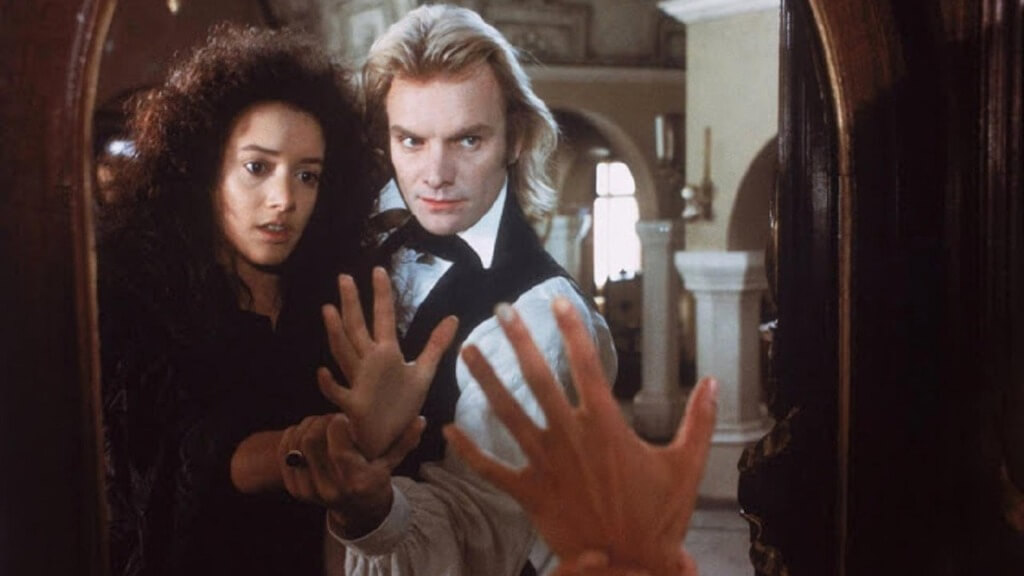
There’s one Universal Monster movie that remains strangely forgotten even by that niche’s doting community of cinephiles, despite the fact that—unlike many of the zero-budget, public domain Dracula films of the 1970s onward—it boasts both a legitimate budget and a wide theatrical release. 1985’s The Bride bowled its way into theaters four decades before Maggie Gyllenhaal added an exclamation point to her feminist reclamation of Bride Of Frankenstein. That earlier film not only featured impressive production design, but a cast including Clancy Brown as Frankenstein’s monster, Flashdance‘s Jennifer Beals as an undead ingénue, and Sting trying on his best Peter Cushing as the Doctor. On the long and winding road of Universal Horror, The Bride is an utterly odd tourist trap.
Perhaps it is the film’s overall disinterest in the hoary horror bona fides that has led to it becoming a forgotten curio of its era, although you wouldn’t know this watching The Bride‘s lush opening sequence. It begins exactly where a traditional Bride Of Frankenstein take would end, with the birth of a female creature, as the impatient first monster looks on, presumably having forced his maker to play god for a second time in his quest for companionship. The purplelicious lab set has all the Frankensteinian tropes in full force—the Jacob’s ladders arcing electrical discharge, the deformed assistant (Timothy Spall) running to and fro, and of course the requisite lightning storm. The creation seems to go wrong as the storm gets out of control, resulting in a brief, inspired moment where errant electricity momentarily reanimates a series of disembodied heads in jars. The whole thing is beautifully Gothic, but it’s all more or less a lie—an implication of the classically macabre that the rest of The Bride never attempts to match. It teases, and then switches to the film’s true identity: a strange fusion of Gothic romance, buddy movie, and costume drama.
The bar that Franc Roddam’s film offers is one that Gyllenhaal’s version will hopefully have no trouble clearing—and the obvious place to start would be by making its title character genuinely central to the proceedings, which is something The Bride never does. Perhaps the female creature, Eva, is underwritten because producers doubted Beals’ acting ability only two years removed from Flashdance, and negative contemporary reviews certainly play up this perception, as does a nomination that Beals received at the 1985 Razzie Awards. In truth, though, The Bride just fails to take any genuine interest in Eva at all, and whatever lapses are present in Beals’ performance are largely outclassed by the even more embarrassing attempt at gravitas put forth by Sting as Baron Charles Frankenstein. If someone was going to leave this mess feeling ashamed, it should be the Police frontman, who ends up sounding childish each time he strains for melodrama with his old-timey thespian delivery.
What 1985’s The Bride actually functions like is something akin to a poor man’s Poor Things: a twisted telling of My Fair Lady, acquainting an innocent and childlike Eva with both the delights of the flesh and the cruelty of the human condition. She doesn’t know who she is, and the dashing Dr. Frankenstein tells her that she’s an amnesiac who was found wandering the woods, and that he will nurse her back to health and mental alacrity. She proves a fast study, to the point that her development becomes accidentally comical—within roughly three scenes, Eva goes from nonverbal, to monosyllabic, to fully cogent and erudite. None of it is from her own perspective, making Eva more pawn than a protagonist, robbing her of pathos. The entire Pygmalion process somehow occurs just off screen, between scenes.
But it’s not just the doctor who takes up all of The Bride‘s oxygen—it’s also the original monster. Of all potential characters, one protagonist of The Bride is Clancy Brown’s creature, who survives a presumed death in the destruction of the laboratory during the opening scene and proceeds to become something like a wandering knight errant for the rest of the runtime. He quickly gains the companionship of the dwarf Rinaldo (David Rappaport), and a buddy dynamic between two men rejected by polite society is born. Rinaldo is the one person who sees the best in the scarred creature, making Brown’s soulful monster dare to dream about a version of himself who is virtuous and humane. They dub the monster Viktor, which is certainly an auspicious and confusing choice of name for the Frankenstein mythos. If anything, it stands out as one of the most gregarious, nonthreatening depictions of Frankenstein’s monster.
 Keep scrolling for more great stories.