Even if you’re a perfectly stable person, the lure of intrusive, self-destructive thoughts can pop up like a devil on your shoulder, tempting you over the side of guardrails and rooftops, or into oncoming traffic. It’s easy to dismiss these invasive what-if fantasies as the unproductive byproducts of minds keen on calculating every possibility, ones that clock danger and flag it just in case we didn’t realize that buildings are tall and cars are fast. But if your typical state is already one of unreality, where you’re dissociated, sleepwalking through your own life, it may be extra tempting to act on these impulses—hoping an extreme sensation will pierce a numbed life. Though The Currents reflects this shock-forward approach, opening with a startling suicide attempt, it’s grounded in this kind of harrowing psychological realism, where an internal crisis of disconnection and distance announces itself through bold, elegant details.
Before Lina (Isabel Aimé González Sola), an Argentinian fashion designer, steps off a bridge and into the frigid winter water below, writer-director Milagros Mumenthaler makes her mental state clear as ice. In Switzerland to receive one of those anonymous cut-glass awards for something she couldn’t care less about, Lina tosses her trophy into the bathroom trash and leaves the office, floating through the streets in a fugue. The near-wordless opening focuses on the strangely specific memories surrounding a traumatic event, Gabriel Sandru’s camera lingering on otherwise disposable details during a chilly, brutal day where nothing seems to matter. All that stands out are the sensations: The overlapping fabric of closing curtains; the laughter of children, faraway and alien; the wind cutting through clothes and rubbing noses raw, an elemental cruelty as vicious yet dispassionate as the welcoming river.
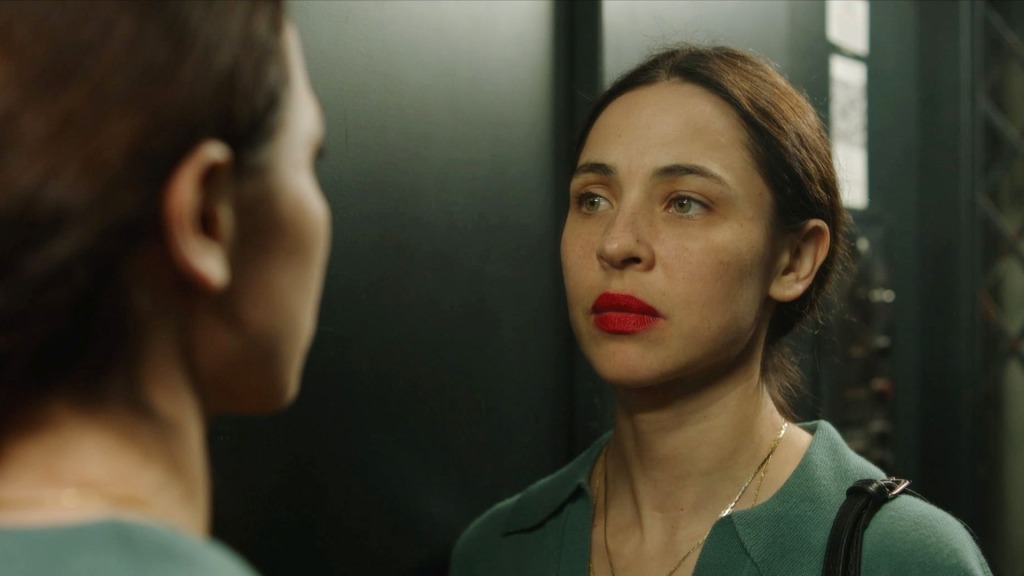
Lina survives her dive into oblivion, making her way back to Buenos Aires in an almost embarrassed silence, swallowing her secret and her personality along with it. The Currents observes her attempt to reintegrate into her own life after disrupting it so severely, though she’s often stuck floating on its surface. She’s visible to her husband Pedro (Esteban Bigliardi) and young daughter Sofia (Emma Fayo Duarte), ostensibly present in their warm, dark home, but they can’t seem to reach her. Portraying this side of depression, the closed-off and listless side where you’re more of a shambling husk than a human, can be as antithetical to engrossing cinema as showing off the process of writing. There’s only so much looking one can do at a person sitting still, staying quiet, staring off into space. But Isabel Aimé González Sola is excellent at staring, especially at herself.
There’s a tangible lack that Sola evokes in her performance, not so much vacant as missing. Whenever she finds herself in another bathroom with another mirror, or her mind wanders into violent daydreams during an otherwise innocuous conversation, or she seems not all there during an otherwise intimately shot sex scene, The Currents pokes and prods at questions more fitting for a horror movie. Did some part of her die down there in the water? Or is it more like something stayed alive that shouldn’t have? This doesn’t manifest in anything supernatural, though Lina is haunted by a lingering aquaphobia. It’s not a terrifying, screaming fear, but a gnawing inconvenience that nevertheless has an increasingly negative impact on her life—a potent metaphor for the kind of mental illness that rots rather than riots.
Retreating from rain and too freaked out to shower, Lina falls further into herself. She shrinks from overstimulation—blaring patterns, cacophonic sound design, overwhelming colors—like an exposed nerve, the film’s aesthetic pulsing in intensity to reflect this subjective suffering. It’s the kind of itching discomfort found in the relatively low-key dramas of Mumenthaler’s Argentinean contemporary Lucrecia Martel. Yet, this reflection has a kinder component to it as well. For every ten sequences of discomfort, there’s a moment of magic, unexplained and bright, found in the score’s flutes and strings and in the engulfing glow of searchlight beams. Mumenthaler accesses both sides of Lina’s uncanny dissociation, the lonesome and the sublime. It’s a captivating assessment of a hypersensitive mental state, nonjudgmental yet clear-eyed about the power it holds over its subject.
But what allows The Currents to sweep you away is its understanding of impermanence. As Lina slowly reconnects with the similarly imperfect people around her—ranging from a hairdresser friend who knocks her out in order to bathe her, to her estranged shut-in mother—she’s confronted by the fleeting shifts in feeling that make her mental illness simultaneously tolerable and threatening. It would actually be easier if she had some certainty. Doubt salts wounds with the possibility of regret. The Currents finds compassion for those stuck in this limbo, with the insightful psychology of its restrained performance and the poignant artistry of its construction interlocking to create a drama that truly understands its opaque subject.
Director: Milagros Mumenthaler
Writer: Milagros Mumenthaler
Starring: Isabel Aimé González Sola, Esteban Bigliardi, Ernestina Gatti, Jazmín Carballo, Emma Fayo Duarte, Patricia Mouzo, Susana Saulquin
Release Date: May 29, 2026


 Keep scrolling for more great stories.