
The first death I ever grieved was David Bowie’s
I haven’t returned to the deathbed confessions of ★ since 2016. Instead, I’ve spent the last decade trying to remember Bowie for his beginnings while I embrace my own.
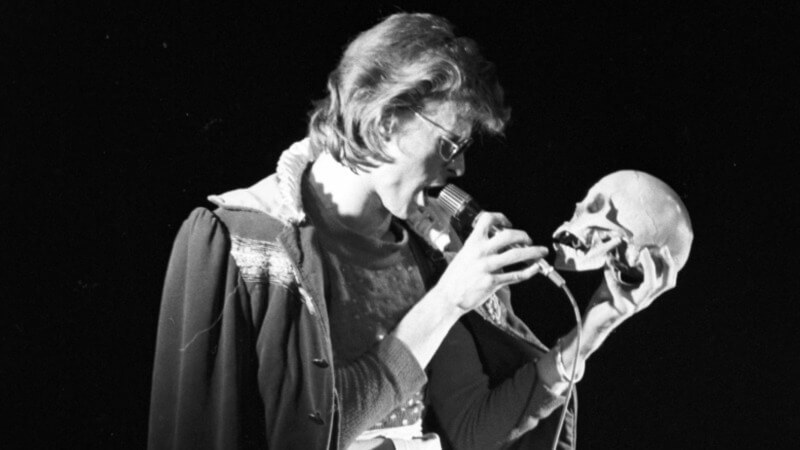
Photo by Joe Sia/Wolfgangs
I was 15 years old when a doctor measured my scrotum for the first time. Somehow her hands were cold even while they were gloved. She read out the measurement to a nearby nurse, whose own hands typed madly, filling in charts and prompts on a desktop screen. It didn’t matter what the number was, the nurse only replied with “uh-huh” or “mhm.” My embarrassments, had I been able to bring them up, would have sounded like I was speaking in tongues. Not like I could talk anyhow. The LED’s were too bright. The table smelled too clean. The paper beneath my bare white ass was too crinkly. The doctor pressed her thumb and index fingers onto the cave-in that separated my two breasts, fiddling with the indent like it was never meant to be there. Suddenly all of me was wrong, even though I’d looked at all of it every day.
It’s never left me, this image of my parents in a Cleveland Clinic examination room, hearing that same doctor tell them that their son has XX chromosomes. In the room’s ugly, a pang of pink broke through the only window and onto me. And in my memory, my parents saw the color, lost some of their own, and asked, “What can we do to fix this?” The doctor calmed them with a script for AndroGel—testosterone cream I’d need to rub on my belly every night to kill the woman inside me. I thought it was my fault, and I had a lot of questions. But I didn’t ask any of them. Everyone seemed concerned enough, so I put my head down and nodded along to every instruction. The doctor referred me to a pediatric endocrinologist at a branch of the hospital closer to my town. I lathered on that gel every night for two years. Then it was four years of intramuscular injections, first in the shoulder and then in the thigh. By the end of college I was jabbing a syringe into my gut weekly. Once, I had so many welts there it looked like a stained glass window. Another time, a needle broke off under the skin and I bled all over the sheets.
I saw the recommended endocrinologist every six months for five years. In a windowless gray, I’d stand before him and drop my pants. He’d grab my testicles and check whatever it was he needed to check. Every time he asked me the same question: “Are you able to achieve an erection?” And every time my answer was the same: “Yes.” I still had questions but I kept quiet. The hormone therapy was working. My metabolism was finally normal and I’d gotten rail thin. I could grow a mustache but barely. The peach fuzz was OK. The pink my parents feared was mostly gone. The doctor played coy about the specifics, treating my condition like a temporary ailment by downplaying its severity. I appreciated the just-business of it all until my brain started getting funny about gender stuff. I didn’t feel like a boy, but I didn’t feel like a girl, either. A college friend suggested the word “genderqueer.” It felt good but not all the way. Something inside of me was suffocating.
After my 21st birthday, I began HRT treatment under the supervision of a new endocrinologist—an internist, because I’d gotten too old for kiddie doctors. I asked my roommate to drive me over there and they kindly did. It was my first time seeing this new guy, and he turned out to be a straight-shooter who kept his hands to himself and treated me like an adult. I finally asked my questions and he answered all of them, the last one most importantly. “You’re intersex,” he said, without hesitation. “And you’re going to be on this medicine for the rest of your life.” And then he asked me a question of his own: “Do you know what ‘intersex’ means?” I nodded, remembering something about it from Freaks and Geeks, my favorite TV show. “It’s when somebody is born with both parts,” I said back to him. “Yes,” he replied. “But not always. It can come down to a lot of factors: hormones, chromosomes, genitalia.” My problem was the middle one: I entered this world with a penis but my chromosome pattern reads XX, not XY. To be told the truth is an act of love and a life-saving amputation, but to be known honestly comes with a price. I kept the news to myself on the ride home.
The 1980s-set Freaks and Geeks aired on NBC when I was a year old, in the doldrums of 1999. Mom and Dad watched the show weekly until the network canned it. Sometime after that, Dad gifted the DVD box set to Mom for Christmas. And eventually, they said it was OK for me to watch it with them. On weekdays after school, I’d watch SpongeBob and The Fairly OddParents and Courage the Cowardly Dog. On weekends, Mom popped Freaks and Geeks into the DVD player and I’d watch for hours and hours. The episodes about getting drunk, smoking pot, and extramarital affairs weren’t off-limits. But the 17th episode, titled “The Little Things,” and its plot centered around a character coming out as intersex (which most folks just called “hermaphroditism” in 1980 and even 1999), was off-limits. Mom claims it was never because of that, but it couldn’t have been because of anything else.
Amy (played by the late Jessica Campbell) tells her boyfriend Ken (Seth Rogen) that she was born with a penis and a vagina (or, as Ken puts it, she was born “with the gun and the holster,” which I’ve always liked) but that her parents chose to raise her as a girl. Ken’s cool reaction slowly morphs into panic. He questions his own heterosexuality and even buys gay porno mags and disco albums to suss out if he’s into guys or not. One of the records he puts on is Linda Clifford’s “If My Friends Could See Me Now,” but he doesn’t dig it. He plays David Bowie’s “Fashion” and is mildly impressed. I’d always thought using Bowie as a barometer for gayness was a neat, if not fair trick. By the time I got to see “The Little Things” I was like a million other queers: a fan of Bowie’s music but still in the closet. I don’t know what introduced me to his music first. It was either “Heroes” playing in The Perks of Being a Wallflower, a quote from “Changes” appearing at the beginning of The Breakfast Club, or red-and-electric-blue lightning bolts on a T-shirt in a department store’s men’s section.
 Keep scrolling for more great stories.