Michael Sarnoski’s grimdark revisionist folktale The Death Of Robin Hood shares a tired, jaded disillusionment around myth and fame with other genre tales intent on eating away at the foundational fables propping them up. Aged gunslingers, assassins, and samurai have all dolefully trudged towards oblivion—as have superheroes like Wolverine, whom Hugh Jackman sent off a decade ago in the Unforgiven of comic movies, Logan. Jackman channels some of that same weariness, where violence is a second nature he just can’t shake, and grapples with the same kind of surrogate fatherhood in The Death Of Robin Hood. But the legendary bandit’s grey-haired reckoning isn’t a reluctant spectacle, nor does it pull our heartstrings as taut as his faithful bow. It’s a slow drip towards the end, reality running out like blood from a vein, leaving only a body of stories behind. But without a compelling narrative or affecting emotions at its core, the subversion is often as shallow as the legend.
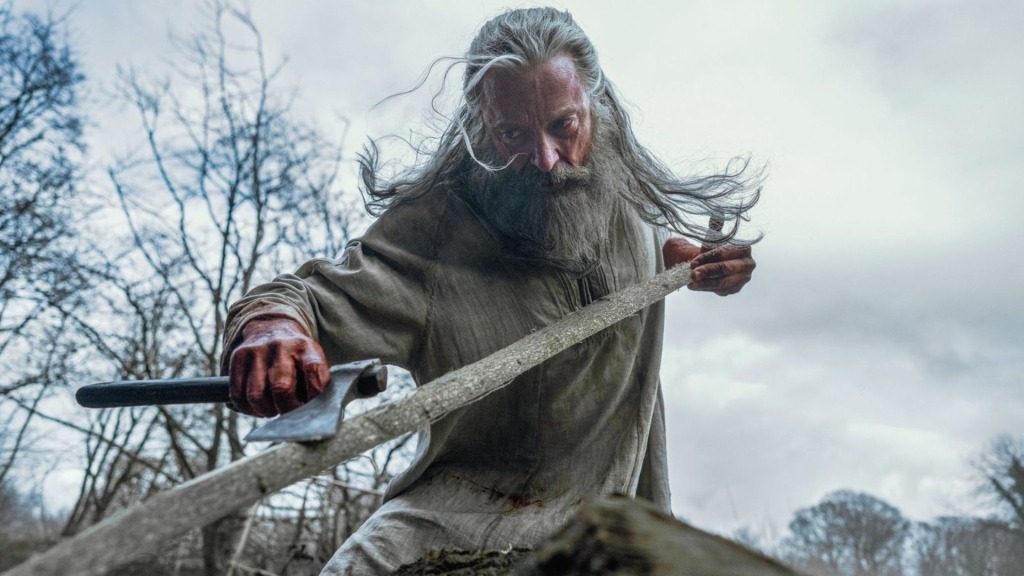
Looking like a rode hard and put away wet Witcher, and as grumpy as Weapon X ever was, Jackman’s Robin Hood has long since given up his murdering and pillaging days, living in isolation from whoever passes for Merry Men in this bleak world. Out in the hills, dirty and cold, he hides out from his past. Fearing retribution from those who seek him out, who often seem downstream of his crimes, Robin is framed not as a local bandit but a prolific force of death, whose wanton violence has the whole of England after him. That propensity for killing crops up in an early set piece of Sarnoski’s film, when it gets closest to the messy period bloodshed of The Northman, and isn’t instigated by Robin. It’s a reaction to those who’ve found him out, or to the needs of his old clansman Little John (Bill Skarsgård), who comes calling for aid: He’s tried to move on from the outlaw life—stealing away someone’s farm—only to be outmatched by the kin of those he took from.
Dragged back for one more job, Robin’s skill with knife and arrow aren’t spectacle but horror, though in the flickering firelight, it’s more like the squint-inducing quasi-realism of Game Of Thrones. Similarly to that show, though there’s beauty in the natural lighting of torches, campfires, hearths, and flaming huts—in the mud-caked skin and hand-fletched arrows—Sarnoski can’t resist shooting with a fabulist’s eye. Sweeping drone shots soak in the rocky landscape, Jim Ghedi’s wailing folk songs blast over the soundtrack, and every once in a while, a bit of weirdness more fitting for something like The Green Knight slips through. Though it’s clear that the film cares about violence begetting violence and senseless cycles of revenge, there’s a noncommittal to its grounded recontextualizing of “Robin Hood.” Even if this incident ends up with him beaten, broken, and shipped off to a priory to recover, he’s still a fantastical killer whose arrows can pierce a skull at an Olympic distance.
Once under the island-bound supervision of Sister Brigid (Jodie Comer), The Death Of Robin Hood shifts from violent elegy to plodding hospice care. Surrounded by orphans and the dying—like a charming leper played by Murray Bartlett under layers of prosthetics and protective garments—Robin allows his body to heal while the film considers the health of his legacy. That means bow-making montages, maudlin and over-literal conversations about the nature and utility of stories, and a chance (albeit a small one) for some kind of redemption when two youngsters (played by Noah Jupe and Faith Delaney) wash up on the shore of this isolated paradise.
But none of these external gestures are satisfying, mostly because Robin’s internal reckoning is held at such a remove that he moves through his own second chance with a hard blankness, neither fully regretful about what led him to this point nor entirely resentful that Brigid saved him from the release of death. It’s stuck in self-serious limbo, festooned with appealingly brutal period details (the visceral jab of a bloodletting fleam is more effective than any of the film’s traditional weaponry) but without the emotion needed to pierce the harsh world it constructs. It’s not hard to believe that a famous outlaw led a far more complicated and grisly life than was passed down in tall tales, but it’s harder to find more than that single note amid The Death Of Robin Hood‘s dull, sludgy drama.
Though Comer is allowed to channel a bit of otherworldly optimism in her soft performance, this is a film about a sad old man, thinking about how much he wishes he was already dead. Like Sarnoski’s other work—Pig and A Quiet Place: Day One—The Death Of Robin Hood follows someone who thinks they’re beyond the reach of the rest of the world, only to be violently disabused of that notion. This just has the added baggage of a familiar hero, draped in period trappings and so intent on going against the grain that it’s drained of vitality.
Director: Michael Sarnoski
Writer: Michael Sarnoski
Starring: Hugh Jackman, Jodie Comer, Bill Skarsgård, Murray Bartlett, Noah Jupe
Release Date: June 19, 2026


 Keep scrolling for more great stories.