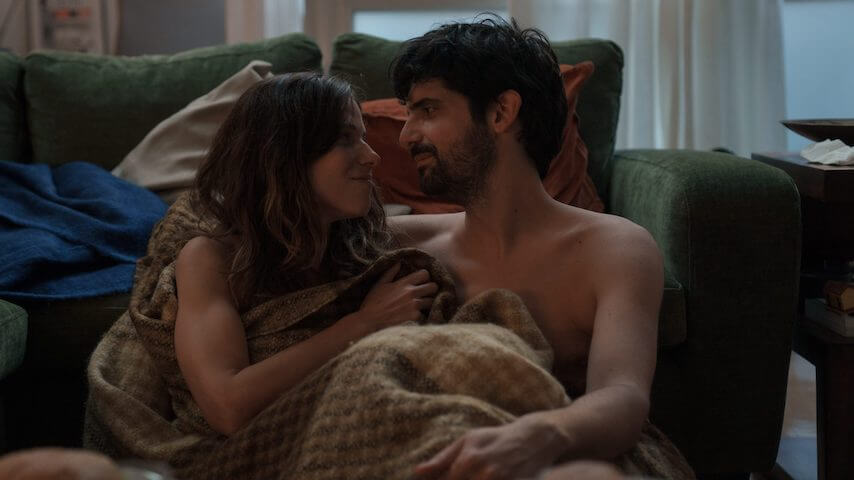
If time-focused love stories are usually fueled by serendipity, The New Years uses up most of its allotted dose of fate just to bring its central pair together. In the waning moments of New Year’s Eve 2015, Óscar (Francesco Carril) is in the middle of the long tail of a breakup, and Ana (Iria del Río) is working a dead-end bartending job. But she notices his sad face, and he catches her smile. Before the night is over, they realize that they’re both celebrating birthdays. One party with some mutual friends later and the two are suddenly in the front car of a yearslong emotional roller-coaster.
The 10-part series, which premieres in the States on MUBI this week after airing in Spain last year, tracks the next decade in the lives of Ana and Óscar. Each episode captures roughly an hour around successive New Year’s Eves, starting with those early hours of 2016 when the pair first connect. Comfortable in some ways, subversive in others, and guided by a lived-in feel throughout, The New Years shows that a series with a format hook like this can still be driven by careful attention to character over all else.
It’s a ride that takes them to other countries, through different stages of personal growth, and past a handful of unaddressed anxieties. These episodes don’t always play out in real time, but none of them feel like an overly edited window into where Óscar and Ana are at the end or beginning of any given year. All these check-ins really do come off like slices from their lives as they drift toward and through versions of the future that neither they nor the audience can quite expect.
Creators and writers Sara Cano, Paula Fabra, and Rodrigo Sorogoyen ensure that The New Years never succumbs to the traps that might otherwise come with its premise.Óscar and Ana both hit significant life milestones over the course of the show—breakups, new jobs, promotions, unexpected life surprises both welcome and unwelcome—but almost all of them are off-camera. Instead of setting up plot points like mile markers on a long interstate highway, The New Years is a lot closer to taking water samples at various spots along a winding river. And meeting these characters where they are instead of making them contort to fit into a preexisting mold is what makes this series a fulfilling watch.
In some ways, that’s just The New Years following its leads. It might make sense for a show like this to have the supporting players in this saga bend to Ana and Óscar, being there only as a person pouring champagne to celebrate or having conveniently timed crises so that the people in the spotlight can show their relative worth. The New Years takes the opposite tack, building an entire series around the idea that, in love and friendship, people are shaped by those around them. Óscar and Ana are mirrors reflecting those with limited screen time rather than the other way around.
There are long stretches of The New Years that feel like they were once destined for the stage. Monologues about childhood memories, arguments about trauma, extended parsings of romantic miscommunication: They all resist spectacle in favor of grounded sequences tied to carefully chosen locations (many of them in the series’ unofficial home base of Madrid). Even when confined to single spaces, Sorogoyen and the rest of the directing team show a graceful understanding of how to use an entire room, with moments of emotional and physical connection choreographed in a way that’s rarely showy.
That’s indicative of the entire series, which keeps a consistent rhythm and pacing throughout. Even the busiest house party or club scenes play out at the gradual speed of life unfolding. When Ana and Óscar are in times of emotional distress, The New Years doesn’t ramp up to accommodate them. This keeps the show from becoming too aligned with one person or the other, letting the viewer place their empathies wherever they see fit.
If there’s anything in The New Years that feels overly neat or writerly, it’s Óscar’s prime hangup, which is slowly revealed over the series’ back half. Once it’s laid out explicitly what might be getting in the way between him and true happiness, neither he nor Ana (nor the show, for that matter) can do much to change it. Yet that’s kind of the appeal of a project like this. By putting each check-in at the most reflective time of each calendar year, it doesn’t feel like that much of a cheat to have people lay out their deepest insecurities for all to see, whether they’re using that act as a weapon or remedy.
The New Years trusts its material enough to not get overburdened by time signifiers. Sure, some hair changes length and color over the years, but aside from the unavoidable COVID-era face masks, there aren’t any obvious cultural signifiers. Instead, The New Years tethers the story to these individual lives. There’s enough specificity in each new development to extrapolate in reverse, filling in the details that aren’t shown. All it takes is a passing comment to conjure an entire passionate weekend getaway or a monthslong fling that never made it to December.
There’s a thrill in seeing each time jump, knowing that these two people have changed. But there’s also a sadness in not witnessing the moments in between, however vividly they might be evoked in retrospect. This show is fittingly self-contained in the same way that a decade is, driving home the point that nothing in life or love is guaranteed.


 Keep scrolling for more great stories.