With Run The Series, The A.V. Club examines film franchises, studying how they change and evolve with each new installment.
Andy, the generically agreeable all-American (cartoon) boy whose sixth birthday incites the plot for 1995’s pioneering computer-animated film Toy Story, should be somewhere around 37 years old today. He probably isn’t; time moves differently in the world of the Toy Story series, which doesn’t mitigate its merciless forward march. Andy was around 18 in Toy Story 3, 15 years after he turned six in the first film, and has since only been seen in flashbacks in the fourth, nine years after that—and though he’s mentioned repeatedly in Toy Story 4, by Toy Story 5 he has disappeared from view. It is a creative necessity for the movies to continue, an inconsistency in the movies’ ongoing master metaphor about parenting, and a sad reflection of real-world losses both minor and major, all at once. Truly, these toys contain multitudes.
Contradictions, too: These are movies about disposable plastic junk that have managed to last for more than three decades. That the once-novel Buzz Lightyear (Tim Allen) has survived long enough to become a de facto vintage toy with his visage largely unscuffed is a playroom miracle—and that’s before you even get into the near-miraculous preservation of Woody (Tom Hanks) and Jessie (Joan Cusack), toys that seem to hail from decades earlier, with only Woody showing the occasional wear and tear. (In the latest film, a familiar worn-paint effect has given his shiny plastic hair the toy equivalent of a bald spot, which is pretty impressive as the sum total of damage for someone living well outside the bounds of traditional toy societies.) Then again, it’s not as if Buzz would be decomposing in real life; more realistically left in a landfill, his neat pop-over plastic helmet might continue to shine on for another century or more, perhaps until only Pixar’s adorable garbage-bot WALL-E is left to crush it into a cube.
Maybe the greater miracle of the Toy Story franchise, though, is how well it preserves the Pixar ethos through a series of long-gap (but not quite legacy) sequels. At this point, there are half a dozen other Pixar follow-ups to their various other beloved works, and while most of them have their charms, none of them are even as good as the later-period Toy Story entries—which manage to outshine plenty of Pixar originals, too.
So what is it about these movies that they have yet to succumb to hugely diminishing returns? It’s tempting to point to the original as such a classically structured foundation that it made further construction much easier, and there’s probably some truth to that. But great originals don’t always beget great sequels, and the first Toy Story also has to contend with a tendency, particularly in American animation, to favor landmark status above all else. It took well over half a century for the idea that Snow White And The Seven Dwarfs might not be the single greatest Disney (and, as such, American) animated feature to gain much traction, because of the sheer groundbreaking accomplishment it represented. Similarly, Toy Story‘s emergence from the field of computer animation in 1995, when even short subjects were still mostly hand-drawn, and with a soulful, punchy buddy-comedy screenplay to boot, was taken as a miracle.
And not without cause. Toy Story‘s coursework-ready screenplay has helped it survive past any sense that 3D computer animation is far more prone to paling next to future upgrades than its 2D counterparts. That limitation actually folds neatly and charmingly into its thematic concerns, as the whole movie is about an old-fashioned cowboy doll feeling threatened by a shinier, more contemporary spaceman figure. The blocky action-figure appearance of the movie’s early human renderings make sense now, too; they have the same ugly cuteness as any number of retro toys. Time and better-looking replacements come for us all.
Woody’s resentment and insecurity about this inevitability is surprisingly vivid for a kid-friendly cartoon from the mid-’90s; good as a lot of the main-line Disney animated features from this era are, they tend to use music and/or adorability to mitigate any of their leads’ mildly bad behavior. Toy Story, by contrast, gives Woody moments of true weakness, particularly his plotting to get rid of the interloping, oblivious Buzz, that aren’t just extreme for a cartoon hero, but on the more unlikable end for Tom Hanks characters in general. From the jump, Pixar assumed that kids could withstand complexity in their cartoons. (Apparently earlier iterations of the movie went too far, with multiple characters, including Woody, coming across as genuinely mean and unpleasant.)
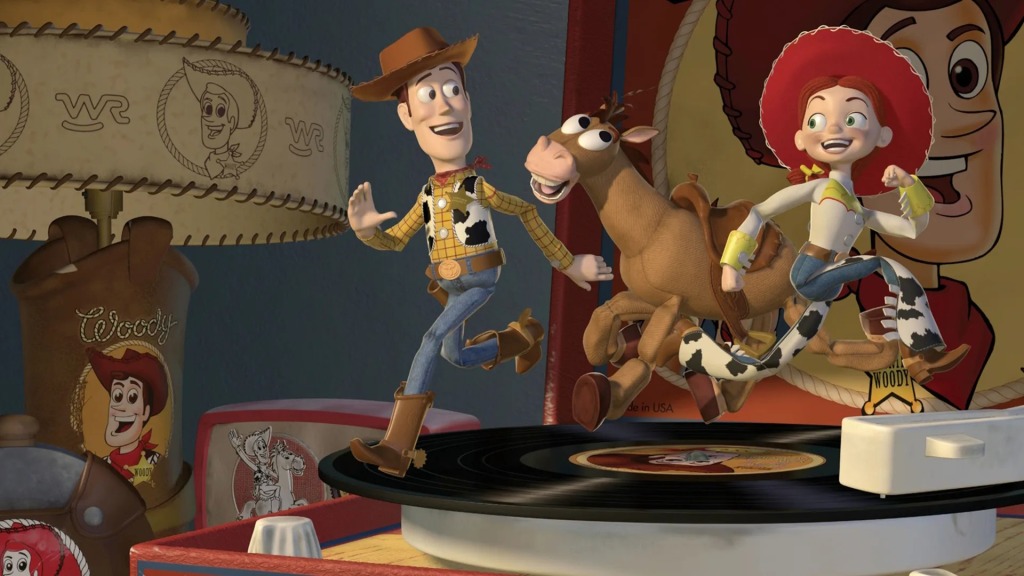
It’s understandable, then, that the novelty of Toy Story will probably always see it favored when it comes to the canonical Pixar lists. Then again, some agree that the second and third films at least provide stiff competition for the first. For me, Toy Story 2 will probably always reign on high. Developed as a straight-to-video project and rerouted to theaters as part of a last-minute overhaul, the only seeming evidence of the film’s heavily rewritten production may not be evidence at all: The immediate swerve from the first film’s comic button—a unified Woody and Buzz, free of previous insecurities, are blindsided by Andy’s Christmas-gift puppy—to the revelation that some time later, Buster the dog is an ally to the toys and Woody in particular. It’s the first of the film’s many pivots, and instead of production seams, all you can see is the result of Pixar’s famous “plussing” technique, a sort of yes-and version of storytelling that encourages the further development of ideas rather than shooting them down.
That technique feels particularly visible when the toys make a mid-movie trip to Al’s Toy Barn: Buzz encounters a new influx of space rangers who share his old delusion; then one of them switches places with him; then the toys accidentally unleash Buzz’s nemesis Emperor Zurg to pursue the new Buzz. This leads to a hilariously abrupt jump into Star Wars parody, which itself quickly cycles through the second Buzz’s anguish, yearning, and finally elation as he’s reunited with his suddenly ex-villain dad. None of this is all that important to the plot of Toy Story 2, nor does it take up all that much screentime. It’s just the filmmakers having a blast with their comic complications.
That sense of effortless elaboration applies to the film’s emotional core, too. The first Toy Story certainly has metaphorical parenting overtones via Woody’s protectiveness (and possessiveness) of Andy. But much of the movie’s conflict is rooted in Woody’s personal insecurity running head-on into Buzz’s delusions of grandeur. That’s not to say parenting precludes either of those qualities, but in the first film it can play just as readily as a workplace or friend-group dust-up, perhaps more than a parenting-specific challenge. Toy Story 2 further blurs the line between parent and child, as Woody comes to fear obsolescence and is tempted to opt out of his de facto child-raising before it hurts him more—exacerbated by Jessie’s sense of abandonment, which is both childlike in its intensity and parentlike in its deep sense of loss. Somehow, the same basic, inevitable fear—that a toy will be abandoned by its owner—is “plussed” into something more resonant than Woody’s initial petty jealousy. What initially feels like the playful projection of a young child’s idea that their toys are alive winds up speaking more to the adult’s knowledge that this life won’t last forever.
By the time we get to Toy Story 3, parental concerns have moved to the fore: There’s the revived question over what happens to the toys and their purpose in life once Andy grows up (repeated from the second film, now with greater urgency); the difficulty of reorienting a post-parenthood life in a new location; and, most bracing, a genuine grappling with mortality, in a sequence that makes it seem—however briefly, however faintly—possible that Woody, Buzz, and the rest of the core gang will in fact meet their dooms in a literal garbage fire. Those parental anxieties are so unavoidable, in fact, that they briefly escape metaphorical territory. Late in the film, Andy’s mom (Laurie Metcalf), so often half-glimpsed as a nurturing but practical type in the background of the toys’ various adventures, pauses for a moment upon seeing her son’s mostly empty room. She barely holds back tears, realizing what she’s about to lose.
This moment both highlights what’s special about Toy Story 3 and partially explains Toy Story‘s supremacy in the Pixar filmography. This moment is wrenching from either side of the parent-child divide—I first experienced it thinking of my mom, and later re-experienced choking back a sob with my oblivious then-four-year-old sitting beside me on the couch—while almost feeling like a fourth-wall break in its drop into an adult human character’s perspective. Parenting is the subject of many Pixar movies from the studio’s first 15 or 20 years, usually to good effect. But the concise moment afforded to Andy’s mom in between a harrowing scene of the toys grasping hands as they accept their fate and a deeply touching one where Andy passes his toys on to the younger Bonnie makes something like Finding Nemo (which similarly transposes the parenting material from subtext to text) seem less elegant in retrospect.
It’s only natural that future Toy Story entries would fail to replicate that precise degree of devastation. At first, the conclusion of what looked like a Toy Story trilogy seemingly pointed to the characters living on in short subjects and TV specials—a perfect compromise to keep their adventures fresh and varied without fully untying the bow of the third film. Most of these further bits and pieces are fun (and the short “Small Fry” is laugh-out-loud hilarious), and even if they somehow hadn’t been, who really cares if a 22-minute Toy Story holiday special isn’t on the level of some of the best movie sequels ever made?
There’s a certain degree of bravery alongside the craven capitalistic desires driving the subsequent creation of two additional Toy Story features. Toy Story 4 is the weirder of the two, offering a parenting-metaphor postscript with Woody very much taking the role of an empty-nester dad. He still likes to help out with the play and care of Bonnie, but he’s more akin to an enthusiastic uncle. Bonnie isn’t Andy, and she’s more attached to Jessie anyway, a bond that eventually informs Toy Story 5. Woody’s quiet existential crisis—what is he, after “his” kid has grown?—is teased out by the more ostentatious existential quandary presented by Forky (Tony Hale), a spork with googly eyes who is unwillingly transformed from inanimate trash to living toy by Bonnie’s creativity and love, a cuddlier accidental Frankenstein story. Forky’s (very funny) desire to self-annihilate and re-assert his proper trash status pushes harder than ever against the cheerful what-if-toys-were-alive fantasy of the first film, and nudges Woody toward a life where he derives satisfaction from helping others like him (lost or discarded toys) rather than insisting on serving as the world’s greatest sheriff (which is to say, dad). If only more semi-retired boomers could be put to such thoughtful, productive use!
This resolution to Woody’s story hasn’t demoted him from Toy Story appearances entirely, but it does leave way for Jessie to lead Toy Story 5, which reframes material from Toy Story 2 for a vaguely period-agnostic story pitting toys against tech, at least superficially. This also plays as a natural extension of the first movie, where the old-fashioned pull-string cowboy is overshadowed by the now-quaint high-tech spaceman. As much as the fifth film threatens to retread old ground, the filmmakers wring additional pathos from more parenting nuances, especially as they relate to a sense of control. Though Jessie still frets about “her” kid no longer needing her, she’s also worried that this will happen before she’s able to finish what’s coded as her parenting job, the way that Woody and Buzz were able to send Andy out into the world at 18. Tech toys no longer threaten to merely replace old playmates; now they can throw the bigger picture of growing up further out of whack.
Yet while Toy Story 5 especially has one major third-act swell of emotion, part of the charm of the later sequels is how they can tell more intimate, less encompassing stories within Pixar’s biggest franchise. The emotional fullness of the original trilogy allows for real development of Woody in the fourth movie and Jessie in the fifth (which in turn calls less attention to the somewhat looser plotting of both movies). Meanwhile, poor Buzz was handed something much more and less in the form of his own sort of spin-off: Lightyear, a bizarre project that purported to show the audience the original movie that would have inspired the stylized action-figure version of Buzz. A title card insists that this was in fact Andy’s favorite movie, despite its fixation on a high-achieving individual grappling with failure in a way that seems unlikely to capture the imagination of the average six-year-old.
While the proper Toy Story movies represent Pixar at the peak of the studio’s mainstream-entertainment powers, setting the standard for much of the rest of their output, Lightyear is most interesting as a strange metatext about the studio learning to cope with its limitations. The gung-ho hero spends much of the movie trying and failing to correct a mistake he makes early on, and then coming to terms with the fact that he must press forward with an acceptance of what life has handed him, rather than attempting to pull off a single grand, heroic gesture that will fix everything. In retrospect, this reads like an insta-apology for the very notion of an alt-universe Buzz Lightyear spin-off, an act of hubris the movie itself attempts to repair by transforming it into one of their trademark adventures with a forceful emotional kick. Though the movie has its moments of sci-fi inspiration (Can you imagine Illumination ever making a movie this reminiscent of Interstellar?), it ultimately doesn’t get there, which makes the experience akin to watching the movie process its own loss in real time.
If only this was as touching in practice as it is in theory. It’s more compelling to watch an army of Wi-Fi-enhanced Buzzes troop in unison around the globe during the funniest passages of Toy Story 5. That might seem like an arbitrary comparison, but it’s notable that multiple Toy Story movies do a better job of conveying smallness in the face of a larger universe in a funnier, more memorable, and more grounded way than Lightyear. (This reaches a peak in Toy Story 2 where the toys attempting to simply cross a street becomes a slapstick disaster, and the visual implication of the toys having driven an airport luggage cart home scores a big laugh.)
In a show of understandable but ultimately misguided faith in the Toy Story brand, Lightyear, which, save a few stunning full-IMAX spacescapes, is as straight-to-streaming an idea as Pixar has ever made public, went to theaters at a time when the vastly superior likes of Turning Red and Luca went straight to Disney+, an act of overdog devotion that the Toy Story movies are smart enough to avoid for their characters. Release strategy vagaries are corporate concerns outside the purview of the movies themselves, yet the Toy Story films in general have increasingly resembled the ultimate high-quality franchise of late capitalism, one that conflates the crass commercialism of acquiring disposable yet landfill-clogging junk with the full experience of parenting—and then makes us cry about it out of affirmation, rather than pure despair.
In some lesser Pixar movies, you can see the engineering calculations behind the whimsical designs and slam-bang gags; Toy Story entries make those calculations integral to the entire operation. None of them feel as personal as their fellow best-in-company Pixar projects, like The Incredibles, WALL-E, Up, or Turning Red. They’re more of a collective home base, both for the filmmakers and the audience. It’s no wonder that this series represents a kind of ever-present time warp, where toys perpetually exist on the cusp of exile, whether individually or, later in the series, collectively. It’s all part of the franchise’s ultimate, lasting contradiction: A joyful series of funny adventures that unfold in constant awareness of a looming loss.
Final ranking:
- 1. Toy Story 2 (1999)
- 2. Toy Story 3 (2010)
- 3. Toy Story (1995)
- 4. Toy Story 5 (2026)
- 5. Toy Story 4 (2019)
- 6. Lightyear (2022)


 Keep scrolling for more great stories.