Paul Bettany’s Vision has never been entirely in focus. Introduced as a late-act twist in one Avengers movie, and killed off as a sacrificial lamb in another, he has worked largely in the margins of the Marvel Cinematic Universe, with Bettany forced to mine traces of the character’s beautifully human inhumanity from deep within makeup, facial prosthetics and scripts constantly racing toward a big, explosive climax. Even in the 2021 streaming phenomenon that bore his name—and which this week’s VisionQuest serves as a direct sequel to, even more so than 2024’s Agatha All Along—The Vision was an accessory character: a ghost trapped in the idiot box; a moving corpse with killing intent. Having finally been given his “own” show at last, Bettany’s former Avenger still threatens to be crowded out at times: Buffeted by a whole sitcom’s worth of mental roommates on the one side, and characters spawned by the necessities of franchise dust-clearing on the other. But with the breathing room of eight hours devoted to his character’s primary-colors mental world, Bettany finally has some real room to work—and to deliver, alongside his old Age Of Ultron co-star James Spader, a fascinating, nuanced, visually compelling meditation on grief, and how it influences the curses and legacies that parents end up transmitting to their children.
It would be reductive, but not inaccurate, to imagine VisionQuest as a series of concentric circles, with Bettany and Spader’s prickly, funny, fascinatingly complex father-and-son, hero-and-villain, jailor-and-prisoner dynamic at its center. The further out you go from there—through a Windows 95 desktop-patterned mental world populated by cast-off Stark Industries AIs portrayed by a host of well-cast character actors, and then out into the real world, where the detritus of WandaVision and Agatha combines with a Marvel-rote pursuit story starring a “quirky” bounty hunter (Todd Stashwick) who won’t shut up about his stupid “code”—the worse the series gets. It’s not like there are no pleasures in these outer reaches. Mike Flanagan veteran T’Nia Miller shows up halfway through the show’s run to deliver a compelling take on the standard-issue “idealist with rage issues” Marvel villain, and showrunner Terry Matalas is kind enough to sprinkle in a typically hilarious deadpan from Diane Morgan for the Cunk heads in the audience. But the further the series moves away from Bettany and Spader, the more clunky the clockwork gets; by the time it’s devoting whole cold opens to a young London conman (Ruaridh Mollica) twitching his way along the breadcrumb trail left by Agatha’s big reveals, it’s easy to imagine you can hear a gear or two getting ready to slip catastrophically out of joint.
And yet, somehow, they never do. The most obvious reason is Spader: If there is a reason, singular, to watch VisionQuest, it’s to see the veteran actor take grace notes he managed to smuggle in via voicework in Joss Whedon’s overstuffed Age Of Ultron and transmute them into entire songs. Modulating on a “boxed crook” performance he gave for roughly eighty gajillion seasons on The Blacklist, Spader finds an unexpected avuncular warmth within his genocidal AI, who Vision secretly saved at the climax of Ultron’s 2015 trip to the CG explosion factory. Beneath the expected (and genuinely delightful) withering asides and moments of icy menace, Spader—free to use his whole face and body to play the character for once, courtesy of the “human avatars only!” rule in the mental space where he’s been imprisoned—finds the person lurking beneath the metal and the mayhem. If the version of Ultron that emerged, crooning his creepy little Pinocchio songs, from Whedon’s pen 11 years ago was a wrathful child, taking out his frustrations on the human race, this one is a more introspective teenager; still dangerous, as Spader’s performance never lets you forget. But far more interesting for having the potential to surprise.
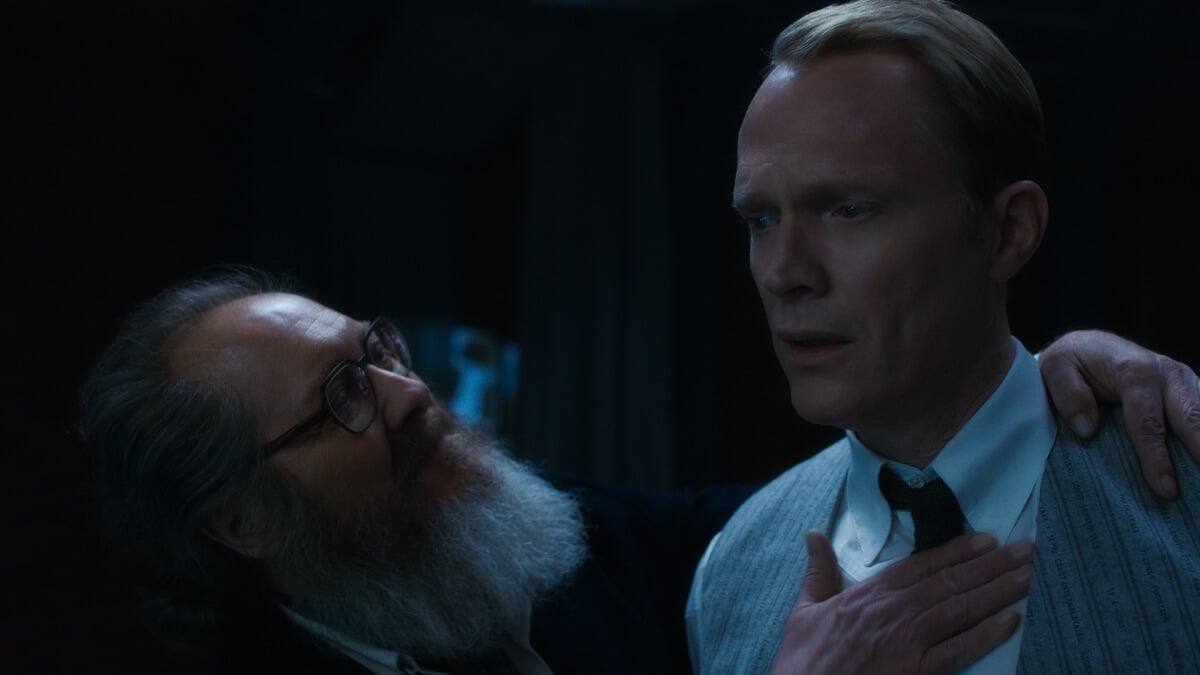
Spader finds an able scene partner in Miller—the two get numerous, fascinating, and sometimes blisteringly ugly scenes together as the series progresses. But he’s especially good opposite Bettany, who plays this version of The Vision as a synthezoid unmoored, teetering on the edge of total dissociation. Bettany doesn’t let the absurdities of plot here get in the way of the emotional realities of the character: WandaVision fans will recall that this Vision is a resurrected, weaponized corpse with memories of an idealized ghost of himself implanted into his synthetic brain, but Bettany believably portrays him as a man who has lost everything, family, friendship, purpose, and self. The Emmy nominee has always been a good fit for Vision, in part because there is something just a tiny bit inhuman about him—an icy distance to Bettany that melts the second he unleashes one of those massive, goofy smiles. Here, more often than not, the latter are absent, or clearly mechanically forced; instead, we get a man/machine whose discomfort at even being addressed as himself is palpable. It is to VisionQuest’s credit, and Bettany’s, that its title character is frequently unemotive but never unfeeling; the series is, on at least one count, mostly about the pleasures of watching something inside him wind its way to its breaking point, and then beyond.
All of which is of a piece with the wider goals Matalas has tackled here. It’s interesting, for instance, to note that he’s a newcomer to this “franchise.” In its most electric moments, VisionQuest sometimes feels like not just a conversation with executive producer Jac Schaeffer’s work on WandaVision and Agatha All Along, but an interrogation of it—and especially its pithy wisdom about grief being “love persisting.” (It acknowledges, for instance, that the recipient of that particular emotional crossstitch wound up being driven so mad by her “persistent love” that she ended up killing dozens of people and then burying herself under a mountain.) The grief of VisionQuest is uglier, if no less undeniable, than that beautiful idea, and intimately tied into the show’s obsession with parents and children, creator and creature. When Bettany’s character struggles, for episodes on end, with whether to embrace Mollica’s possible son-by-spiritual-association as his child, he’s not just quibbling about plot details like “my enemies might hurt you”; he’s wrestling with whether to pass on the poison that life and loss have injected into his artificial heart. It’s heady, worthy stuff, and the material that best positions VisionQuest as a worthy successor to WandaVision’s complicated legacy.
Not that it’s all trauma and digital misery here. VisionQuest also shares WandaVision’s interest in formalist experiments and staggeringly gorgeous set design, presenting Vision’s mental world as a sumptuous 1950s dreamscape, filled with beautiful mid-century modern appliances loaded up with silly computer puns. And although it’s not quite the shapechanger that either Wanda or Agatha were, the series still shows a welcome dedication to treating TV episodes as episodes, adhering to a central conceit rather than being just a one-hour chunk of a longer story. (A midseason installment that sees Vision repurpose his mental buddies as the characters in a police procedural is especially fun on that score, as Matalas plays with Schaeffer’s ideas about the ways we use the language of TV to help us understand the world.) Sure, it’s not devoid of the ugly realities of streaming television: Vision, for all that he claims to be a super-genius endlessly running thousands of simulations of every situation, is sometimes forced to act astoundingly stupidly in order to get the show to its next big plot beat. And the Marvel Machine’s need to get one of its post-Endgame characters to actually resonate with audiences is a frequent distraction, mostly just serving to remind the viewer why Bettany and Spader are bona fide movie stars, and their colleagues here are not.
But those aspects are, of course, the price of entry for any of Disney+’s various Marvel shows over the last half-decade. They’re the hard shell of franchise obligation that has to be gnawed through to get to the rich character and performance meat inside. On that score, VisionQuest is a pleasantly light chew: Smart, affecting, and funny, and buoyed by several serviceable performances—and two or three absolutely stellar ones. It brings this odd little trilogy of TV shows to not just a satisfying conclusion, but a meaningful one; at long last, it gives The Vision the focus a hero of his potential has always deserved.
VisionQuest premieres Tuesday, October 13 at 9 p.m. ET on Disney+.


 Keep scrolling for more great stories.