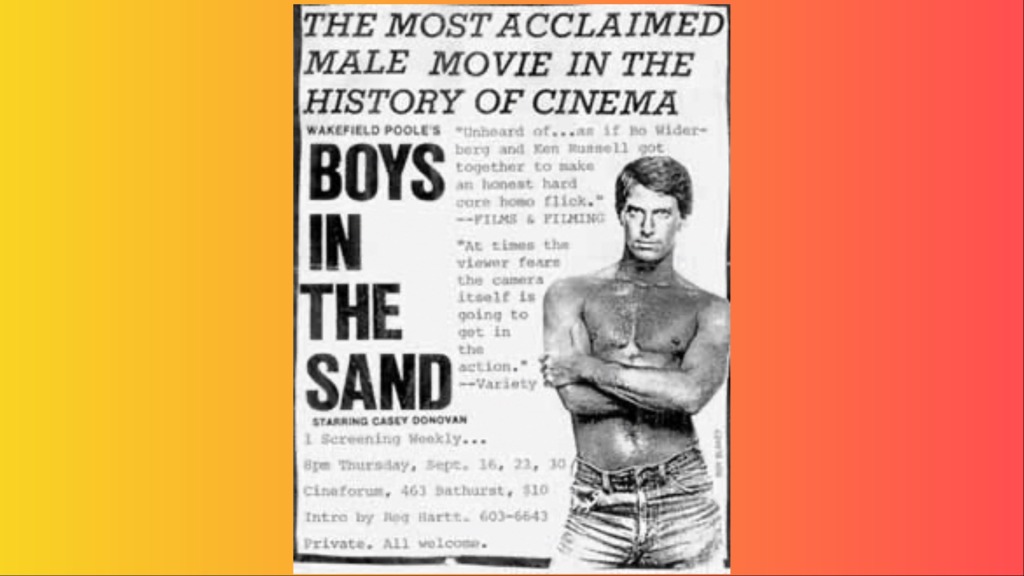
Strangest fact: Boys In The Sand may have created the trope of porn movies spoofing titles of other films. (The title is a reference to Mart Crowley’s play The Boys In The Band, about a group of gay male friends.) So tonight while you’re curling up in front of The Devil Wears Nada 2 or Project Rail Mary or 28 Inches Later: The Boner Temple or Assenger, take a moment to respect their ancestors.
Thing we were happiest to learn: Wakefield Poole had a pretty uplifting reason to make his porn movie. Movies that included gay characters—pornographic or otherwise—tended to be exploitative and relied heavily on stereotypes, and at the dawn of the Gay Rights Movement, there was a lot of self-hatred in the gay community, which media representation was all too happy to reinforce. After watching a film called Highway Hustler, Poole declared it “the worst, ugliest movie I’ve ever seen!” He resolved to do better, and started working on “a film that gay people could look at and say ‘I don’t mind being gay—it’s beautiful to see those people do what they’re doing.”
And while gay pride certainly had room to advance beyond “I don’t mind being gay,” it was a positive mindset in 1971, and it’s reflected in the film. By porn standards, Boys together is positively sweet and romantic (and slightly surreal), at least compared to the “Orifice Verb Roman Numeral” titles of the DVD porn era. The first two vignettes involve a fantasy man emerging from the water and having sex with a sunbather—the first on the beach, the second poolside. The third uses the old repairman trope, but the sex scenes are Donovan’s character fantasizing about the repairman; he only comes indoors at the end, with just a hint that the fantasies are going to be replayed in real life.
Thing we were unhappiest to learn: Gay porn’s moment in the sun didn’t last. As anyone who watched Boogie Nights can tell you, VHS killed theatrical porn (and the fleeting credibility the genre started to enjoy). Poole and Donovan would reteam for more porn (and Donovan was a minor celebrity for years after Boys), but when they attempted a Boys sequel in 1984, it was too little, too late. Worse, by the ’80s, AIDS was decimating the community Poole wanted to celebrate on film. Donovan died of the disease in 1987, and Poole quit filmmaking because “I lost my fanbase to AIDS.” Poole himself claims to have avoided the virus only because he was such a heavy cocaine user he was unable to have sex. (The public embracing a gay film in 1971 may be a feel-good story, but it is still the porn industry in the ’70s and ’80s; there’s a very low limit to how wholesome the story was ever going to be.)
Best link to elsewhere on Wikipedia: If you’re looking for some less smutty Wiki pages to check out for Pride, a good place to start is LGBTQ Culture In New York City. The city that was the birthplace of the modern gay rights movement has always been an epicenter of queer culture, and the page takes you from Stonewall through to convicted felon Donald Trump’s assaults on trans health care (and his failed attempt to take down Stonewall National Monument). The exhaustive page also includes sections on drag culture, the city’s gay institutions, burgeoning “gayborhoods” in the wider metro area, and the original Pride parade, still the biggest and best.
Further down the Wormhole: If you’d prefer even more smutty Wiki pages to check out, there’s always Pornography In The United States, which runs the gamut from dirty French playing cards and daguerreotypes through to the OnlyFans era. As many have observed, porn has been the driver of a lot of technological advances online, streaming video in particular, so it’s only a short leap from porn in the U.S. to Timeline Of United States Inventions. The 1890 to 1945 section is of particular interest, given it starts with inventions like shredded wheat and the stop sign, and in a few short decades gets us to the microwave oven and cruise control. Somewhere in between is the safety razor; we’ll look at its colorful inventor, King Camp Gillette, next month.


 Keep scrolling for more great stories.