[Editor’s note: The following contains spoilers for You Can See Everything.]
Seeing You Can See Everything for the second time, in a packed theater, one waits with bated breath for over 90 minutes, anticipating the reaction that will come when Amanda Seyfried appears, in the flesh, sitting on a couch next to Nathan Fielder, watching footage from that previous hour and a half. There are gasps, laughs, and delighted shrieks. By that point in the film, all we’ve seen of Seyfried is a few clips from her performance as Elizabeth Holmes in Hulu’s The Dropout. Now she sits nervously, almost ashamedly, watching Holmes herself watching and reacting to the miniseries. As Holmes is confronted with a scene in which her fictionalized self has the button on her blouse done up by her fictionalized ex-boyfriend, something real seems to hit her. She turns away from the screen, eventually closing the laptop. Seyfried, eyes red and welling up, her expression unsure, sheepishly remarks, “I love that scene.”
Bringing Seyfried into the picture is something one might have expected of Fielder and co-director Lance Oppenheim, whose interests in everyday human performance have been very much evident in their work separately for years now. Self-reflexivity is especially present in Fielder’s television shows, and increasingly so, from his beginnings on the CBC’s This Hour Has 22 Minute, through Nathan For You and its remarkable feature-length documentary finale Finding Frances, to the unnervingly hilarious bending of reality in The Rehearsal and The Curse. Those familiar with Fielder’s work might also guess that Seyfried’s appearance on the couch, watching the real woman she portrayed watch her portrayal, is only the beginning of her involvement. The tip of the iceberg, in truth. Over the rest of the film, while Holmes begins serving her 11-year prison sentence and Fielder continues his investigation into the truth of the Theranos founder convicted of defrauding investors, Seyfried becomes his partner and co-conspirator, a role she inhabits with palpable relish.
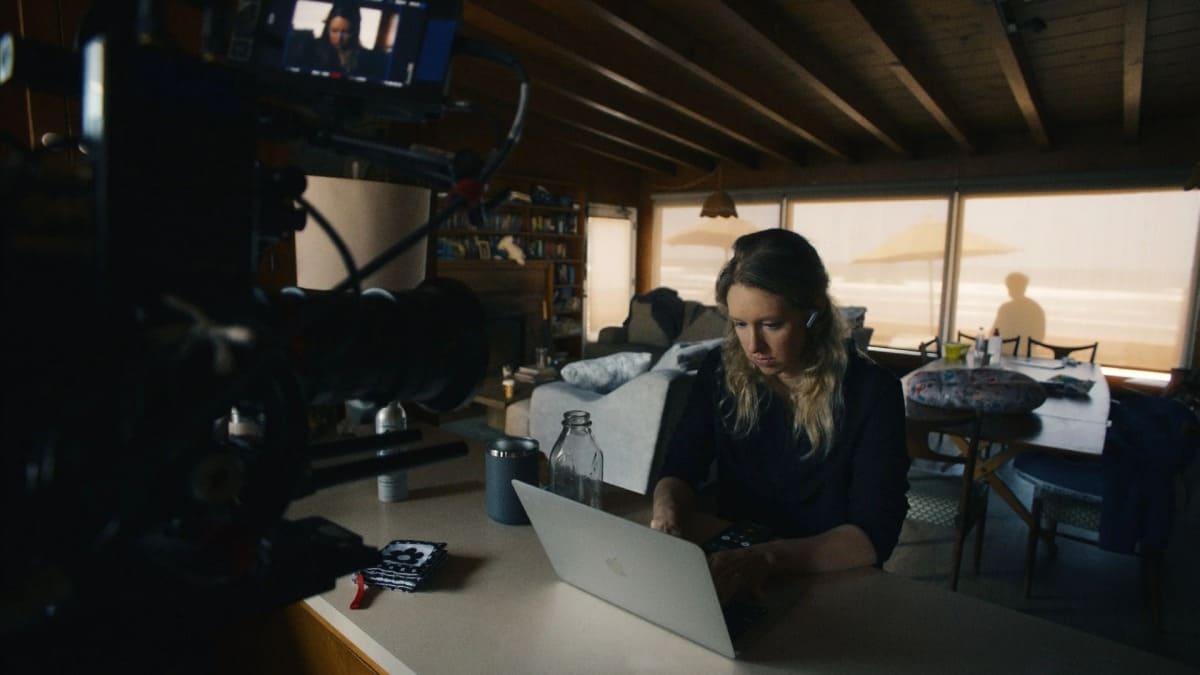
Seyfried’s ostensible function in You Can See Everything is a practical one. Fielder and Oppenheim have scenes they want to convey to the audience for which they have no footage. In lieu, Fielder reconstructs those scenes from memory as scripts, and Seyfried, having played Holmes before, becomes his scene partner for a series of reenactments. In the first such reenactment—incredibly, filmed at the same house he stayed at with Holmes and her fiancé Billy Evans before her surrender to authorities—Fielder relates something he told Holmes when they first met to discuss the possibility of a documentary. He brings up David Blaine, and a trick the magician does where he appears to poke an ice pick through his hand. Everyone takes it as an amazing illusion, but Fielder is sure there’s no trick at all. He believes Blaine actually pierced a small hole through his hand in order to perform the stunt, but sells it to audiences as a trick. Shades of The Prestige, just one of many films recalled by the construction of You Can See Everything. Are you watching closely?
In a three hour film, there’s a lot to take in, and memories get jumbled. Watching it a second time, it’s easy to misremember scenes like the David Blaine conversation as having happened with Holmes, before she goes to prison, looking forward to them only to be surprised by the movie all over again. So convincing is the reenactment and Seyfried’s performance that it fools the mind into believing it’s seen the real thing. Fielder and Oppenheim couldn’t possibly pull it off without Seyfried’s game participation in a twisted examination of a real, unknowable individual.
You Can See Everything structures its three hours around one very simple but grand question: Is Elizabeth Holmes lying? Given her history, the reporting around her, the facts of her trial, and even some of the very real-seeming behavior in the documentary itself, the next question, as Fielder spells it out, becomes: If Holmes is lying, is she the most manipulative person alive?
The line between manipulator and actor is a thin one, and You Can See Everything is ultimately a film about performance, perspective, and control. Seyfried is forced to confront difficult feelings of her own, having played what she refers to as a fictional character based on Holmes, which, even when she says it, feels like a lie she’s telling herself. The truth anyone can plainly see is that Seyfried had a read on Holmes that she felt was accurate, and she admits she’s defensive about it. She knows one scene from The Dropout, of her as a teenage Holmes dancing worshipfully in front of a Steve Jobs poster, is over-the-top and unreal. She defends another scene in which she, as Holmes, says everything is fine after Theranos’ magical blood-testing device craps the bed, explaining that the real Holmes may not have said that, but she behaved like it. Does that make it true?
Seyfried’s defensiveness evinces something else, though. She does feel bad about herself, she says almost offhandedly, and you can see it on her face throughout. It’s the reason she tells Fielder, after first watching his documentary footage, that her mind wandered toward the possibility of playing Holmes again in some kind of sequel to The Dropout. You Can See Everything, it turns out, is that sequel, and in scenes of Seyfried once again playing Holmes for Fielder’s reenactments, it’s clear this isn’t the same performance she gave before. Holmes is slightly older, and now a mother, and so is Seyfried. It’s more than that, though. You can see it in Seyfried’s eyes when she first watches the footage Fielder and Oppenheim captured. They light up, and they study. She’s seeing new things. Things that weren’t evident in the hours of deposition tapes and performative media interviews. “She’s not just an idea in my head,” Seyfried says.
For the first time, Seyfried is seeing Holmes at home, in her natural environment, being challenged by a nosy documentarian, controlled in strange, unsettling ways by her partner, and expressing emotions that, at least some of the time, feel sincere. Holmes’ humanity, buried in layers of performance for the camera, comes through in a new way, and Seyfried soaks it in. Seyfried’s performance of Holmes has improved and grown richer. Given the opportunity to do it all again, to return to her Emmy-winning role, the actress outdoes herself. And still, it’s not actually real. The only hope, as Fielder later expresses, is that they’re being accurate, whatever that means.
Seyfried’s involvement grows only more multi-layered as she gets pulled in past mere reenactment. Feeling like there are answers they’ve not gotten from Evans, she and Fielder head out to Texas to meet him, hiding their motivations for doing so. She’s just Amanda Seyfried, an actress who Fielder happens to have met and gotten to know a bit, and she wants to meet Holmes’ family. She’s going undercover as herself, and she admits she’s having fun doing so.
The scenes with Evans and their kids, and Holmes calling from prison are filled with an unusual tension as Seyfried attempts to keep up the ruse, acting natural while engaging Evans in conversation that might reveal just how much Holmes knows and doesn’t know about his control over her life. Over dinner, their conversation snakes between recriminations about The Dropout, comments about Evans’ sexual adequacy, and arguments about Charlie Kirk, but eventually Seyfried gets there. Evans reveals, for example, that many of Holmes’ tweets from prison are actually just him posting as her without her consultation. The shock on Seyfried’s face may be real, but she acts it, too. She’s in character, after all, a fact we’re reminded of when, while Evans is out of the room, Seyfried has a little back-and-forth with Fielder before taking a breath and finding her character again.
In the final major sequence of the movie, Fielder heads to Seyfried’s farm in upstate New York to go over the script for a reenactment of his final encounter with Holmes, during a visit with her in prison. The pair sit by a fireplace in a Phantom Thread-like scene, with a Phantom Thread-like score. There’s also plenty of The Master in there, and Vertigo, too; apt for a film about an obsessive man falling under the spell of a blonde and then recreating memories of her with a stand-in.
They go over the scene, the reenactment they produce intercut with their dialogue as they go. They keep pausing, sometimes to go over the accuracy of a word—the meaning of “is” hasn’t been this important since the ’90s—and other times to assess Holmes and their sometimes divergent interpretations of her. “I’m tired of people speaking for me,” Seyfried says, as Holmes, in the reenactment. It’s been a while since we’ve actually seen Holmes onscreen, and by now we’re almost fully lulled into accepting Seyfried’s simulacrum in her place. Seyfried’s performance in this particular reenactment is extraordinary. She feels completely of a piece with the real Holmes we’ve previously spent time watching, often in extreme close-up, revealing every micro-expression.
All of it is there on Seyfried’s face, accentuated by her drained, pale skin, and her dry, cracking lips. It’s in her open-heartedness toward Fielder, the way tears form in her unblinking eyes and her cheeks redden with emotion, her stilted speech and odd use of words—you, too, might be looking up the definition of “anneal” after the movie—and it’s in her superficial serenity, masking an air of nerves and panic. Fielder says she was shaking slightly when they hugged, and when Seyfried plays the scene, you can see that, too.
It all feels so accurate, so real. But it’s not, and it can’t be. Fielder himself is still trying to figure out whether he’s got it right, and Seyfried also challenges him. She poses a question: Did he leave anything out of his reconstruction that would hurt Holmes? Has he grown too protective? It’s a perceptive question, and one that ties the entire film together. It’s too perceptive of a question, maybe. Enough to make you wonder whether the conversation about the script is itself real, or a reenactment, or “produced” in reality-TV style, with lines and conversations pre-planned. But if it’s not real, does it matter? It feels real, and it feels right, which is a testament to Fielder and Oppenheim’s craft, and to Seyfried’s talent. Holmes may or may not be lying about everything, and she may be performing the whole time, but there’s truth in performance, and Seyfried finds it.


 Keep scrolling for more great stories.