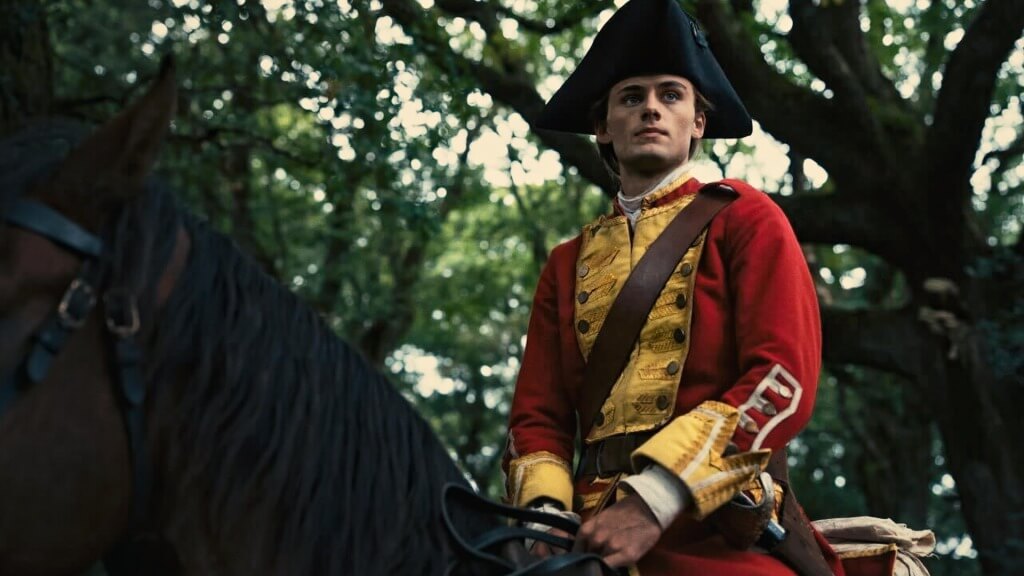
The film introduces Young Washington (which, like Young Sheldon, is how one should refer to the character) when the off-brand Dunkirk twink (William Franklyn-Miller) wakes up in the shellshocked midst of a bombing. It’s the French And Indian War, Young Washington is blighted by dysentery, and his forces are being wiped out. It’s hero time. Or, it will be. The movie then pauses for an hour-and-a-half of flashbacks, showing how a defiant, striving Young Washington had to fail before he could triumph, before returning to the front. During this extended hero’s journey, Young Washington assures its audience that the Founding Father was always an exceptional and deserving bootstrapper—he’s the fastest scout, the tallest soldier, the squarest jaw-clencher, the readingest and writingest social climber—but the thrust of its mythmaking is done during battle.
That means the explosive finale, which blows past other period warfare films and becomes a cannonball Platoon. Never self-aware about its own aggrandizing (this is no America: The Motion Picture), Young Washington declares its subject not a war hero, but an action hero. Stumbling out of his sick bed, freshly awake after passing out from fever and, one must assume, shitting blood like an Oregon Trail casualty, Young Washington single-handedly reverses the course of the French And Indian War. He defies a fellow soldier, who informs him that they’re in retreat, and charges back into the fray. “What could be worth the risk?” his compatriot asks him. Stone-faced, Young Washington replies like any Hollywood hero: “My men.”
Those militiamen, his Virginians—a plucky group of anachronistic good ol’ boy rednecks, armed mainly with hillbilly wisdom—are being routed, and General Braddock (Animal Farm‘s Andy Serkis, continuing to collect Angel paychecks) is getting his ass kicked. But that’s only because ol’ George hasn’t been there. In the real Battle Of The Monongahela, the British got whipped and Washington mostly helped them retreat with dignity. Here, Young Washington turns the tide, taking over from Braddock (his starstruck dying line, as Young Washington rides off: “Who’da thought?”) and tearing through the enemy ranks on his lonesome.
He’s cutting down dozens with a cutlass, he’s trick-riding off the side of his horse, he’s Legolas with a musket. He’s adjusting fighting styles on the fly, abandoning typical British stand-and-shoot fare for more modern tactics. Sometimes the film remembers that he’s also supposed to be doing all this while super sick, which only makes the climactic battle seem like the Founding Father equivalent of the Michael Jordan flu game. The Virginians, the British, the pair of enslaved men who get roped into the fight? Useless. Washington strides in front of the opposing line alone, their shot finding no purchase in his blessed body. Later, this miracle is made textual, when Chief Red Hawk (Montana Cypress) calls Young Washington over. His conclusion? Since his men never usually miss, the future President must be selected by the divine as some kind of holy champion. While filmmaker Jon Erwin (American Underdog, Jesus Revolution) is relatively restrained in how much Christianity makes its way into the movie, the floodgates open at this moment.
To be fair, this battle did in fact lead to legends surrounding Washington’s bulletproof nature. To be less fair, those legends were mostly retold by wackos like the Joseph Smith Foundation, which depicts his Neo-like superpower in a series of AI-generated images. But empty myth and legend are all that films like Young Washington cares about, and it’s fitting for an anniversary celebration where empty myth and legend have dominated the proceedings. Despite not being about the United States, the Revolutionary War, or Washington’s leadership, Young Washington knows that what makes it truly American is its unearned sense of entitlement. The final moment of the film—if you’re not counting Grammer passing the plate—is on-screen text, explaining that the colonies would eventually declare themselves The United States Of America. These lines fade to black, the final visible words being “The United States Of America,” a concept that the film itself only ever addresses by proxy, embodied by the impenetrable colonial Rambo that is Young Washington.


 Keep scrolling for more great stories.