InCult Of Criterion, The A.V. Club highlights a new release from The Criterion Collection each month, examining the films entering an increasingly accessible film canon.
“How does a guy who is known for the best fart jokes in cinema go on to make The Elephant Man?” Mel Brooks wasn’t talking about David Lynch, but rather about himself. Yes, the most straightforward film David Lynch ever made (even beating out The Straight Story), owes its existence in part to the centenarian comedy legend, who was a far better producer than those in The Producers. The Elephant Man was a big step for both filmmakers, being the second feature (and first studio picture) for Lynch and the second production for Brooks’ company Brooksfilms. Bonding over a fondness for outsiders and for Lynch’s debut Eraserhead—to hear Lynch tell it, Brooks burst from the screening room, embraced him, and said “You’re a madman, I love you, you’re in”—the established parodist and burgeoning surrealist created a drama that blended their most accessible and humane sensibilities.
Yet even for a mainstream tragedy, it was still coated in smoke and suffused with strange sensations. Yes, The Elephant Man had practical backing from Brooks, who secured financing in part by promising that he’d return to TV for an NBC special, and a pedigree that lured an exceptional cast including John Hurt, Anthony Hopkins, and Brooks’ wife, Anne Bancroft. (Hopkins was badgered into the role, with his agent fielding daily phone calls from Brooks.) But the feelings evoked by its aesthetic are pure Lynch: Chaotic terror, melodramatic affection, and abstract unease growing from a nightmare-carnival score from John Morris and cinematographer Freddie Francis pushing the black-and-white bleakness even further than in Lynch’s first film. Amid these sights and sounds, some standard for a Victorian drama, others heightened into a tortured Dumbo daydream, emerge emotional themes that would persist throughout Lynch’s work. Friendship, beauty for beauty’s sake, greed, cruelty, and hard-to-define fears that exist in the shadowy corners of our collective unconscious—these, for good and ill, unite all of us in Lynch’s mind.
That means everyone, even those on the very outskirts of society. Channeling the stark fringe atmosphere later pursued by Guillermo del Toro in his remake of Nightmare Alley, The Elephant Man takes place in an industrializing London, a grotesque and dangerous hybrid environment pockmarked by the ugly machinery driving progress. Smokestacks belch, boilers rattle. There lives John Merrick (Hurt), a man whose intense physical deformities have consigned him to the freakshow. There too lives Frederick Treves (Hopkins), a surgeon keenly interested in Merrick, who takes him in as a patient.
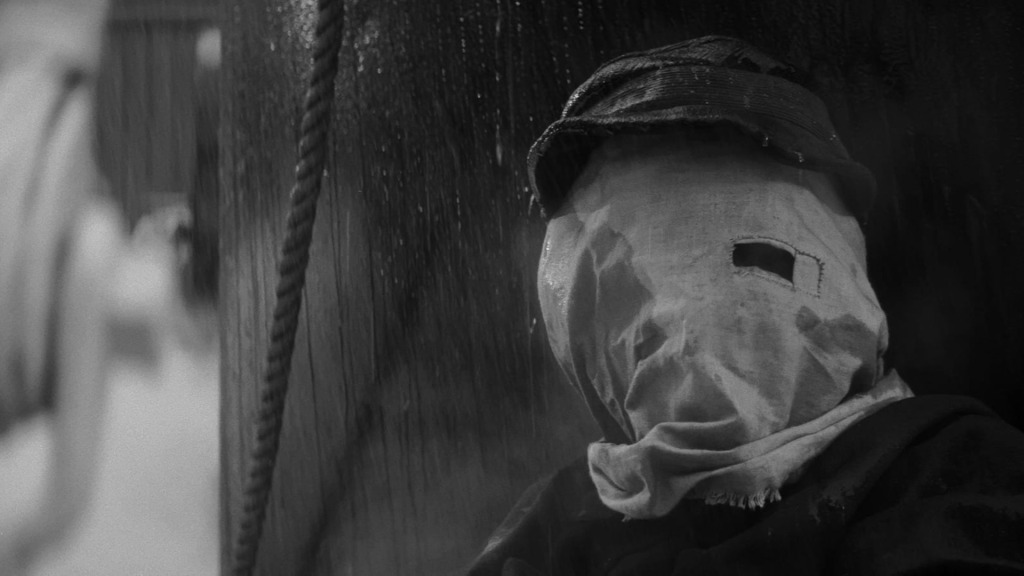
Treves’ interest is meant to mirror our own. His is a piercing stare both sympathetic and ambitious, one that begins shedding a single tear and only becoming more self-aware over the course of the film. Initially, though, The Elephant Man encourages the curiosity of a circus act, delaying a direct look at Merrick for half an hour. Shrouded by masks, cloaks, and a medical curtain that mirrors the showman’s sheet hiding him from a gawking audience, Merrick’s body is approached by a conflicted film, one both whetting our interest towards and protective of its subject.
When Merrick is revealed, the reactions from those who see him are almost uniformly panicked (though some respond with a commingling of the grotesque and erotic that wouldn’t be out of place in Emerald Fennell’s Wuthering Heights). Artist Christopher Tucker earns the screams; his work on the film is the main reason the Oscars now have an award for Makeup and Hairstyling. Though films like Planet Of The Apes earned special commendations from the Academy, An American Werewolf In London won the first award in the competitive category a year after The Elephant Man hit theaters. Tucker took on the role, turning Hurt into Merrick using casts of the real man’s body (so real, in fact, that the plaster still had Merrick’s hair embedded in it), after Lynch failed to create a version of the makeup himself. This is another moment where Brooks stepped in; a worried Lynch thought he’d be sacked right before filming began, but Brooks assured him that his time would be better spent focusing on directing.
With Hurt adeptly transformed, Lynch was free to focus on the acting, blocking, and the soundscape. The film, handsomely framed in classical set-ups with the same kind of respect for the past as Young Frankenstein, sinks into the haunting quiet of the era, with the rush of gas lights and the tocking of a clock tower the main accompaniment to Merrick’s saliva-flecked wheezing. Unearthly hums and whooshes, that would persist throughout Lynch’s films, create an ominous and encompassing white noise (black noise?) that do nothing to prepare the audience for the loud punctuations of Lynch’s more abstract moments. These, mostly in the bookends of The Elephant Man, distort the screaming of Merrick’s mother to resemble the trumpeting of an elephant. Her head tosses and turns in pain as the city churns out mechanized industry and human cruelty in equal measure. These quintessentially Lynchian sequences are more memorable than Hurt reciting Merrick’s favorite psalm, or receiving a kiss from Bancroft’s sympathetic stage actress, or even the wincing conscience of a little boy played by Rocketman filmmaker Dexter Fletcher.
And they almost didn’t make it into the movie at all. Paramount pressured the filmmakers to trim these dreamy freakouts, until Brooks put his foot down. “We are involved in a business proposition,” Brooks said. “We screened the film for you to bring you up to date as to the status of that business project. Do not misconstrue that as our soliciting the input of raging primitives.”
This hilarious protectiveness likely comes from a few factors: Brooks has a history of shutting down studio notes, and likely felt that The Elephant Man was a proving grounds for Brooksfilm, as his company had only previously made Bancroft’s directorial debut Fatso. But underneath, Brooks’ kinship both with Lynch and Merrick seemed personal. The producer saw Merrick’s story as analogous to discrimination faced by Jews (“My films, even if they’re comic, they’re about: ‘Let’s accept the bizarre. Let’s learn more about these creatures, or these Jews.'”), and from his Midwestern stiffness to his unapologetic eccentricity, Lynch never quite fit in with conventional Hollywood (Brooks referred to him as “Jimmy Stewart from Mars”). These were men who could relate to someone who was treated as mere entertainment, trotted out by benevolent and exploitative forces, their uniqueness bringing in the cash for an establishment they couldn’t ever really join.
This shared outsider status lends The Elephant Man‘s ending another touching layer. When Merrick chooses death by deciding to sleep on his back, with a single pillow, as someone without his unique physicality might, it is born from a desire to be closer to normalcy. Yet, even this suicidal gesture is met with something out of the ordinary, the moment of the movie most representative of its filmmaker: An abstract view of Merrick’s soul, rushing into space, meeting a translucent vision of his mother in the stars, who quotes Tennyson’s “Nothing Will Die” as the Elephant Man does just that.


 Keep scrolling for more great stories.