Somehow, I’ve become my family’s designated AI factchecker, the go-to voice in the groupchat who points out the weird glitches, unreal behavior, and details that don’t make sense in these generated videos. It’s given me a front row seat to see how AI slop manipulates unknowing viewers’ emotions, warps their sense of reality, and misinforms them about what’s happening in the real world. I thought this had prepared me for whatever nasty business Dreams Of Violets, Ash Koosha’s AI-generated vision of Iranian oppression, could lob at its audience at the Tribeca Film Festival. But even after so many hours of debunking and disproving some truly despicable videos, a feature-length version of this dystopian hell proved even more insufferable.
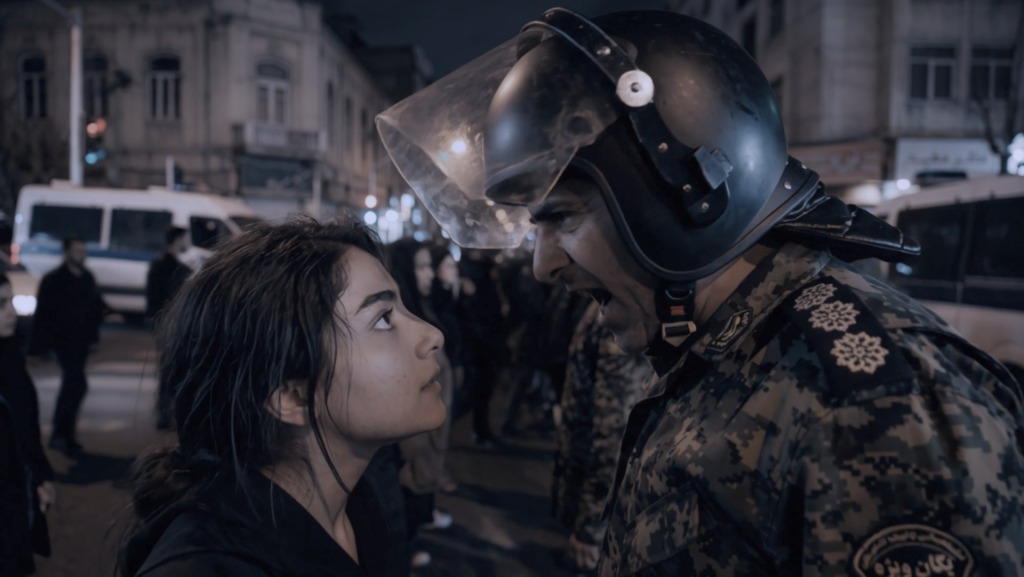
Dreams Of Violets is a take on the protests and mass killings in Iran during January of this year, when the country’s security forces turned on citizens, leading to the deaths of thousands. It opens with a garish shot of a molotov cocktail falling through the sky, followed by fighter jets screeching over an old man holding a bouquet of violets—a preamble to the carnage to come. Then begins the parade of point-blank shootings and screaming victims disappeared into vans. The horrors persist until, finally, something of a main character emerges: a young boy in a wheelchair, trapped in his family’s apartment and worrying about his older brother. Little by little, a small group of refugees form underneath his balcony. A doctor, a piano student, a grad student, an older woman, and a soldier who grows a conscience in the midst of conflict. But they are no match for a weirdly muscular supersoldier who looks like he escaped from a bad video game, and soon they too join the body count, spurring the young boy to vengeance.
This is all handled with the sensitivity of a John Woo film, right down to a shot of a flying dove juxtaposed with a shot of violets hosed down with blood. Dreams Of Violets is essentially an AI-generated snuff film, a supercut of people who don’t exist being subjected to executions that didn’t happen—though they’re, presumably, based on footage and still images of ones that did. If it takes 75 solid minutes of poorly rendered murders to make you feel something, you may already be dead.
It’s sobering to realize multiple people thought Dreams Of Violets was ready for public viewing. There’s no care for the actual art of filmmaking in any frame of this bloody sideshow. Common generative AI mistakes abound: Walls move when they shouldn’t, as do smaller items like seeds on baked bread. Hands cause the software to panic. Characters inexplicably move or sit down from one shot to the next; some scenes repeat more than once, like one where an old woman drops a piece of bread. At first, I resented the insult to the viewer’s intelligence. But the longer Dreams Of Violets continued, I started to think its so-called director had outright contempt for his audience.
Koosha—a tech entrepreneur who’s already tried to use AI to replace songwriters, and is now giving it a shot as an actor-turned-director—does not know what he’s doing. Generative AI tools have allowed him to create something deeply disturbing with very little consideration of what effect it may have on an audience. If he so badly wanted to tell the story of what’s happening in Iran, there are a number of options available that don’t require feeding footage of human rights abuses into a copyright infringement machine in order to spit out an approximation of a massacre.
This project blurs and remixes real suffering and persecution into something more shallow than a greeting card, flattening people’s faces and names into a voiceless mass of NPCs to be mowed down by burly soldiers. Consider the sacrifices Jafar Panahi made for movies like It Was Just An Accident, or how carefully Kaouther Ben Hania approached the story of The Voice Of Hind Rajab to recreate the struggle to save a young girl trapped in a car in Gaza. If speed was the focus, why not use the on-the-ground footage to create a documentary like No Other Land, rather than feed the work of others into the slop machine? Self-promotional prompters like Koosha disrespect the work of real artists, filmmakers, and storytellers—not to mention, in this case, the victims—to sell a gimmick and themselves.
While Tribeca has always had a fondness for new tech, platforming Dreams Of Violets as their first AI-generated feature is a terrible mistake, both because of its quality and because it belittles the work of actual independent filmmakers. At the festival screening, those onstage extolled Koosha for spending two or three sleepless months working on this reprehensible stunt. There was breathless excitement both outside the theater and onstage at the Q&A about how this film only cost $2000 to make. It still looks like the filmmakers overpaid to disrespect both the dead and the living, stealing their stories and enshittifying true events. The tech bro obsession to move quickly and break things has its limits, and it’s very painfully clear that Gardens Of Violets crashes headlong into them. It reeks of the hacks who cry about music being hard to make or that writing a script is too difficult. The creative process should remain difficult, not for budget concerns, but so we can avoid slapdash nightmares like these. Art is work, and to paraphrase The Princess Bride, anyone who says differently is trying to sell you something.


 Keep scrolling for more great stories.