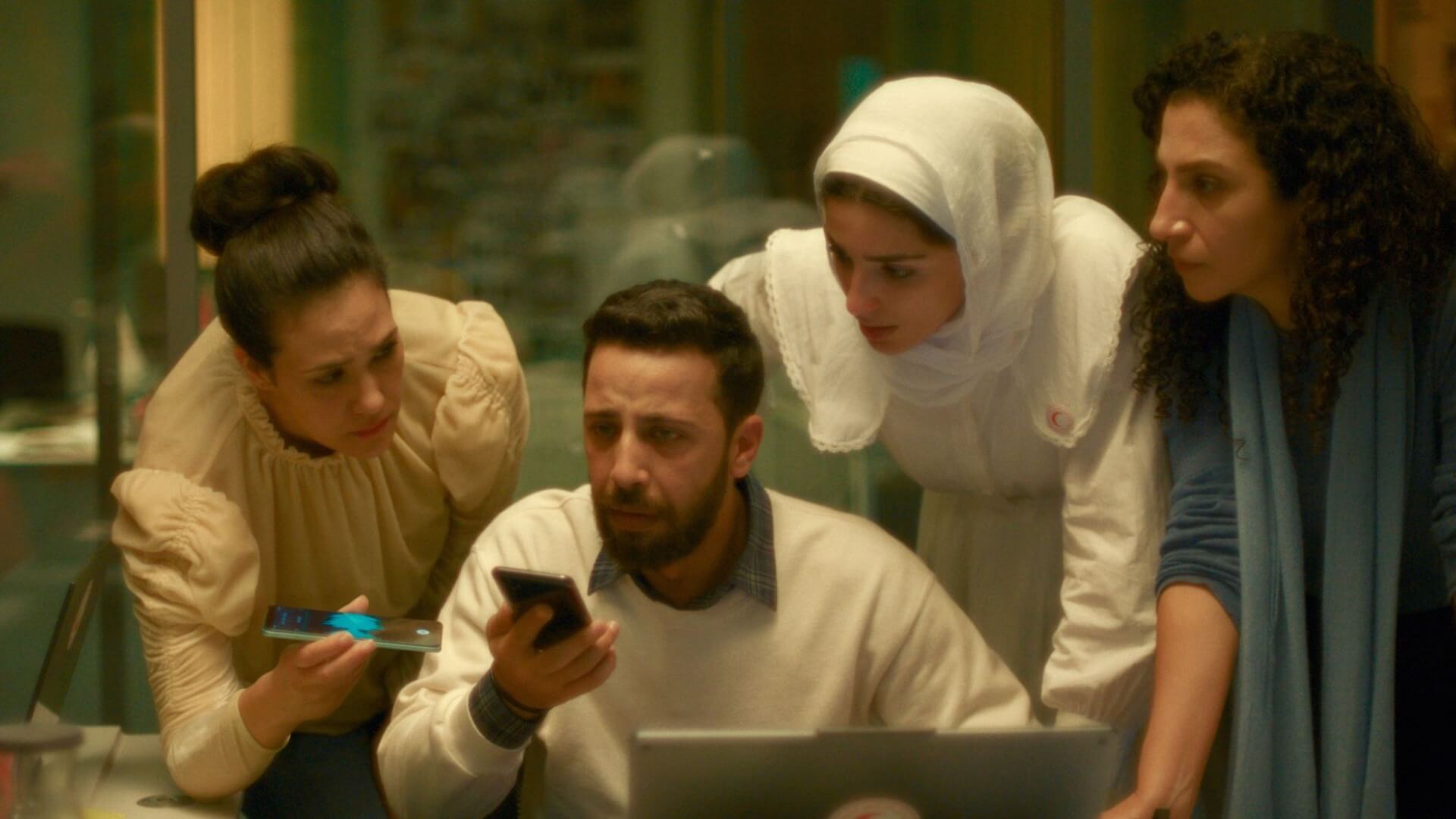
Actual recordings of Hind’s conversation with PRCS operators Rana (Saja Kilani) and Omar (Motaz Malhees) form the bulk of the narrative. The actors recite these real individuals’ responses, while they commune with a ghost. As the film’s title explains, the voice of Hind is thoroughly present in the film; her visage arrives on-screen as Rana and Omar receive photos from the girl’s relatives. The details of Hind’s case have been extensively covered in the news, but as Ben Hania proves, reiteration can be a powerful tool. The five-year-old was in a car with her uncle, aunt, and three cousins as they fled from Gaza City. Their car was intercepted by an Israeli tank, which opened fire and killed everyone but Hind and her 15-year-old cousin Laya, who originally connected with the Red Crescent. After the car was sprayed with bullets once again, Laya was killed while on the phone. Yet a small, sweet voice lingered on the line, and dispatchers immediately began the convoluted process of getting Israeli military approval to send one of their ambulances to the besieged area to retrieve the girl.
As Hind’s case gained international notoriety, the suspense of the film’s central rescue mission should feel somewhat deflated. We all know that the child was martyred by one of the nearly 400 bullets fired at the vehicle, and that her final moments were spent trapped in a car containing the corpses of her family members. As sordid as this hard truth is, Ben Hania’s focus on the humanitarian workers prevents the film from veering into full-blown nihilism. While she is certainly faithful to the audio recordings that were preserved from the emergency call, she also writes dialogue between the colleagues that prods at institutional and cultural frustrations outside of the all-encompassing devastation of armed conflict. It would take only eight minutes for an ambulance at a nearby hospital to drive and collect Hind, but the convoluted bureaucratic process that would grant rescuers a “green light” from the Israelis takes hours without avail. At one point, Omar vitriolically spits at Madhi (Amer Hlehel), his protocol-obsessed superior, “It’s because of people like you that we’re occupied!” In Mahdi’s view, however, coordinating with the Israeli army is a necessary evil that ensures the safety of his rescuers. Without securing their approval, the IDF can kill with impunity. Yet, as the occupation rages on, it’s become clear that there’s very little the Israeli military can’t get away with, and the climax of The Voice Of Hind Rajab only further exemplifies their tyranny.
If there’s one critique to level against Ben Hania’s film, it’s the lack of forging a legible path forward. As we saw last year with the acclaimed documentary No Other Land, not even an Oscar win could secure that film American distribution, resulting in the filmmakers opting to independently release the film online. Even more nefariously, the attention of the international film community didn’t deter Israeli settlers from targeting filmmakers Basel Adra, Hamdan Ballal and Awdah Hathaleen, with the latter being fatally shot, a sickening mirror of No Other Land‘s climax. Industry members have spent years donning watermelon-inspired “artists for ceasefire” pins; Israel has since committed to a “ceasefire,” but the carnage continues. Fashionable acts of protests clearly aren’t cutting it. What next?
The gut-wrenching answer is that nobody has the answer. The Voice Of Hind Rajab won’t single-handedly shame Israel into exiting Palestine—not even the ICJ has succeeded on this front—but the immediacy of her approach is commendable. Some may find the swift decision to enter production on a film about a child’s brutal assassination to be in poor taste, but with the glut of devastating content emerging from Gaza each day, it makes sense to commemorate a crucial Palestinian figure while memories are fresh. The issue, however, is that our feeds contain endless recordings of children suffering persecution; we all paid close attention to Hind at the time, but the fatigue of unwavering access to genocidal viscera is broadly settling in. “Check out social media,” Omar scoffs as the team decides to post online about Hind in a last-ditch effort to influence safe passage for their ambulance. “Children’s bodies ripped apart on the side of the road. Do you really think the voice of a terrified little girl will spark their empathy?”
Director: Kaouther Ben Hania
Writer: Kaouther Ben Hania
Starring: Saja Kilani, Motaz Malhees, Amer Hlehel, Clara Khoury
Release Date: December 17, 2025


 Keep scrolling for more great stories.