Sébastien Vaniček’s Evil Dead Burn takes a number of ambitious swings to stand out from what has become a full-fledged horror franchise, but not all of these decisions fit seamlessly into the series’ framework. It’s a misfit standalone entry that has moments of humor and striking camera moves but ventures into too-serious territory in such a way that it loses the Evil Dead spirit of guilt-free chaos.
At least Evil Dead Burn wastes no time jumping right into the horror deep end. The movie opens on a lake where two unsuspecting friends become the latest grisly victims of the undead—one of which makes its way from the lakeshore to the road in search of its intended mark. Will Price (George Pullar), a hot-tempered restaurant owner, races down the dark and winding road after a jarring fight with his wife Alice (Souheila Yacoub) and hits the Deadite dead-on, learning the hard way that they’re coming for his family. The Price family—whose name is a possible nod to the master of the macabre Vincent Price—are a tortured lot, whose missing grandfather once obsessed over ancient evils instead of his family, eventually leaving them behind. Now, after Will’s funeral, the evil has come home. Possessions spread through the clan like the flu, leaving Alice to confront her demons, both past and present.
Vaniček’s feature debut Infested was such a skin-crawling delight, it’s easy to see what made him a good candidate for Evil Dead. The thriller, about a spider infestation that takes over an apartment complex, cooked with many of the same creepy ingredients that make an Evil Dead movie—like a small group of loved ones who watch their friends and neighbors cruelly picked off by scary forces beyond their control, and free-floating camera moves that seemed grown from Sam Raimi’s innovative style. Yet, Evil Dead Burn steps far enough away from the series’ core to defy audience expectations. Standard beats, like an incantation from the Book Of The Dead and a chainsaw, are briefly shown for fan service, but the story moves on without them. Instead, Evil Dead Burn digs deeper into the archives to reincorporate the dagger from Raimi’s original trilogy into the arsenal against the undead, making it a MacGuffin that the Deadites pursue.
Unlike Lee Cronin’s deliciously madcap Evil Dead Rise, Evil Dead Burn approaches a decidedly somber topic alongside its supernatural chaos with mixed results. Like David Gordon Green’s Halloween focusing on trauma when a serial killer comes back for a victim, Evil Dead Burn wrestles with domestic violence through Will’s abuse of Alice. The movie explores just how enabling the rest of the family was over Will’s behavior, how the violence in Will is present in his younger brother Joseph (Hunter Doohan), and how their lack of support for Alice continues to make life difficult for her even after Will’s death. In fact, Joseph is in competition with the jerk from Obsession for worst horror movie boyfriend of the year after he decides to save himself at the expense of his girlfriend.
While tragedy is at the heart of many Evil Dead stories, Alice endures enough abuse-filled flashbacks that it interrupts the rollercoaster feel of unleashing the undead. It isn’t a surprise that Vaniček and his Infested co-writer Florent Bernard would want to pursue a deeper conversation with their latest work—their previous horror brought up issues of policing poor Black and brown communities in France—but it feels grafted on to Evil Dead Burn. There’s enough harm done to the women at this family gathering that it’s already uncomfortable to watch them continually knocked around.
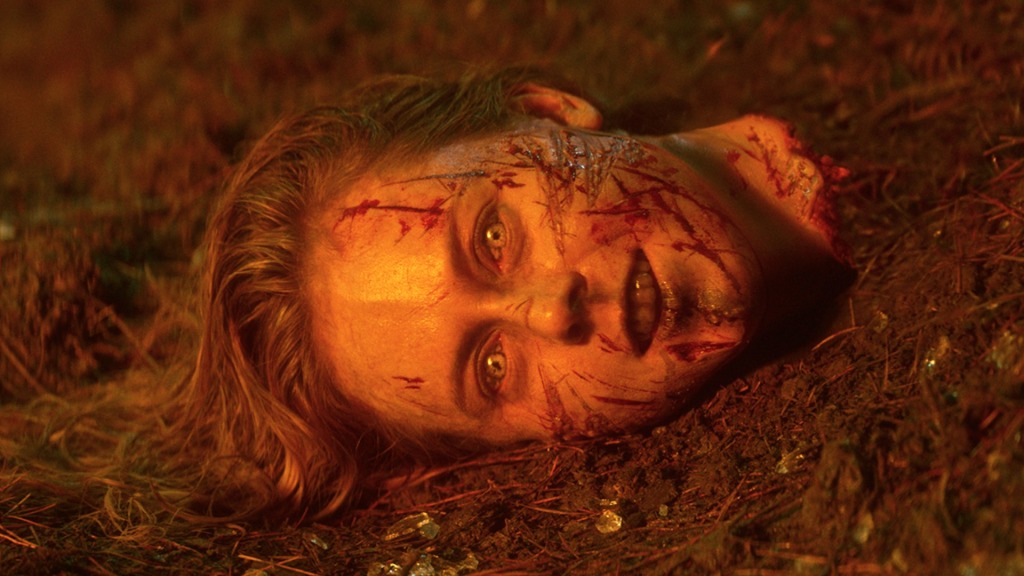
The chilling effect also extends to the film’s aesthetic, as Vaniček and cinematographer Philip Lozano opt for a muted graytone scheme as cold and clammy as a Deadite’s skin. But what Vaniček loses through his aversion to color and his commitment to making his entire cast appear sallow, he makes up through stylish camera tricks, like a Fred Astaire-style “dancing on the ceiling” move when a Deadite captures Alice, crawls along a wall while defying gravity, and suspends her from above. Much of the film is shot in close-up, so that each painful injury or panicked reaction is right in the viewer’s face. The camera also does a number of free-wheeling moves that might make it the most dynamic of the new Evil Dead movies: There’s the famous spirit run above the trees when evil is summoned, a hyper-focus on Alice as chaos reigns around her, a God’s eye view of a multi-room fight scene, and a rollover shot recreating a move Vaniček made in Infested. These techniques are a better stylistic fit than some of the CGI, which can look oddly unrealistic against the rest of the movie.
As the new Evil Dead franchise continues (Evil Dead Wrath is already in the works), the challenge and the opportunity for directors is how to make each new installation their own. Vaniček took several risks to take the story in his own direction, like forgoing the buckets of blood soaking the climaxes of both Evil Dead and Evil Dead Rise to lean into the Burn side of his film’s title, setting the stage for fiery graves, skin-melting injuries, and a charred final boss amid an ash-colored landscape. But part of the appeal of the Evil Dead series is a wanton chaos and cruelty, where outrageous feats of possession and pain could happen to any character. While Vaniček certainly nails the gruesome side of the assignment, his attempt to give the movie a deeper meaning is ill-suited for the Deadites, overshadowing the cartoon horror with that of real life.
Director: Sébastien Vaniček
Writer: Sébastien Vaniček, Florent Bernard
Starring: Souheila Yacoub, Hunter Doohan, Luciane Buchanan, Erroll Shand, Tandi Wright, Maude Davey, George Pullar
Release Date: July 10, 2026


 Keep scrolling for more great stories.