House Of The Dragon is different. The characters aren’t pulled from traditional fantasy archetypes like the plucky princess or the power-hungry queen, nor is the plot designed around the battle of good vs. evil. Instead, it takes the more observational approach of historical royal dramas like Netflix’s The Crown or PBS’s Victoria. Presenting viewers with a rooting interest isn’t the point: When Victoria depicts how Queen Victoria handled the Irish potato blight or The Crown details how Queen Elizabeth reacted to her sister’s relationship with a divorced man, the goal is simply to explore how the social and psychological realities of individual leaders shaped history on both a personal and nation-wide level. House Of The Dragon gambles that audiences will be willing to invest in that level of detail about the fictional history of its fantasy world—a gamble just as big as the assumption that audiences would want to watch a high fantasy series with so much cynical death and bloodshed in it.
While the fantasy genre is driven by character and morality, history is conceptualized through themes. That’s why House Of The Dragon can sometimes zoom through major events while also drilling deep on season-long dream therapy sessions. Both can be powerful ways to explore the arc of history and the personalities that impact it. Nowhere is that clearer than in the divisive first half of season one, which speedran nearly 20 years in just six episodes. It’s a choice that threw a lot of viewers because, in the fantasy genre, you expect to follow the main characters on every step of their emotional journeys—living in their headspace as they grow and change. In a historical series, however, the point of view is more omniscient. While House Of The Dragon is incredibly invested in its characters’ psychologies, it isn’t interested in their “journeys” in such a literal way.
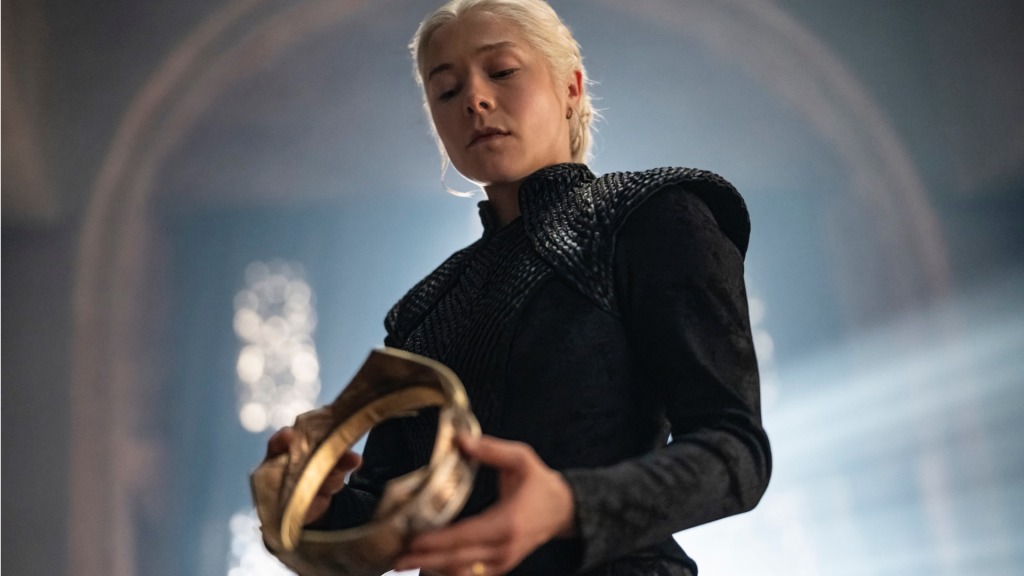
Instead, the character work is done through juxtaposition and parallel. Those early episodes spend a lot of time on the boundary-breaking affair between young Rhaenyra (Milly Alcock) and her protector Ser Criston Cole (Fabien Frankel), only to jump ahead to adult Rhaenyra (Emma D’Arcy) giving birth to her third child with her lover Ser Harwin Strong (Ryan Corr). That’s because the actual emotional connection between Rhaenyra and Harwin doesn’t really matter. The important takeaway is how Rhaenyra learned to balance the royal demands of political marriage with her own private sense of sexuality and desire. Everything beyond that can be extrapolated. It’s like digging into King Henry VIII’s affair with Anne Boleyn and then noting that he married four more times after that. Once you’ve wrapped your head around the first transgression, the others are easier to understand.
History often moves in cycles, which is another thing House Of The Dragon continually emphasizes. Those first six episodes feature Daemon Targaryen (Matt Smith) and Corlys Velaryon (Steve Toussaint) dealing with various pirate-related dramas in a region known as The Stepstones, a through-line that never quite springs into a fully formed storyline the way it would in a fantasy epic. Instead, the show is interested in The Stepstones as an idea more than a place—a thorn in the side of Westeros that lingers across multiple Targaryen rulers, all the way up to the season-three premiere. It’s the fictional equivalent of exploring the United States’ involvement in Latin America not through the lens of one particular coup d’état, but the broader policy of intervention and invasion that impacted decades of global history.
Much as Thrones is inspired by the Wars Of The Roses, House Of The Dragon is inspired by an earlier civil war known as the Anarchy, in which King Henry I attempted to leave the throne to his daughter Empress Matilda only for his nephew to crown himself king instead—a conflict the show engages with much more directly than Thrones did with the succession of conflicts that led to the Tudor dynasty. In fact, so many of the royal customs and rules of succession on House Of The Dragon are taken directly from the British monarchy. (Even the incest is just a heightening of marriages between royal cousins.) If you’ve got any background on stuff like the Princes In The Tower, as recounted in Shakespeare’s Richard III, it adds weight to moments like the one where Otto Hightower (Rhys Ifans) warns his daughter Alicent (Olivia Cooke) that whether Rhaenyra wants to or not, she’ll have to kill Alicent’s sons to shore up her claim. The season-three premiere even has Rhaenyra directly quote the real-life Queen Elizabeth I as she bemoans, “I may appear to have the weak and feeble body of a woman, but I possess the heart and spirit of a king.”
While Game Of Thrones had plenty of great female characters, House Of The Dragon is fundamentally built around the question of if and how women can claim power within a medieval hereditary monarchy that needs them to exist but doesn’t want to let them climb too far. That gives the show a defining central theme in a way Thrones never really had. Yet those who only see House Of The Dragon as a direct prequel miss out on what it’s intentionally doing differently—like when season one’s compelling exploration of the “battlefield” of childbirth was dismissed as a continuation of Thrones’ thoughtless brutality against women. Those prepared for a character-driven fantasy series thought the show was simply cruelly killing off supporting players we barely knew, when it was actually arguing that the underdiscussed realities of women deserve to be front and center in the historical record, just as much as the overdiscussed realities of men.
If House Of The Dragon suffers for Game Of Thrones’ sins, it’s also sometimes unfairly compared to its strengths too. Critiques of the show are often really just suggestions on how to make it feel more like Game Of Thrones by adding more comedic sidekicks and commoners or getting to the action quicker. But that assumes House Of The Dragon wants to be a sprawling high fantasy series with political elements rather than a political drama where the high fantasy is almost incidental. The conversations are the action on the show, just as the words are the action of a Shakespeare play. And it would make no more sense for this series to regularly leave the perspective of its royal players than it would for the Cate Blanchett Elizabeth films to suddenly cut to a group of guys hanging out at a pub just to mix up the vibe.
In fact, the best way to appreciate House Of The Dragon is to stop putting it in Thrones’ shadow at all. (Something the show probably should have done itself by commissioning an original theme song.) Though it may be a less overtly “fun” show than Thrones, it’s a smarter, denser one too. House Of The Dragon realizes that realism isn’t just violence, it’s also small council meetings where advisors debate how to deal with blockades and couples keep having the same fight over and over again for decades because that’s how life works and monarchs reign. Much more than Game Of Thrones, this is a show about Aragorn’s tax policy. That sort of historical lens won’t be for everyone, just as Thrones’ dark fantasy riff isn’t for everyone. But as with A Knight Of The Seven Kingdoms, House Of The Dragon’s genre shift isn’t a genre failing. It’s just charting new territory on the Westeros map.


 Keep scrolling for more great stories.