Beneath House Of The Dragon’s naval battles and aerial grudge matches is the idea of legacy—not just of crowns and castles but of promises made to children and the expectations imposed upon them. This obsession unites every player in this dance of dragons, be they garbed in green or black.
An old adage says whenever a Targaryen is born, the gods toss a coin and the world holds its breath. Westerosi history offers a less mystical explanation for the house’s many catastrophes: the worst among them could have used a hug from time to time. There are the dark magics of Old Valyria to consider when discussing Targaryen inheritance—fire and blood, and all that. But the house’s fissures and madness also stem from parental interest and ability, the duties some fulfill for their children and others deny—sometimes for the better, more often for the worse.
After last week’s Rhaenyra-focused hour, the series’ scope widens to Tumbleton. That’s the prosperous and whimsically named market town where we find Prince Daeron (live-action Zelda star Benjamin Evan Ainsworth) under the supervision of Lord Ormund Hightower, who begins his desperate siege against Team Black after sending Daemon Targaryen to King’s Landing with a counterfeit prince. His ruse will eventually bring the wrath of Westeros’ new queen down on his and Tumbleton’s heads, but first, there is a theme to explore.
More interesting than Ormund’s strategy (if you call holding a town near the capital with but one small dragon a strategy) is his strange paternal relationship with Daeron. Despite his faults, which present themselves in full this week, the prickly lord has long treated the boy well and raised him to be kind. Yet Ormund, who can read the writing on the wall (and the raven’s message reporting that Aemond is missing and can’t bring dragon support), uses his lifelong affection to mold the boy into a weapon. This episode charts his emotional pivot through the lessons he teaches his ward: When one of his men assaults Kat (wife of Ser Hugh), he explains that a lord must maintain a firm grip on their subjects and punishes the offending Hightower soldier accordingly. Later, he perverts this ruling by demonstrating precisely what “firm but fair” means in practice, and Daeron receives his education in how power justifies itself.
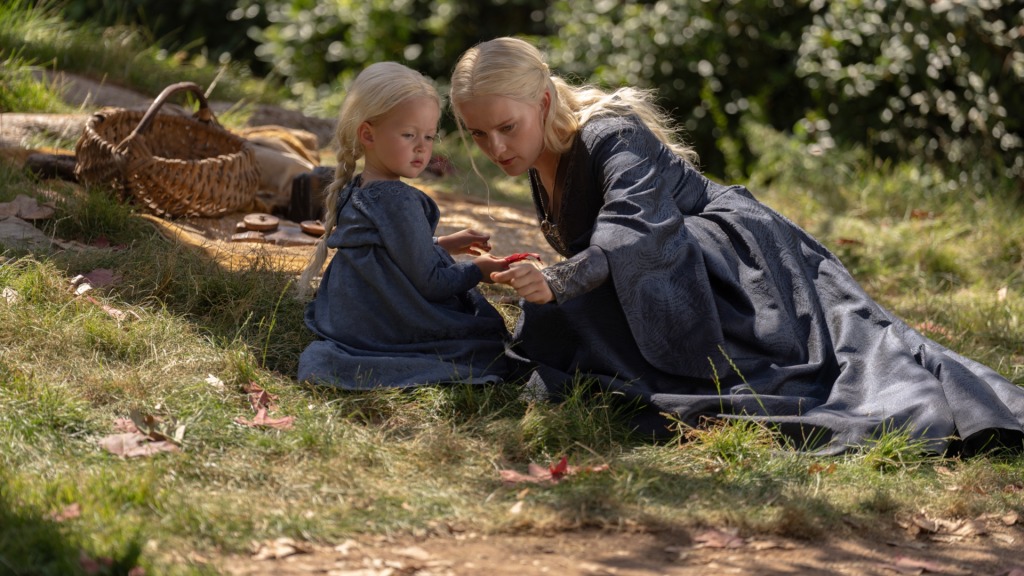
Their relationship underscores this episode’s abiding concern: What does good parenting look like in a brutal world? It might come down to distance and luck. Alicent tells Rhaenyra that sending her son to Oldtown as a baby was possibly her truest act of motherhood: “In truth, I’m glad I waged that battle [against Viserys], seeing now what came of our other sons.” Aegon and Aemond each proved incapable of ruling responsibly, governing either through impulse or cruelty. It’s notable that Rhaenyra is looking at Helaena and her daughter Jaehaera as she listens to this; the image of a young woman caring for her little girl subtly shifts the episode’s focus from sons to daughters. After all, we learn that Helaena is concealing a surprise pregnancy to protect not just her children but herself, so that she may one day raise them free from her family’s insanity. Helaena has already lost Jaehaerys, but Jaehaera and her unborn child (Maelor at last?) might yet have a chance for happiness. (They’ll need a lot of hair dye, I think.)
Then there’s Daemon and his daughter Rhaena in the Vale, who encounter each other in the desolate caverns where she’s stashed herself away with all life’s numerous disappointments and shames. Here, the dragonknight is confronted by the extent of his neglect: Rhaena is as wild as her Sheepstealer now, and as a dragonrider, she feels fate has given her the purpose her father never did. “Can you yourself say you ever gave me more than a passing thought?” she asks Daemon. She regrets Prince Jace’s death and is willing to spend her days in a dragon’s nest as penance. Daemon just has to promise his silence. He does as he’s bidden, killing a sheepherder and bringing the scorched head to his queen. Therein lies a problem: Rhae wanted to look Jace’s killer in the eyes as she delivered justice, her last act as his mother. Daemon has now taken that from her, in more ways than she realizes.
Not all of this week’s parental gifts are meant to be torture. Corlys, still smarting from his rift with Rhaenyra, sends Alyn to serve in his place on the Small Council while he hunts down the surviving Triarchy. “There is great opportunity for you there. I can’t give you legitimacy, but I can give you the chance to better yourself.” Later, Alyn and Rhae speak of their fathers. Alyn diplomatically observes that Corlys “feels thwarted” and that “a fight is what he needs.” Rhaenyra absorbs this as she looks at her own father’s model of Old Valyria, that ominous place of prophecy and doom, and says, “fathers have a maddening capacity to at once inspire and incense… don’t you think?” Alyn does.
Corlys’ heart is normally in the right place, but it’s been scarred by years of betrayal, war, and death. This rift between him and his queen drives him to battle, as rifts so often do, yet he also gives his son a chance to grow, perhaps even beyond him. Ironically, for a show rife with terrible parents, Corlys, for all his faults and failures, remains one of its best. With some luck, Alyn’s place at Rhaenyra’s side will benefit his future, maybe even win him the legitimacy he so desires. In a place like King’s Landing, that’s about as close to love as politics allows.
Stray observations
- • Looks like Rhae got her Queensguard. Hello, Ser Adrian Redfort (Barry Sloane of the Call Of Duty: Modern Warfare games and Destruction in season two of The Sandman).
- • Her Grace also removes the small council’s balls—there’s a metaphor in there, somewhere, I’m sure—calling them a “relic of a dead regime.” I mean, they were used during her father’s reign as well as Aegon’s, and probably her grandsire before them. Not that I’m married to those things; in fact, I found them just as distracting as poor, departed Prince Jaehaerys did last season.
- • Take note: Rhae’s drinking wine during small council meetings now.
- • Is it some SAG-AFTRA rule that only one character named Daeron can appear in a TV episode? Where’s faux-Daeron? Did the queen have him killed or what? Gah!
- • Meanwhile, in creepy Harrenhal, Sers Criston and Gwayne encounter Alys Rivers, seeking Aemond One-Eye. “As I’m sure do many,” she says. What’s she done with him, I wonder?
- • Criston, who never says die, orders his men to stop the advancing “river scum” from reaching the capital, despite being grossly outnumbered. His ruse? Guerrilla tactics: man to man, free of dragons. “Let us attack it, like the scorpion does the ox.” Or the ant to a boot.
- • Gwayne’s suggestion that Helaena and her mother are in chains is wrong, but it reflects the uglier relationship between Rhaenyra and Alicent in Fire & Blood, where Rhae keeps her stepmom in golden chains.
- • Well, a Hand brings all those cats to the Red Keep, at any rate. Otto was the one to do it in F&B; here, Alyn suggests a heightened feline presence to thwart Aegon’s rats.
- • Aegon and Larys, hoofing it to Rook’s Rest, encounter Sunfyre, seemingly dead. It’s a tender moment (“I’m here,” he says, petting his dragon). Soon, Aegon is insisting that Sunfyre still lives, but this has to be grief talking—right? After all, Dragonriders have a peculiar connection with their mounts. Maybe Sunfyre is taking a really deep nap.
- • Speaking of dead dragons, there’s the corpse of Princess Rhaenys’ dragon Meleys draped over the walls of Rook’s Rest, showing what a rotting dragon corpse actually looks like.
- • The graffiti adorning King’s Landing reads “Queen of Bastards” with three upside-down triangles, blue, red, and green. Is this a marker representing the three forks of the Trident, perhaps symbolizing the fall of Rhaegar Targaryen under the warhammer of Robert Baratheon decades later? A bit of playful foreshadowing from the smallfolk?
- • At the rate Rhaenyra keeps denying him stuff, Ser Ulf has less than he had before he became a dragonrider. No more pub time? What’s an Ulf to do?
- • “You should know, I’m the clever one around here.”
- • It’s funny how Rhae complains about having a light council, but when it’s full, something comes up that compels her to clear the room. There’s never a good time to rule when one grieves.
- •Isn’t Ormund’s sword, Vigilance, made of Valyrian steel? That fact either perverts his words against the Targaryens or suggests the lord’s appreciation for good steel. Either way, what a complicated fellow.


 Keep scrolling for more great stories.