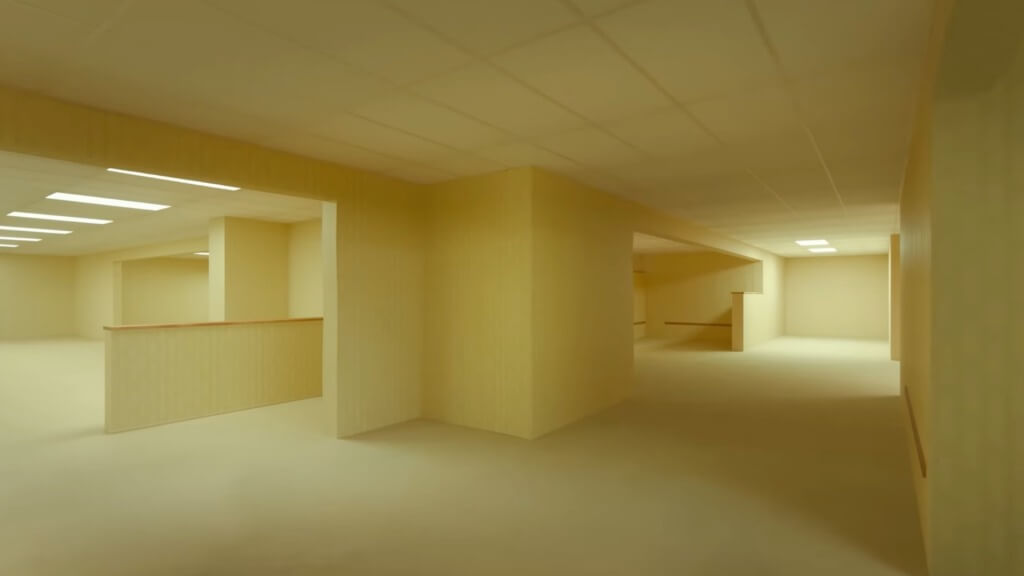
YouTuber and visual effects artist Kane Parsons didn’t create the Backrooms, but he did turn it into a viral sensation. On January 7, 2022, Parsons debuted “Found Footage,” the first short film in a series set in the Backrooms, a surreal and seemingly endless network of corridors and hallways. Parsons’ video was based on an image posted on a 4Chan thread in 2019; the photo was a response to one user’s request for “disquieting images that just seem off.” In the last four years “Found Footage” racked up 77 million views, becoming the model for the porous, mutation-prone “liminal horror” subgenre of media that ranges in length and ambition from YouTube and TikTok shorts to feature-length movies, like Parsons’ own feature adaptation of Backrooms.
As its name suggests, liminal horror usually takes place in purgatorial, in-between spaces that evoke a dream-like atmosphere. The Backrooms’ labyrinthine design, harsh fluorescent lighting, and tacky/drab yellow wallpaper have helped to make its half-dizzying and half-narcotizing effect synonymous with the subgenre. But liminal horror media also tends to crossover with other surging horror fields, especially “analog horror,” given the approaches’ mutual fascination with now-antiquated, consumer-grade digital cameras, which conjure up warped memories of the past. A hazy, pixelated aesthetic only enhances viewers’ dread as we vicariously navigate abandoned, cavernous spaces whose cheery décor belies a hollowed-out nostalgia.
The Backrooms’ influence has expanded so far that some creators and fans have claimed other iconic works of liminal art as part of its lore, including Jared Pike’s three-dimensional “Dream Pool” illustrations. Pike’s tantalizing drawings of shimmering, impossibly deep indoor pools are the basis for “The Poolrooms,” an unofficial extension of the Backrooms. And while the “Dream Pools” series began a year before Parsons’ first Backrooms project, Pike also found inspiration in a Reddit thread on liminal spaces like the Backrooms—specifically Roccolo’s Swimming Pool, a real indoor pool designed in 2015 by the Italian architecture firm Act Romegialli.
Still, Pike eventually treated Parsons’ work as the model once there was so much demand for new Poolrooms art, including a couple of computer/video games, that he felt compelled to animate his own illustrations. Pike soon realized that what he valued about his “Dream Pools” work wasn’t necessarily what his new audience wanted more of. “I initially didn’t see the appeal of it,” Pike tells The A.V. Club, specifically talking about one of the games based on his artwork. “I thought it was cool for maybe a few minutes, but there isn’t much substance there.”
Moreover, Pike refuses to demystify key “points of intrigue” in his artwork. “If you saw what’s lurking behind certain corners or in the shadows, then you wouldn’t find them to be very scary. I like having control over what people can and can’t see because that’s a big part of what makes it alluring and mysterious.”
The eerie suggestion that something might be “off” has not only prompted scads of new liminal horror art, but also a conversation between this art and the artists’ hazy memories and experiences—not to mention those of the people seeing the art. For years, Pike’s fans have told him that they’ve dreamed of imaginary places like the Dream Pools. The artist didn’t have similar nightmares before he drew the Pools, though he’s had a few dreams about them since. Instead, Pike wanted to chase feelings of nostalgia, which he thinks might be universal. From his own childhood, he remembers swimming alone while traveling on family vacations, particularly in hotel pools and camping grounds.
But why do liminal horror fans want to revisit the recent past? Pike thinks it’s a matter of timing. “I don’t think it’s a coincidence that the whole liminal space trend really took off during the pandemic,” Pike adds. “Many crowded places went empty overnight, so a lot of essential workers have now experienced these spaces first-hand. There’s also a desire for escapism, in that sense. Because liminal spaces, and the Backrooms particularly, are endless and infinite by nature. There’s so much to fill in and your brain kind of goes wild with possibilities.”
As an expansive umbrella genre, liminal horror either includes or at least partly covers a number of related terms, including both “dreamcore” and “weirdcore” aesthetics, which use lo-fi technology and nightmarish imagery to put viewers into a suggestible state. Dreamcore filmmaker Tata Dovnar enjoys the flexibility of working “at the intersection of various subgenres” for her TikTok and Instagram shorts, which mostly take place in her characters’ bedrooms. Dovnar decorates and lights these rooms with what she describes to The A.V. Club as the “‘bedroom cozy’ aesthetic viewers are used to seeing in lifestyle content.”
In her shorts, Dovnar reimagines the bedroom as a perverse, liminal horror space where anything that’s potentially comforting winds up feeling destabilizing and unfamiliar. “I rely on my imagination to distort familiar, mundane environments,” Dovnar says. “I love taking a simple bedroom or a hallway and, through lighting and [camera] angles, making it feel like it shouldn’t exist in the real world.”
Dovnar’s protagonists (often played by her) typically find themselves on the blurry threshold between sleep and wakefulness. They’re also usually haunted by evil mirror versions of themselves or their loved ones, who look identical except for their sharpened teeth and blackened, hollow eyes. Dovnar handdraws her monstrous doppelgangers’ features onto individual image stills, then adds a layer of film-like grain for texture and “to add a sense of nostalgia, turning the digital image into a lived-in memory.”
Dovnar also tries to “evoke a sense of lost time” using the suggestive hallmarks of outdated technology, like cryptic, stream-of-conscious style voiceover narration recorded with Speak & Spell-evoking programs or vinyl-record-style hisses and pops on the soundtrack. She likes to keep “the viewer in a state of hyper-awareness, waiting for a ‘jump scare’ that might never come, because the atmosphere itself is already suffocating enough.”
Dovnar writes her scripts at night, to maintain a suggestive atmosphere and “to capture that specific state of mental exhaustion where logic begins to fail.” Her shorts also either recreate or suggest her own experiences with sleep paralysis, which explains why so many of Dovnar’s protagonists are powerless to resist their nightmarish tormentors. “By merging my real-life experiences with these imagined landscapes, I create a narrative flow that feels fluid and unpredictable, much like the logic of a nightmare,” Dovnar suggests. She adds that, while her work essentially draws on viewers’ nostalgia, not all of her fans were alive during the time periods that her work brings to mind. So when it comes to the pop culture of the 1980s and 1990s, younger viewers “aren’t remembering it—they are reinventing it.”
Rather than being a conscious rejection of modern trends, particularly the stifling omnipresence of AI-generated art, Dovnar sees liminal art’s retro aesthetics as expressing “a growing subconscious desire for something ‘human’ and ‘imperfect.'”
“By using grainy film textures, distorted analog sounds, and handdrawn effects, I offer something tactile and flawed,” Dovnar says. “I believe that in an era of rapid automation, people find a unique comfort in art that feels clearly and intentionally made by human hands. It’s not about rejecting the new, but about preserving the raw, tactile soul of the past.”
A number of recent horror features have also used feelings of nostalgia to evoke a liminal horror mood, especially given their creators’ use of lower-resolution cameras. Set in the early 2010s, the disorienting 2022 found-footage gem The Outwaters is presented as the last known proof of life for a wayward group of desert explorers. Writer-director Robbie Banfitch uses the audiovisual limitations of his protagonists’ cheap digital cameras to both reflect natural beauty, drawing inspiration from Terrence Malick’s transcendental dramas, and also subvert its surface charms.
By stressing both the thrilling possibilities and limits of what outdated technology can and can’t show, Banfitch’s movie fits right in with other liminal horror projects, since it preys on viewers’ fears that, at a moment’s notice, they could fall through the cracks of the world as we know it. (By sheer coincidence, The Outwaters debuted at the 2022 Unnamed Footage Festival in San Francisco, where it was paired with Parsons’ first Backrooms short at its premiere screening). And while Banfitch is still reluctant to explain what everything in The Outwaters means, he insists that everything in the movie is very “intentional.”
“I always knew that ‘the outwaters’ is an unknowable kind of place and was therefore aware of what might come through or be captured by a consumer camera,” Banfitch tells The A.V. Club. “So there’s a number of moments where you have to wonder if this force that they’re encountering has possessed or merged with the camera.”
Banfitch not only plays one of The Outwaters‘ lead roles, but also feels a kinship with his lost protagonists, since he also felt compelled to film everything when he was a teenager in the late ’90s and early 2000s. The Outwaters is, in that sense, a dialogue with Banfitch’s past: “I was reacquainting myself with my annoying former self; I used to film everything I saw.”
Like the character he plays in The Outwaters, Banfitch’s attention used to drift from his human subjects to impressionistic details, like how their hair moves in the wind. He compares his younger self’s intuitive approach to the scenes in American Beauty where Wes Bentley’s teenage shutterbug finds poetry in mini-DV camera footage of a plastic bag flitting around in the wind. “It was exciting just to have a camcorder and to be able to experiment,” he says.
Banfitch also thinks that he’s nostalgic because “movies—and furniture, and cars, and art, in general—used to be more beautiful.” He points to how much longer a movie’s average shot used to be compared with how brief it is now. Making experimental horror movies like The Outwaters reminds Banfitch of the uncertainty and thrills of navigating an unfamiliar space. “It’s like being a deep sea diver or exploring outer space,” he says. He also loves recent horror features that take liminal horror aesthetics in new directions, like writer-director Kyle Edward Ball’s avant-creepy 2022 gem Skinamarink, because “anything can happen.” “That’s why so many kids want to go to the moon when they’re little,” Banfitch says. “Being a pioneer. That’s the thrill of being human—exploration.”
That adventurous spirit has already led some of liminal horror’s pioneering filmmakers to produce some of the most thrilling, revitalizing genre features of recent years, like Skinamarink and I Saw The TV Glow, Jane Schoenbrun’s heartbreaking trans-media drama. And the subgenre has only started to cross over into the mainstream. It’s only a matter of time before standout liminal horror filmmakers like Dovnar expose their unsettling lucid nightmares to an even wider audience, transforming what could be pat retro-nostalgia into viscerally disturbing and thrillingly personal expressions of our shared need to escape the overwhelming present, and retreat into warped memories of the past.


 Keep scrolling for more great stories.