D+

John Cena comedy Little Brother is an Edible Arrangement of low-hanging fruit

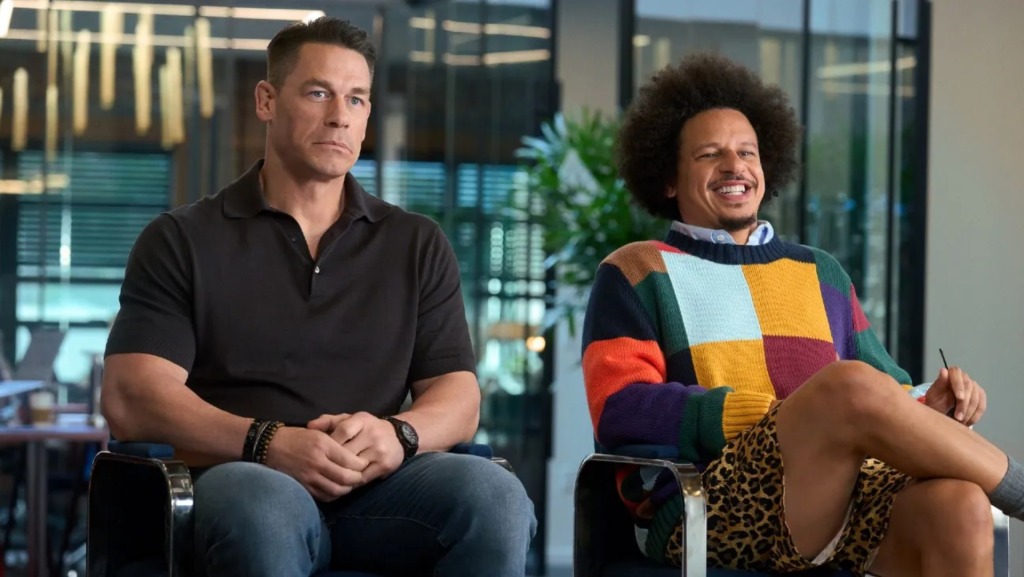
Eric André comes to mess up Cena's day in this rote, manic mismatch comedy, in which they don't even play brothers.

John Cena comedy Little Brother is an Edible Arrangement of low-hanging fruit

John Cena, like fellow erstwhile wrestler Dwayne Johnson, is an actor-as-workaholic. While balancing the enormous demands of a 25-year wrestling career with his ambitious pivot to onscreen performing, he’s clocked in for the Fast & Furious franchise and successfully anchored two seasons of Peacemaker. Readily grasping the fact that audiences enjoy seeing their musclebound screen heroes poke fun at themselves, Cena has leaned into comedy, both in cameos (Sisters, Trainwreck, Barbie) and leading roles (Vacation Friends, Ricky Stanicky). Cena checks a lot of the conventional boxes, in other words, of a 21st-century aspiring movie star. He has built his career thoughtfully, and with purpose—he even learned Mandarin. Unfortunately, there’s a wide-eyed, ineradicably earnest emotionality to his default screen persona, and it’s this misdirected, try-hard performance instinct that helps sink Little Brother, a boisterous yet rote comedy that does itself no favors by treading such familiar narrative ground. 

In telling the story of a serious, career-minded man whose orderly life is upended by an eccentric interloper, director Matt Spicer’s Little Brother recalls What About Bob?, though the broadness of its tone leans more in the direction of the seething familial exasperation of Daddy’s Home and its sequel (both of which also feature Cena). Successful real estate agent Rudd Landy (Cena) shares two teenage sons with supportive wife Deirdre (Michelle Monaghan), but is uptight about joining the cast of the hit reality show, NYC Hustlers, that he feels will help take his business to the next level, allowing him to escape the shadow of his hedge fund billionaire brother Josh (Christopher Meloni).

This anxiety is supersized when Marcus Pinchel (Eric André), whom Rudd connected with via a mentorship program while in high school, comes back into his life. Rudd hasn’t seen or thought about Marcus in decades, but owing to the fact that Rudd’s assistant Mia (Sherry Cola) has kept up a lengthy email correspondence in his name, Marcus believes the pair’s bond to be something it is not. When Marcus, fresh out of a psychiatric hospital, is heartily embraced by others in Rudd’s life, it threatens Rudd’s sanity.

Spicer touched something real in his parasocial dark comedy Ingrid Goes West, which also centered on a mentally imbalanced person tracking down someone with whom they feel they have a bond. It’s easy to see a thematic link to Little Brother. Unfortunately, Andrew Mogel and Jarrad Paul’s screenplay feels like a gathered basket consisting of only the lowest-hanging fruit, leaving Spicer grasping for connections that usually aren’t on the page and can’t be conveyed by his star.

While including a number of flashbacks, the script doesn’t know how to handle the canyon between Marcus and Rudd’s respective views of their relationship back in 1998, and how that might more realistically inform their present-day behaviors. The movie’s clammy desperation is perhaps best embodied by a riff on anilingus, which Marcus enthusiastically recommends to Deirdre as a “hard drive reboot” for Rudd, to help unstick their marriage. Unable to let this foreshadowing linger even a minute, the movie leaps, in its very next scene, into a public presentation (glimpsed, naturally, by other characters) of the same—one of several moments that don’t believably connect with its characters. Some of the movie’s production details also exhibit a number of unforced errors, for which any number of easy write-arounds are sadly ignored. For example, the mental health facility Marcus leaves and later returns to is located in North Carolina, which at one point means an unconvincing 22-hour roundtrip drive.

Little Brother does feature a couple of decent jokes (while the film isn’t especially referential, Justin Timberlake and Michael Douglas each catch third-act strays), and makes a nice moment out of Hoobastank’s 2004 power ballad “The Reason.” But it’s the type of streaming film that too often underscores its quips, having characters comment on them, and seems largely built around expected moments of slapstick physicality (pratfalls, a deployed fire extinguisher) and shock humor.

André, as viewers of the hidden-camera comedy Bad Trip will attest, doesn’t shy away from using his body for comedy, and Little Brother affords him similar opportunities to mine nudity and physical humiliation for laughs. He delivers on that front, while also generating a bit of bemused pathos by way of his shrugging acceptance of his doomed life. Additionally, Ben Ahlers (The Gilded Age) makes a solid impression as a real estate bro nervous about Rudd (and then Marcus) encroaching on his NYC Hustlers stardom. Cena’s set of skills, though, are most successful when deployed in an ensemble format, as with Blockers. In Little Brother, every emotion is surface-level, and his performance starts off so high in wound-up frustration that there’s quickly nowhere left to go. It’s as if he’s in the wrestling ring again, playing to the back row. The result is an ill-defined set of scene premises that don’t cohere into something more than the sum of its parts and in fact, as it wears on, becomes less than those moments.

If Cena wants to stretch himself and become a more compelling and convincing leading man, he will have to find directors to push him and material that asks, or even demands, he focus on conveying an interior life. Little Brother isn’t that movie. That it doesn’t really aim to be is no great sin. But that it by and large fails even on its own more limited terms makes it disappointing.

Director: Matt Spicer
Writer: Jarrad Paul, Andrew Mogel
Starring: John Cena, Eric André, Michelle Monaghan, Christopher Meloni
Release Date: June 26, 2026 (Netflix)

 
Join the discussion...
Keep scrolling for more great stories.