
Joe Wright made Pride & Prejudice feel fresh all over again
Keira Knightley and Matthew Macfadyen shine as one of the most iconic couples in rom-com history
Image: Photo: Libby McGuire
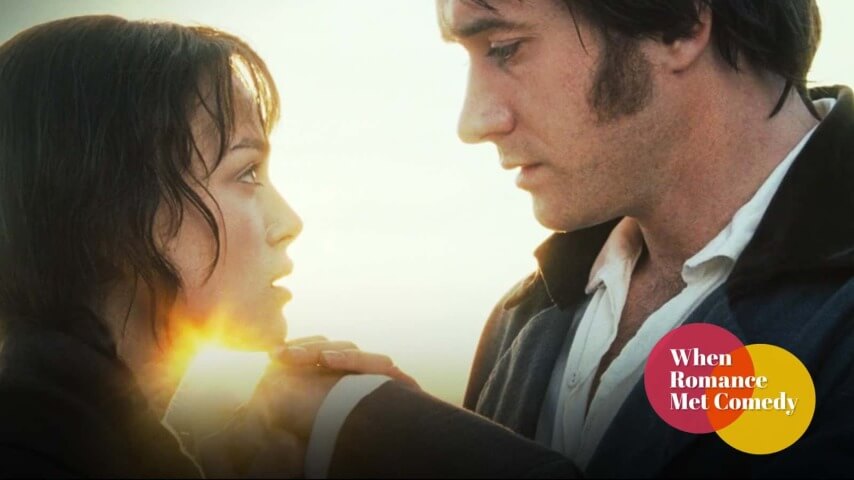
It is a truth universally acknowledged that the best moment in 2005’s Pride & Prejudice is a close-up of a hand. After a tense social call, proud Mr. Darcy (Matthew Macfadyen) surprises pert Elizabeth Bennet (Keira Knightley) by wordlessly helping her into her carriage. Before she’s even had time to register what’s happening, he’s already striding away, his hand leaping out of its skin at the experience of having briefly touched hers.
Joe Wright’s sterling adaptation of Jane Austen’s classic romance lives in the contrast between wide shots and close-ups—the former emphasizing the film’s stately setting, while the latter highlights the private emotions hidden behind Regency-era formality. And in just four much-GIFed seconds, Wright demonstrates how a dash of visual intimacy can bring Austen’s centuries-old source material to vivid, sexy life.
The hand flex was something Macfadyen spontaneously did while performing the scene, and when Wright spotted it, he insisted on getting a close-up. The 33-year-old first-time feature director often worked that way—encouraging his actors to live in their space as naturally as possible and then capturing the authentic moments that arose between them. The film was shot entirely on location, much of it at the 17th-century Groombridge Place manor that stood in for the Bennet family home. After a three-week rehearsal process, the cast broke in the set by playing sardines in the house. And since the Bennets were each assigned their own bedroom, the actors would often just hang out in their characters’ respective rooms between takes rather than heading back to their trailers.
The result is a period romance that feels as chaotically alive as it does artfully choreographed. When people talk about the stunning visuals of Wright’s film, they’re usually referring to his gorgeous compositions: Lizzy standing on a windswept cliff, Darcy striding across a misty moor, the young lovers touching foreheads as the sun rises behind them. But Wright is also incredibly smart about interpreting Austen’s savvy prose in visual terms. Pride & Prejudice (the ampersand was added for the film) is a story about dualities: the gulf between our first impressions and our true natures; the differences between our public behavior and our private thoughts. And Wright’s camera playfully reflects those themes, from quick zooms that zero in on a character’s internal panic to smash cuts that juxtapose behind-the-scenes chaos with polite public presentation.
Though Wright’s adaptation emerged in the shadow of the six-part BBC/A&E miniseries that gave the world Colin Firth fever in 1995, it was actually only the second big screen adaptation of Austen’s signature story. (The first was a 1940 studio picture that reimagined the material as a sort of Victorian-era comedic romp starring Greer Garson and Laurence Olivier.) That’s kind of remarkable given that there’s perhaps no single piece of literature more influential on the modern-day romantic comedy genre than Austen’s 1813 novel, which took the oil-and-water dynamic of Shakespeare’s Much Ado About Nothing and grounded it in a social realism anchored in a female point of view. Not only has Austen’s Pride And Prejudice inspired modern day retellings like Bridget Jones’s Diary, Bride And Prejudice, and The Lizzie Bennet Diaries, you can also see its influence on rom-coms ranging from The Philadelphia Story to When Harry Met Sally to The Ugly Truth.
When it comes to period adaptations, the 1995 version is the choice for Austen purists, many of whom scoffed at the way Wright’s two-hour movie simplified the source material and traded Austen’s wry social satire for a brooding Romanticism in the vein of Wuthering Heights. Though the screenplay by Deborah Moggach returns to the novel’s focus on Lizzy, Wright makes the Bennets poorer and kinder than they are in Austen’s original tale, pulling more from the “muddy hem” sentimentality of Little Women than from Austen’s icy critique of dysfunctional parenting. (Greta Gerwig’s 2019 Little Women adaptation, in turn, feels like it owes a lot to Wright’s chaotically lived-in aesthetic.)
But what Wright’s version lacks in fidelity, it makes up for in originality. Wright doesn’t rewrite Austen so much as take her pre-existing pieces and reconfigure them in slightly different ways, bringing new layers to Pride & Prejudice’s familiar enemies-to-lovers arc.
The most inspired choice Wright makes is to lean into the idea that Darcy isn’t arrogant so much as socially awkward. It’s why Macfadyen’s casting is so genius. The energy that makes him such a stellar comic buffoon on Succession is exactly what makes him such a great romantic leading man in Pride & Prejudice. (Summing up the shock a lot of people now feel at Macfadyen’s range, Knightley recalled, “When I went in to read with Matthew, I was so blown away that I virtually couldn’t get my lines out. I just kept staring at him thinking, ‘What the hell happened between you walking in as Matthew and you starting to read?’”) What Lizzy initially perceives as Darcy’s rudeness is mostly just social anxiety or failed attempts at banter. When Darcy eventually explains, “I do not have the talent of conversing easily with people I have never met before,” it seems less like an excuse and more like a man vulnerably trying to explain a genuine difficulty in his life.
It’s a savvy interpretation of the inherent dichotomy of Mr. Darcy, an intensely principled man who’s beloved by his friends, family, and servants yet dismissed as standoffish by strangers. Here he’s clearly the kind of guy who’s only really comfortable in his own space, around people he knows. And Wright’s more sympathetic take on Darcy also makes Elizabeth pricklier by comparison. Each time they meet, Darcy tries to course correct from a previous blunder, but Lizzy is too stubborn to see these imperfect gestures as anything but further confirmation of his bad first impression. (“I could more easily forgive his vanity had he not wounded mine,” she admits to one of her sisters.) In the 1995 version, Jennifer Ehle plays Lizzy as an endearing, intelligent rom-com everywoman. In the 2005 version, Knightley plays her as a little bit more of a brat, with a touch of Emma Woodhouse hubris to overcome.
 Keep scrolling for more great stories.