B

Propolis puts the bee in board games

This mash-up of several board game genres might be too ambitious, but it's still a winner.

Propolis puts the bee in board games

You’ve played board games with meeples, but have you played one with beeples?

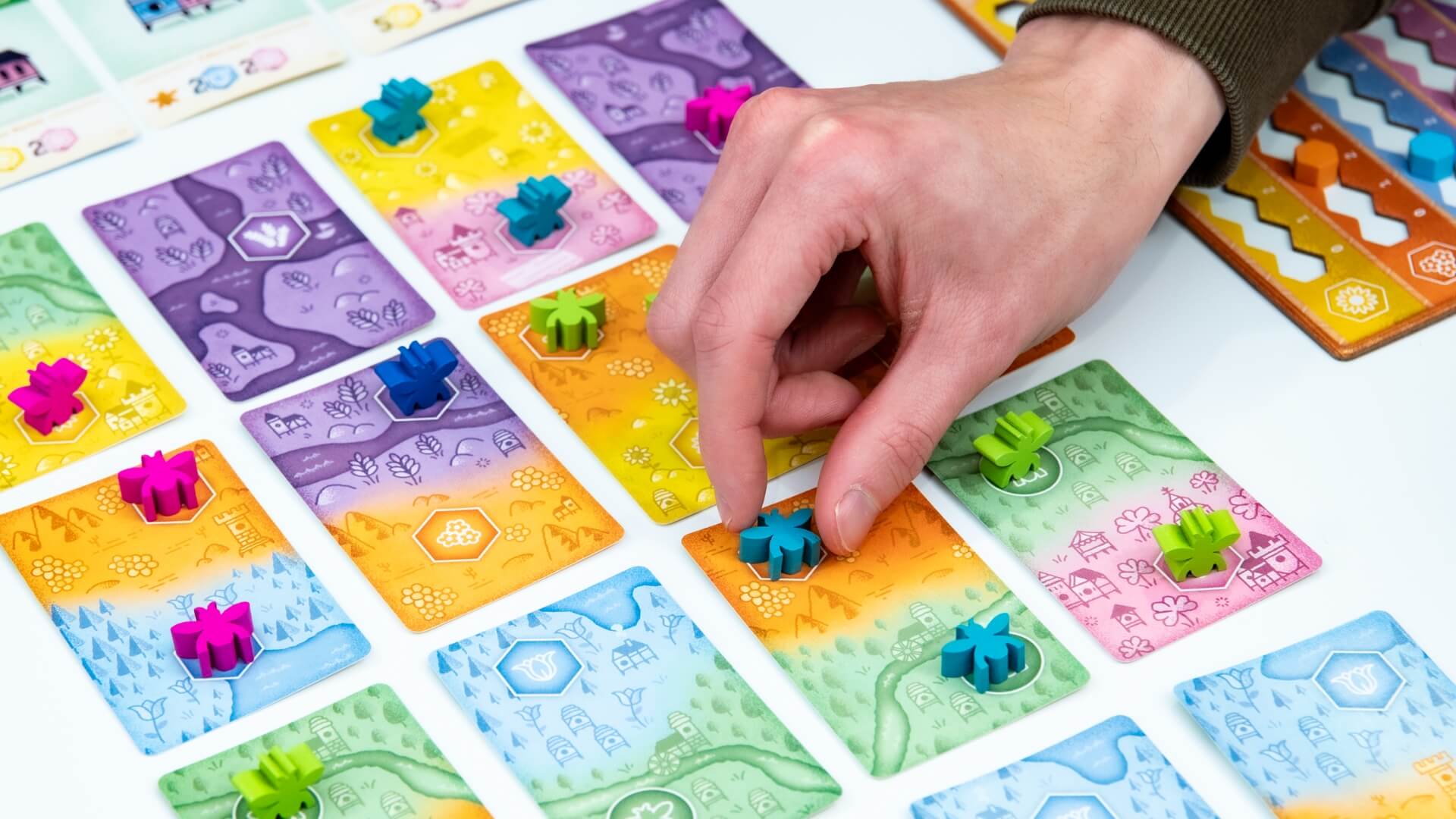
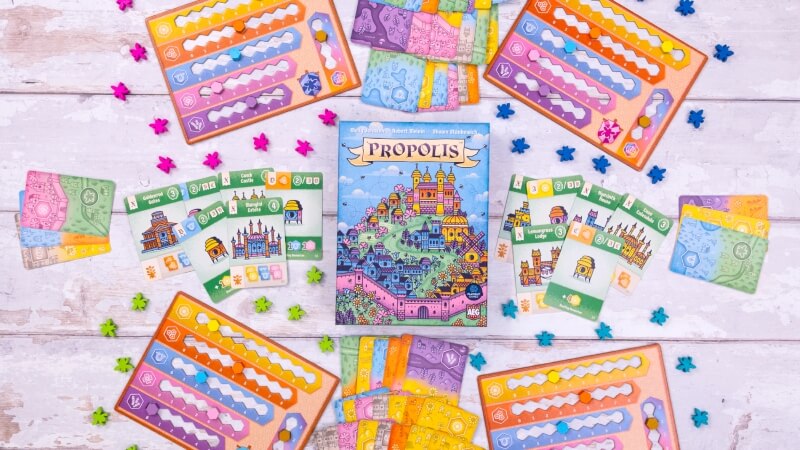
Propolis is a small-box engine- and tableau-building game from the same trio behind the game Point Salad that asks you to place your worker bees—hence, beeples—on various landscape tiles to collect five different resources to build the structures that can make up your queen’s palace. It’s an impressively lightweight version of these mechanics, but it may try to pack one mechanic too many into the game.

The heart of Propolis is the deck of double-sided cards, with one side showing structures that the players will try to build while the other, the landscape side, shows the spaces for players to place their beeples. One possible action on a turn is to place beeples on the landscape, taking the resources shown on those spaces, or using those spaces to gain additional beeples or trade one resource type for another. Another action is to “fortify” all of their own beeples on one card, lying them on their side and taking the associated resources a second time. A third option is to recall all of their own beeples, and the last option is to build a structure or a queen’s palace card. You can take just one action per turn, so the game plays very quickly.

Propolis board game review

Each row in the landscape area has four cards in it, and once all four cards in the row have at least one beeple on them, the players check to see if any player has the majority, with fortified beeples counting double. If so, that player gets to take all of their beeples back, and the rightmost card is removed and replaced. This area control aspect is the weakest part of the game; it’s a scant reward for having the majority, and it’s only worth pursuing the majority if you believe it’ll get you your beeples back immediately. Most of the time, it’ll be more efficient to grab additional resources in pursuit of one or more structures.

Structures may require payment of beeples as well as resources, but nearly all of them offer some kind of benefit. Some give permanent resources as a reward, in a specific color or as a wild resource; some allow you to take temporary resources or reclaim your own beeples from the supply; many offer game-end points, which can be fixed or variable based on other cards you’ve already purchased. The Queen’s Palace cards are much harder to obtain, as they require that you have multiple permanent resources already in your play area on structures you’ve purchased, which in turn requires that those have shown up in the structure market, and they give a few extra victory points as reward—probably not enough to justify going specifically for them as a strategy.

The game ends when any player has 10 cards in their tableau, including their starting structure (which gives a permanent resource as well as three starting resources), after which you score, adding up the points from any structure cards showing either a fixed number or a formula giving points based on resources you have or specific structure types. It’s possible to get 40+ points, but that would be a rather exceptional game, and getting into the 20s is going to be a challenge for new players.

Propolis—a real term referring to a glue that bees produce and use to seal holes in their hives—combines worker placement, resource management, tableau-building, area control, and engine-building in a single box, and in theory, that’s fantastic. I like all of those mechanics, and many of my favorite games at least mix a few of those together. Propolis could probably have done with one or two fewer mechanics to streamline the game’s scoring and strategies, though; the area majority part didn’t do it for me, and the tableau-building part is limited to the resources granted on the tops of some of the cards. The core of the game is in the placement and the resource collection, with the placement decisions driven not just by what you immediately need but by the limitations of the available resource spaces, and that ultimately makes the game a winner—and because it’s fairly quick to play (well under an hour), it’s a great introductory game for people who haven’t played this style before.

Keep scrolling for more great stories from The A.V. Club.
 
Join the discussion...
SELECT permalink, ID FROM `pm_article_index` where`article_category` like '%|games|%' and ID<>1859206647 AND article_type like '%|reviews|%' ORDER BY post_date DESC LIMIT 7;