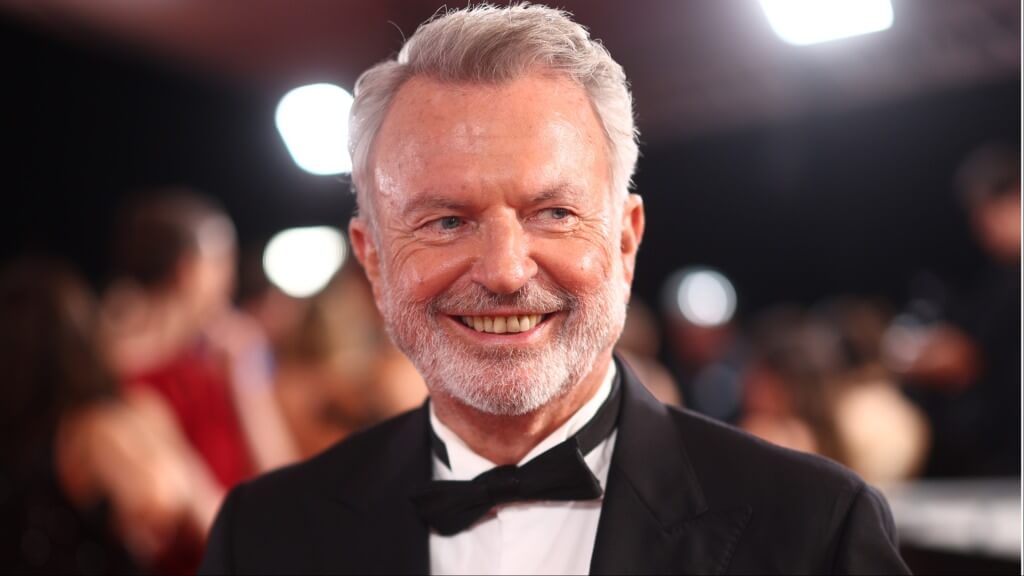
The actor: Sam Neill, who got his start as a jack-of-all-trades with the New Zealand National Film Unit, but after appearing in such films as Sleeping Dogs and My Brilliant Career, soon found his services in greater demand. Slowly but surely, Neill pulled increasingly higher-profile gigs, the culmination of which occurred in 1993, when he starred as Dr. Alan Grant in Jurassic Park. Still rarely at a loss for work, Neill can currently be found in the ensemble of Fox’s Alcatraz, which airs Mondays at 9 p.m. Eastern.
Alcatraz (2012-present)—“Emerson Hauser”
Sam Neill: It was just one of those things: I finished a job—I can’t remember what—and was passing through town, my agent said, “They’d like to see you at Bad Robot,” and the next day I was onboard.
The A.V. Club: How new was Alcatraz to you? Did you have any familiarity with the prison and its history?
SN: I’d been out there once. It was many, many years ago, but, you know, the strange, haunted sense that it has remained with me to this day. That was something like 20 years ago, though. When you do something like that, you don’t imagine that it’s going to become part of your life in the future. Certainly not a place like that!
AVC: When you got the part, did you go out on your own to do any further research, or did you just kind of decide to go with whatever reality the producers built for the show?
SN: Well, we are, of course, dealing in fiction. And a fairly heightened form of fiction, in my view. [Laughs.] We’re in the J.J. Abrams version of Alcatraz, which verges on becoming a graphic novel, but I’ve always thought that this particular show… Of course, it has that sort of sci-fi splash and fantasy elements about it, but the bedrock in which it’s grounded is that strange island in the middle of the harbor. We have a good book about Alcatraz that floats around here—you know, one of those big coffee-table books that’s filled with black-and-white photos and gritty stories about what happened there—but apart from that, I’d have to say that we’re making it up. [Laughs.]
AVC: What’s your take on Hauser?
SN: I think of Hauser as a sort of dark avenging angel. But a damaged one, at best.
AVC: He certainly comes across as a cut-the-crap kind of guy.
SN: Yeah, he’s on a mission, one that he’s been on for quite a while when the story starts, and he has a long history. He’s been to a lot of places where bad things have happened over the years. He started out as a San Francisco cop—that’s what took him to the island initially—but in both past and present, Alcatraz has woven its way through the fabric of his life.
AVC: Because of that, though, we get to see two sides of him. There’s the gruff way he acts around Madsen (Sarah Jones) and Soto (Jorge Garcia), but then there’s the softer side that emerges whenever Lucy (Parminder Nagra) enters the picture.
SN: Well, it’s become apparent as the episodes go past just how central Lucy is to the core of Hauser’s character. But, of course, what happens when you’re separated for as long as they have and in the way that they have? This is the story that has yet to be told, their separation. This thing that took them apart 50 years ago has thrown them together again, but in the meantime, it’s fair to say that Hauser has become a very different person from the one he was 50 years ago. [Laughs.] And she hasn’t changed at all, because she’s… jumped. If we’re given the chance to come back and tell more stories, that’s something we need to reexamine. And I’m looking forward to that, actually.
AVC: Has it been tough to find the middle ground between the comfortable format of a procedural and the depth of a mythology-heavy serialized drama?
SN: Well, that’s the bit of tightrope-walking we’re doing from week to week, isn’t it? Where we try to balance without falling off. I suspect that the following we have is more interested in the mythology than the procedural, but someone else would have to do a bit of research on that to be sure. But the mythology is probably the part of the show that I’ve found the most compelling.
SN: Please don’t mention that ever again. [Laughs.] Don’t even inquire about it. When I was a very young person, making documentaries, that was my first little go at it. And it was terrible.
AVC: If nothing else, it seems like you learned quite a bit from your days working with the New Zealand National Film Unit.
SN: Oh, I learned a great deal, actually, because I trained as an editor before I was doing anything else, and when you’re making your little films, you research them, you write them, you direct them, and you put them together. You even played the music. You did everything, really. I was working there and acting part-time for about seven years, so I had a sort of very different background to working in film than most actors do, I suppose.
AVC: We couldn’t find so much as a clip of it online, but it’s tough to fight off the desire to go searching further for it.
SN: Please don’t. If you continue to try and find it, I will hunt you down. [Laughs.]
SN: The first film was a very pleasurable time. It was very nice to work with Steven [Spielberg], and [Jeff] Goldblum and Laura [Dern] were fun to hang about with. We sort of knew at the time that we were on the threshold of something very different and new. You know, it was a smart, popcorn-friendly idea, but it was also where these new technologies were coming into their own. CGI, for one thing, and also these very sophisticated puppet things that Stan Winston had developed. It was a number of things that came together in a rather fortuitous way at just the right time.
AVC: Regarding Stan Winston’s creations, Laura Dern referred to her leading man—referring in this case to the T. Rex—as “very temperamental,” saying that he broke down often.
SN: [Laughs.] But what a wonderful thing he was, that T. Rex. I think it was a lesson that’s been forgotten a little bit, in that I don’t entirely think that computer-generated films, as interesting as those have been, are quite the same as those with three-dimensional actors and three-dimensional devices in them, if you like. But if you combine them, the actual things help to make the computer-generated things seem more actual. And that’s something I think is sometimes forgotten.
AVC: How was it to return to the role of Alan Grant for the third film?
SN: I really enjoyed coming back for a second time, actually, because I’d kind of worked out how to play the character, and in the, uh, seven years of downtime [Laughs.] I had a bit of a think about how I should’ve played the character, and I came back and did it better, I thought.
AVC: Would you be willing to come back if there’s ever a Jurassic Park IV?
SN: Look, I’d never say never to anything like that, of course, but every year you hear another rumor. I’d be very surprised if they ever actually make another one.
AVC: Just to get formal clarification on an unsubstantiated Wikipedia claim, is it true that you were offered the part of Elrond in The Lord Of The Rings but had to decline because of your commitments to Jurassic Park III?
SN: No, but I was offered a part in Lord Of The Rings, but it wasn’t Elrond. That, of course, was my friend Hugo Weaving, for whom I am often confused. Neither of us understands why, but probably twice a week I’ll be walking down the street and someone will say, “Loved you in The Matrix!” [Laughs.] And I always smile graciously and say, “Thank you very much!”
The Dish (2001)—“Cliff Buxton” Dean Spanley (2008)—“Dean Spanley”
SN: Oh, I’m glad you’ve seen The Dish! Good ol’ Patrick [Warburton]…
AVC: It’s a small film, but it seems like almost everyone who’s seen it remembers it fondly. It came up repeatedly when word got out that we were going to be speaking with you.
SN: Oh, really? Oh, that’s good to know. [Laughs.] Yeah, it’s a sweet, small film with sort of an unobvious humor running through it. I’m quite fond of that film.
AVC: And how was good ol’ Patrick to work with?
SN: Oh, he was hell. [Laughs.] No, no, he’s a lovely man, Patrick. You know, another film that has comic elements like that, another one that I’m quite fond of but which far fewer people have seen, is one called Dean Spanley, which was made about three years ago. It’s with Peter O’Toole, Jeremy Northam, and Bryan Brown, and it just disappeared into some Miramax dungeon or something and has never emerged, apart from in the UK and my part of the world [Australia and New Zealand].
AVC: What was the premise of the film?
SN: Well, it comes from a very unlikely novel by a man called Lord Dunsany, and the Peter O’Toole character is slightly based on Dunsany himself. If I tell you the premise, you will think it’s not particularly something that is credible, but it’s a film that really flies. I play an Edwardian vicar who has a proclivity toward a particular wine called Imperial Tuckay, from Hungary, and when he has quite a few glasses under his belt, he has flashbacks which are—unbeknownst to him—to his previous incarnation as a dog. But the film is about grief and reconciliation and lots of other things, including the marvelous word of wine, which I have a vested interest in, I think you’d have to say. [Laughs.]
Possession (1981)—“Mark”
SN: Oh, my God. You’re really finding the obscure ones now. [Laughs.] Yeah, that was probably the most crazed thing I’ve ever done. It’s by a fabulously crazed Polish director called Andrzej Żuławski, with Isabelle Adjani playing my wife, who was pretty out there at the time as well. [Laughs.] We were shooting in Cold War Berlin, and… It’s sort of a monster movie, but it’s more about the terrible destruction of a marriage than anything, and if you have the courage to sit through the whole thing, it has its rewards.
SN: Ah, yes! Well, it’s always flattering to be asked to be on The Simpsons, so I was very pleased to do that. Interestingly, I asked them, “What is the character like?” And they said, “Well, he’s a sort of James Mason villain, if you like.” Which is curious, because James was, in fact, a mentor of mine and a friend of mine.
AVC: Could you then picture him in the part when you read it?
SN: Oh, yes. And I think he would’ve been better at it than me. But, then, he was better than me at most things.
Reilly, Ace of Spies (1983)—“Sidney Reilly”
AVC: That was your first full-time series gig, correct?
SN: Yes, it was, and it was a cracker of a job, actually. It was about seven months or something like that, all filmed around Elstree [Studios, in Hertfordshire, England], and every episode we’d get four or five really good British actors who’d come in. It was a great little learning curve for me, that job. And it still has its admirers. I still get fan mail for that thing, you know?
SN: I don’t know why I was asked to audition, but I was, and I did, against my better judgment. My agent, who has now left this mortal coil, so I suppose I can say what I like… [Laughs.] But she was deluded about certain things, and one of her delusions was that Bond would’ve been good for me, and vice versa, so I went very reluctantly out to test for that. And to my great relief, I didn’t get the part, and I haven’t looked back. [Laughs.] You know, all those guys have been much better than I would’ve been. And Timothy Dalton got the part that time, on that occasion, and he was very good.
Sally Hemings: An American Scandal (2000)—“Thomas Jefferson”
SN: Oh, hardly anyone remembers that, do they? [Laughs.] I mean, it’s hardly ever been mentioned again. I’m not entirely sure if I ever even saw it. Of course, it was based on the occasionally contentious theory, whether you accept it or not, that Sally Hemings was Jefferson’s mistress and, indeed, bore him several children. Unfortunately, we will never really know the truth of that. What we do know, supposedly, is that Sally Hemings’ descendants have Jefferson DNA in them, but, you know, she might’ve possibly been with his brother. There are different theories, and I’m not enough of a historian to give you a definitive answer on that. [Laughs.] But it was interesting. And then we were shooting in Richmond, Virginia, which was very nice, and we had a really lovely designer who sort of recreated Monticello. So, yeah, I enjoyed it.
A Cry In The Dark (1988)—“Michael Chamberlain”
AVC: For the record, this was already in the mix to be asked about even before the recent developments.
SN: By “recent developments,” you mean that they’re opening another inquest into the baby’s death? That just astonishes me that they’re going about this again. I thought that everyone had been exonerated, and the conclusions had been signed, sealed, and delivered: A dingo did take that baby. Why it all has to be opened again, I have no idea. I’m flummoxed by that. But it was a good part to play, and, of course, I was very pleased to see Meryl [Streep] up for the Best Actress Oscar. I thought we worked well together. It was a great script, and she did a great job on that film.
AVC: What did you think when “maybe the dingo ate your baby” became a punchline on Seinfeld?
SN: Isn’t that strange? I mean, people are always saying it, and I find a lot of things amusing, but I never really find that amusing because… that was such a cry of despair, you know? Even as much as I loved Seinfeld, one can never really forget that. It was a horrible thing. I find humor fails me when it comes to that.
SN: Oh, dear. Well, you know, I gave it a bash. [Laughs.] It wasn’t, I have to say, the greatest film in the history of cinema. But I did give it a bash.
AVC: Was it challenging to play the son of the devil?
SN: I was very young and inexperienced. I would’ve done it differently now. I was hyperventilating, really, because it was my first sort of big film abroad, and… well, you know, I’m sure I could’ve done it better. But the interesting part of the role for me was that I thought, “It must be a desperately lonely business being the antichrist.” [Laughs.] So apart from the relishing of the obvious things you do when you’re playing the Antichrist, having a high old time doing evil things, the less obvious dimension, I thought, was that kind of terrible isolation. I mean, you can’t actually confide it anyone that that’s what you are, because you’ll lose friends even more quickly. “By the way, I happen to be the son of Satan…” That doesn’t fly. [Laughs.]
The Piano (1993)—“Alisdair Stewart”
SN: Wow. I’d forgotten the name of the character! Yeah, I’m very fond of Jane [Campion]. I’d do anything for Jane, really. And, you know, Harvey Keitel’s just a fabulous actor. The part was interesting to play. The guy’s not the sharpest knife in the drawer, you know. [Laughs.] Just a little bit stupid, and a little bit Victorian-cauterized in the emotional department, so it was interesting to play, yeah. And it was lovely being home in New Zealand, surrounded by my own people.
Sleeping Dogs (1977)—“Smith”
SN: Wow. You see, that was my first feature film of all, with my friend Roger Donaldson, and there I really had no idea what I was doing. [Laughs.] In fact, none of us did. Apart from Michael Seresin, who shot it, no one on that production had ever made a feature film before. In fact, there hadn’t been a feature film made in New Zealand for something like 17 years. So we were really… We lit a little candle, which didn’t illuminate much of the darkness in front of us, but we got through it. It’s a very uneven film, and I’m pretty uneven in it. [Laughs.]
Oh, actually, the other person on the film who had any experience was, of course, the wonderful Warren Oates. He came in for about two weeks, I think, and… [Laughs.] He discovered on day one, I think, that in the area of New Zealand where we were working, they grow the best marijuana, and so he was basically smoking joints all day. In some of the scenes where he’s playing Col. Willoughby, a U.S. army advisor in New Zealand, he’s addressing his men with his hands behind his back, and you might even possibly detect the little curving smoke behind his right shoulder, because he wouldn’t even put the joint aside when the camera was rolling. He just put it behind his back!
But Warren was a lovely guy, and when he left—I’ll never forget this, actually: He shook my hand, and he said, “Goodbye, Sam! I’ll see you in the movies!” It was such a surprising thing for him to say, but I was very touched by it. I never saw him again, because he died rather young not very long after that. But he lived hard, you know. And he had some great stories of the madness of working with Sam Peckinpah.
Event Horizon(1997)—“Dr. William Weir” In The Mouth of Madness (1994)—“John Trent”
SN: Yes, well, apart from the discomfort of being naked for days at a time, covered in blood and prosthetics, I enjoyed it. [Laughs.] And, in fact, a couple of weeks ago, I had dinner with my old mucker, Laurence Fishburne. We had a really good time on that. It was all studio, of course. We didn’t actually go to space, unfortunately.
AVC: In Psycho, Norman Bates says, “We all go a little mad sometimes,” but it seems like you go mad a little more often than some. For instance, you also did John Carpenter’s In The Mouth of Madness.
SN: Yes, and, you know, there’s a clip from that which resurfaced the other day. It was… Oh, whose film was it? There was a campaign on YouTube for an Adam Sandler film, and there’s one where George C. Scott goes into a cinema, sits down, and watches the trailer for…
SN: Yes! Well, there’s also one where I wander or stumble in from the deserted street into the cinema, I’ve gone mad and I’m covered in crosses, and I sit down and… in the actual movie, I’m watching myself, but in the clip on YouTube, I’m watching Adam Sandler and laughing in a rather out of control manner. It works quite well, actually. [Laughs.] Of course, no one asked if they could use it, but I can’t say as I really care.
AVC: Did you consider it complimentary that you were the go-to guy for crazy people for a while?
SN: You know, I wonder how many of those I just turned crazy when I played them. [Laughs.] I can’t recall. But I’d sooner be crazy than boring!
Dead Calm (1989)—“John Ingram”
SN: Well, that was fantastically good fun, actually, although quite a lot of the time we were seasick and cold and wet and stuff like that. It was a very interesting film to do, as there were only three characters, you know, but it works very well, and it built quite a few careers. For [director] Phillip Noyce, it launched him into big action films, and there’s this Australian actress called Nicole Kidman in it who you might’ve heard of…
AVC: The name sounds vaguely familiar.
SN: Does it now? Well, that’s where she got her first big bump from, in no uncertain terms.
AVC: She’d probably prefer that people remember that as her first film rather than BMX Bandits.
SN: [Laughs.] You’re very knowledgeable, aren’t you? BMX Bandits. Oh, God, yes. When she was an 18-year-old with curly red hair…
SN: Well, the best thing for me about that was being in Ireland, really. Being in Dublin. It’s kind of similar to what we’re doing with Alcatraz, but the good thing about doing a long-form thing—and that was 13 hours, same as we’re just completing here—is that you form a little company. And there were some very good people working on that. We loved hanging out with each other, and a similar thing’s been happening with Alcatraz. We’ve grown very close. It’s been a lot of fun. But Wolsey, he’s a very complex character, and I love that kind of descent from a man’s power through vulnerability to humiliation to death. That was quite a course, you know?
My Brilliant Career (1979)—“Harry Beecham”
SN: A most important role for me, I must say, because that’s the film that took me out of New Zealand, the film that allowed me to live and work in Australia, which I love. Yeah, that was probably more transformative than anything else I’ve done, in a way. Without that film, I never would’ve—prior to that, I’d done Sleeping Dogs, and I thought, “That was a one-off, I’ll never do another film.” And if you look at Sleeping Dogs, you think, “Well, I wouldn’t use that bugger again.” [Laughs.] But I did get cast in Brilliant Career, I kind of understood a little bit more about what was necessary, and it was a great opportunity for me. That film changed me into an actor rather than just a part-time thespian.


 Keep scrolling for more great stories.