Spoiler Space offers thoughts on, and a place to discuss, the plot points we can’t disclose in our official review. Fair warning: This article features plot details of Supergirl.
Coming out of James Gunn’s Superman, there were a whole bunch of things to debate: the twist about Clark’s Kryptonian parents, the rushed introduction of the Justice Gang, the potential readings of the film’s fictional international conflict as an allegory for Israel and Palestine. Coming out of Craig Gillespie’s Supergirl, however, it’s clear there’s only one storytelling choice that’s going to dominate the conversation. Kara Zor-El (Milly Alcock) spends the entire movie convincing her young charge Ruthye Marye Knoll (Eve Ridley) not to murder the villain who killed Ruthye’s family—culminating in a big speech where she gets the 13-year-old to put down her sword and walk away. A life well-lived will be Ruthye’s revenge. Then as soon as the teen is out of sight, Kara goes ahead and stabs the guy to death herself. It turns out the Girl Of Steel isn’t here to be anyone’s role model.
It’s a big swing, especially considering the fact that Superman snapping Zod’s neck at the end of Man Of Steel was still hotly debated basically up until the point Gunn reset the big-screen DC canon last year. Here Kara’s climatic murder isn’t even committed in self-defense or to save a bunch of people; it’s a pure, calculated revenge execution. It’s also the exact opposite ending of the comic the movie is based on, Supergirl: Woman Of Tomorrow, in which Ruthye ultimately convinces Kara to banish the guy to the Phantom Zone for 300 years instead of slaying him. Yet Gunn was so committed to screenwriter Ana Nogueira’s adaptative change that he refused to let Gillespie film any alternate versions as backups.
In the moment, it works. Supergirl goes out of its way to establish that Krem (Matthias Schoenaerts) isn’t just a murderous pirate, he’s also a human trafficker who kidnaps young girls into Handmaid’s Tale-esque sex slavery to continue his all-male race, the Brigands. He poisons dogs, murders adults, and slays multiple children with the help of enough resources that it doesn’t seem like a prison could easily hold him. To simply bring him into custody or leave room for his redemption would have felt too Pollyannaish to be believable—an example of how women and girls are expected to “be the bigger person” even in the face of unspeakable cruelty and trauma.
And yet it’s hard to say that the rest of the movie properly builds to its dark conclusion. Though Supergirl takes its cues from True Grit, too much of the film is waylaid trying to be a “fun” alien roadtrip—to the detriment of both of its female leads. Gillespie can’t decide if he wants to follow Ruthye through Kara’s eyes or Kara through Ruthye’s, so instead he commits to neither point of view. Most of the story involves the two of them wandering into a new alien-filled location, asking if anyone knows where Krem and the Brigands are, and then getting into some kind of semi-comedic scuffle before heading off to the next locale.
That leaves the film bouncing back and forth between fun and despondent in a way that sometimes feels intentional but more often looks clumsy. The sex slavery stuff, in particular, is an incredibly dark thing to put into a PG-13 blockbuster in a way the movie can’t entirely figure out how to handle. Kara and Ruthye are nearly trafficked themselves when a pair of desperate parents agree to hand them over to the Brigands in exchange for the return of their kidnapped daughter. By the end of the ensuing fight, both the parents and their daughter have been murdered by Krem—all because Kara stopped Ruthye from killing him moments earlier.
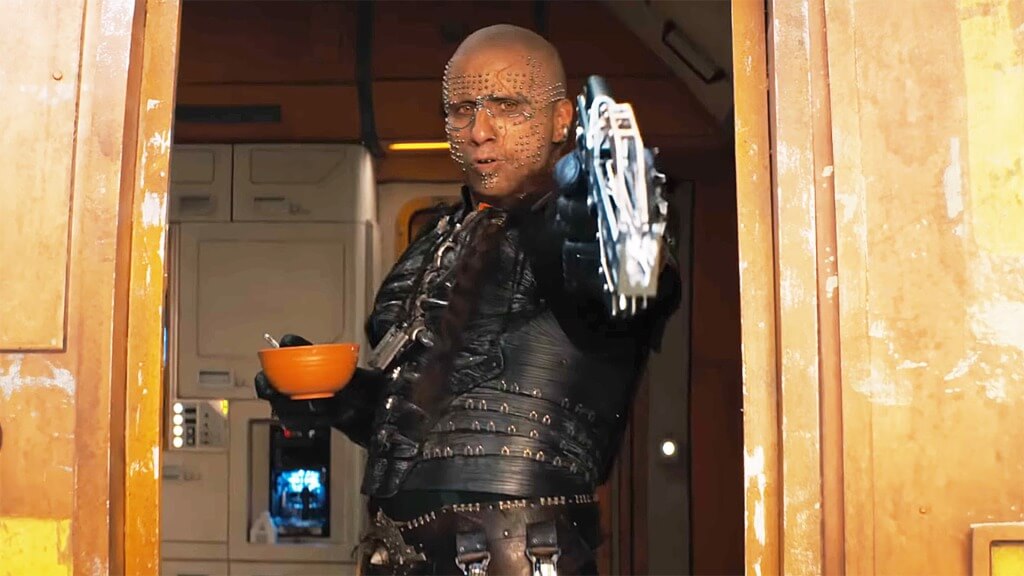
Yet that heavy sequence comes during the same scene where a cigar-chomping Jason Momoa zooms in on a motorcycle to spout one-liners while whipping a chain over his head in knockoff KISS makeup. It’s tonally bizarre. Supergirl needs Krem to be evil enough to justify Kara killing him in the end, while the story around him is zippy enough that the moment comes as a surprise. The result is a movie that turns a shipping container full of voiceless child brides into a MacGuffin while spending much of its runtime on the antics of its moustache-twirling villain. The same odd sense of focus extends to Kara’s backstory as well, which isn’t even explained until the middle of the second act. Her survivor’s guilt and trauma are foregrounded in various flashbacks (as is her loose connection to Clark), but her journey to the present moment is opaque.
This all contributes to the sense that Supergirl cares about Kara and Ruthye as ideas, but not exactly as people. That’s why it almost needs the final murder twist to work. Without it, there’s just not much there. With it, however, the film at least offers something to chew on with the question of what it means to be virtuous in a morally corrupt universe. Earlier, Kara claims that while Clark sees the good in everyone, she sees the truth. Her climactic choice is built from two contradictory truths: Ruthye doesn’t deserve to live with the guilt of killing Krem, and Krem doesn’t deserve to live at all. So Kara decides that the ethical thing to do—the “good” thing—is to take on the burden of that guilt herself. What’s the difference if she adds a little more trauma to her heaping plate? She knows that killing someone takes a little bit of your soul and closes off a little bit of your heart, and she decides that’s a cost she’s willing to live with, especially if it means another young girl doesn’t have to.
Building to that ending without a proper foundation, though, makes it feel wobbly. The idea that Kara and her more famous cousin never kill is gospel to a lot of comics fans, but it’s just another thing that gets lost in the shuffle when Supergirl spends so much of its runtime on intergalactic rest stop comedy, outer-space bus heists, and slo-mo fight scenes scored to breathy pop covers. Still, at least there’s an honesty to Kara’s ultimate choice. Gunn’s sunny Superman raised these ethical questions only to resolve them by having a superfriend be the one to murder an evil head of state, so that Clark could keep his hands clean. To its credit, Supergirl gives Kara the courage of her convictions when faced with something similar. It may not be a pretty ending, but at least it doesn’t shield us from its own morality.


 Keep scrolling for more great stories.