“Back in 1995, short-sighted retailers did not order enough dolls to meet demand.” So says Tour Guide Barbie, not speaking about merchandise from her brand’s own 2023 box office smash, but instead describing a gleaming wall of Buzz Lightyears as she ushers visitors through a Toys-‘R’-Us-sized store in Toy Story 2. At the time, this was a winking reference to the way that the success of the film’s 1995 predecessor did indeed catch stores (and Mattel, as it turns out) off-guard, leading to quick sell-outs of Woody and Buzz toys just as the holiday season approached.
Today, this moment is its own time capsule. Places like Al’s Toy Barn, with its endless and well-stocked rows, are all but extinct, with toys sold in a three-aisle department within big-box stores; in smaller specialty shops that pride themselves on not stocking mostly plastic crap; or in online stores that triple down on said plastic crap. Woody and Buzz are regular fixtures at those locations, though rarely in the overwhelming numbers of this scene, which showcases hundreds of boxed-up Lightyears. For that matter, the recent live-action Barbie movie grossed more than any Toy Story movie, with an ad campaign that specifically mentioned that it was for people who hate Barbie, too. Even taking that success into consideration, a line of dialogue from Toy Story 5 seems inarguable: “The age of toys is over.” That admission may seem obvious, yet it arrives in the midst of a toy-centric summer at the cinema, albeit one with the more traditional focus of selling toys based on movies.
The process of translating popular toys into films has never been as successful as vice versa, even with Barbie as the exception on the level of a cultural phenomenon; this summer, only Masters Of The Universe has attempted to replicate that particular magic trick, and will wind up making substantially less than Lightyear, nevermind Barbie. Trying to make Barbie For Boys, it replaces the straight-shot but highly resonant messaging of “it is literally impossible to be a woman” with some empty-headed filibustering about empathy and non-toxic masculinity that feels cribbed from someone’s corporate PowerPoint produced in haste within a week of Barbie hitting big. It’s only fitting that this moderately fun movie, which probably owes part of its existence to Barbie, feels a bit like a project designed by a Ken. It’s plastic pretending to be human, subbing in “empathy” and a bunch of self-conscious jokes to conceal its true subject: The boundless love its makers have for the toys it’s based on. Better to make a mercenary toy-based movie out of love for the material than contempt for the audience, to be sure, but as any contemporary parent knows, there are limits to how far Gen-X enthusiasm for this or that object of childhood nostalgia can carry a younger audience.
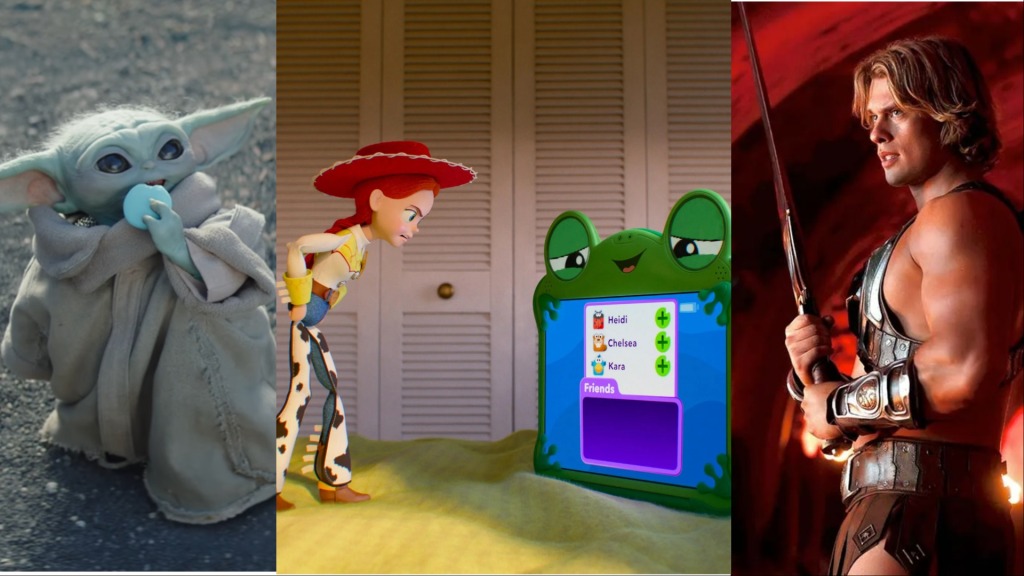
Of course, Masters Of The Universe has flopped in theaters before, and should it get another chance in another 40 years, it will probably flop again. Maybe the greater sign of the wear and tear experienced by the toys-and-cinema relationship is the more widely seen The Mandalorian And Grogu, the first new Star Wars movie in almost seven years. As it’s become clear that this movie could slide in under Solo to become the lowest-grossing live-action Star Wars movie to date, several caveats in its favor have been brought up: First, it didn’t cost nearly as much as Solo to produce; second, and perhaps more importantly, it will move a lot more merchandise, as Grogu-adorned products have become a bonanza for Disney.
This latter point seems true enough given the sheer volume and variety of Grogu stuff available, but if you look closer at the former bread and butter of Star Wars merchandising, however—action figures—you’ll find a telling lack of imagination or enthusiasm. If nothing else, The Mandalorian And Grogu is toyetic, that shamelessly, magically corporate-coined word supposedly birthed to describe the toy-manufacturing and toy-selling potential of Batman & Robin. For long stretches, Mandalorian barely contains a single human face, instead populating the screen with helmeted space cowboys, droids, and creatures. It’s basically Playset: The Movie. Yet you wouldn’t necessarily know that from looking at its most prominent toys, which focus heavily on Grogu himself in various plush-and-plastic combinations. Meanwhile, the extensive Black Series of well-appointed six-inch action figures includes such eclectic and beloved characters as AT-AT Driver, AT-RT Driver, Stormtrooper, and Snowtrooper. (Yes, these anonymous white-armored baddies are all considered separate characters. They’re also consigned to one action sequence at the beginning of the movie.) Oh, and kids can also thrill to a figure that looks a bit like the corpse of Sigourney Weaver.
Granted, the Black Series figures are not aimed principally at younger children, and the line also includes representations of the Mandalorian himself, Grogu, their alien pal Zeb, and bad guy Embo. There’s also a smaller, more affordable, and kid-targeted ActionVerse line of figures that includes Mando, Grogu, Zeb, a droid, and a trooper. They seem like an afterthought, and many stores haven’t seemed to bother with the full lineup. This all reflects the way the action figure market has shifted away from youth and toward adult collectors—and that makes sense considering that you can’t force tablet-raised kids to care about mashing figures together, especially once they reach a certain ever-decreasing age.
What’s striking about the Mandalorian toys, though, is how Disney doesn’t seem to want anyone mashing them together. Any kids or adults who want to recreate their own version of, say, the chaotic arena battle scene, where Mando and a swole Hutt fight off a variety of crazy alien creatures is out of luck (or will have to make do with checking eBay for an old Nexu figure). Star Wars and its toy lines once had a symbiotic relationship, the imaginative designs of the movies fueling the obscurities of the toys—which in turn often served as de facto early pages of Wookieepedia, offering names and sometimes brief backstories for the briefest of on-screen presences. Now those two wings of the brand seem to compete over who can be more staid, cautious, and conservative. Lucasfilm wants to sell toys without being accused of doing anything too ridiculous.
The lack of those plastic supplements to the Mandalorian movie isn’t what makes it a minor exercise within the Star Wars canon. But it does make some of the movie’s best qualities—namely its oops-all-side-characters eclecticism—seem half-hearted, consigned to the whims of a Gen-X director rather than excitingly shared with any of its younger viewers. Like Masters Of The Universe, the relationship between the movie and its toys is weirdly respectful, lacking in gleeful absurdity. Even as a self-send-up, the endless stream of Barbie variants in Greta Gerwig’s movie (almost all based on actual toys) did a more concise job of poking fun at its own lore than Masters Of The Universe, with its odd snarky remarks about how silly or dumb it all is.
This paradoxically makes Toy Story 5, which will almost certainly post both the biggest box office and the best toy sales of any movie this summer, the movie that seems to best understand how and why to let go of that movie-toy relationship. Part of the movie’s strategy is to gradually expand the tent for what is considered a toy; when tech-disdaining cowgirl doll Jessie (Joan Cusack) encounters a bunch of discarded, obsolete pieces of kid-friendly tech tools, she eventually realizes that they have the same anxieties that she does about wanting to help “their” children and also maintain that relationship for as long as possible. (The unspoken flip side: An action figure or plastic dinosaur isn’t actually any less a piece of landfill-clogging junk just because it has a superficially cuter face.) Though Toy Story itself is old enough to inspire as much nostalgia as any other legacy brand, the filmmakers are sanguine about the idea that toys will no longer dominate the attention of the typical child for quite so long a period. Value isn’t necessarily determined by longevity. Toys are here for a good time, not for a long time—and that was always true to some extent.
Toy Story 5 does fudge its point slightly by conflating an interest in toys with the whole concept of imaginary play, something children engage in without any actual playthings at hand. (This was explored through the creation of Forky in Toy Story 4, though plenty of kids don’t even need that level of toy substitute.) The filmmakers can’t resist making Bonnie’s willingness to play with her toys part of an innate creativity and specialness—as universal as Pixar can be, these high-achieving artists and engineers are real suckers for the notion of innate specialness—which anyone with a sizable action figure collection can attest is not remotely accurate. There’s even a hint of capitulation to Big Tech in the movie’s ultimate resolution, as if the filmmakers were forced to conclude that devices can’t be all that evil if they share anything in common with our beloved plastic junk of the past.
But Toy Story 5‘s vision of how toys might change shape and function is nonetheless more encompassing than the summer’s other toy movies, and more consciously aware of the contradictions in appreciating symbols of impermanence that nonetheless stubbornly refuse to biodegrade. Maybe the physical accumulation of so much spent fun will be the subject of the next engaging toy movie, whether that’s Toy Story 6 or something less expected. (Probably not that Hot Wheels movie.) Though there are toys produced for young-skewing multimedia phenomena like Five Nights At Freddy’s or The Amazing Digital Circus, there’s something more evocative about the youth support for Backrooms, a movie about the liminal spaces that might have once been occupied by plastic junk. It’s not for kids, of course, but it does underline the difficulty of selling an uncomplicated form of feel-good nostalgia to the next generation. At least since the late ’90s, big studios have been hungrily eyeing those endless aisles stocked to the endcaps with Lightyear figures. Maybe they should have been looking toward the clearance shelves instead.


 Keep scrolling for more great stories.