For as long as they’ve endeavored to make video games more than mere quarter-recirculatory systems, developers have borrowed from the movies. Gaming and cinema are both visual mediums at heart, and Final Fantasy II didn’t need advanced photorealism to do a simple riff on Star Wars. But this year in particular has seen a change at the movies, perhaps because filmmakers who actually grew up on gaming have now reached the age and attained the budgets where they can take full advantage when translating the form. Nowhere has that been more clear than in horror, where a recent adaptation finally merged mechanics with cinema to create what has to be the best game adaptation yet, while movies otherwise unrelated to games adopted the atmosphere and stylings of survival horror games to great effect.
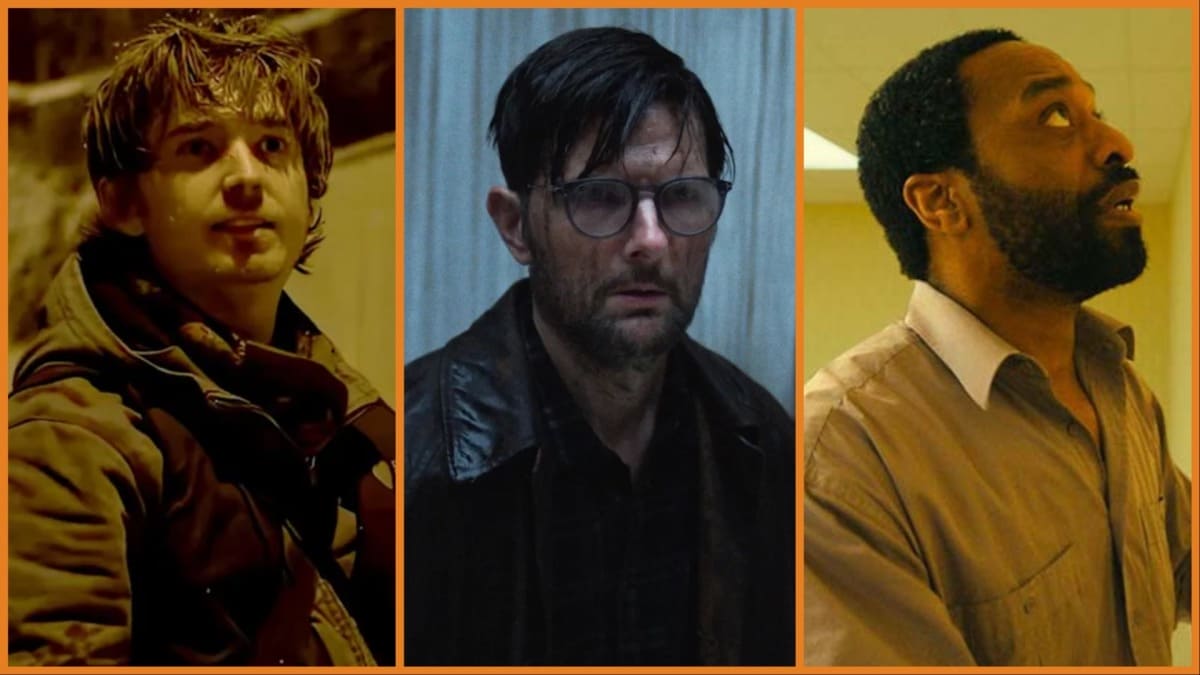
Despite not being based on a game at all, Damian McCarthy’s Hokum proves to be a much better adaptation of Silent Hill 2 than the actual baffling, incoherent version released earlier this year. Most obvious is the haunted protagonist, in this case Ohm Bauman (Adam Scott), a writer visiting an old Irish hotel to both spread his parents’ ashes and clear some writer’s block. The comparisons continue once he gets trapped in the abandoned Love Suite, a dank, dusty environment that feels straight out of any number of horror games, but things really kick into high gear once he has to find his way out.
McCarthy establishes the space by giving us a tour of sorts, lingering on a creepy cherub clock, a full bathtub, an ominous dumbwaiter—a Myst-like series of objects ready to puzzle its player. Perhaps the most survival-horror touch of all is when Bauman unlocks the back of a cabinet and discovers a door to the other side of the room, replicating any number of weird exits found in Silent Hill—and that’s not to mention the corpse in the dumbwaiter that takes us down into what may as well be hell. All of this comes before the big scary witch is thrown into the mix, leading to what may as well be a stealth sequence involving noisy hanging bottles and the task of trying to avoid a wandering enemy, all leading up to the inevitable sprint back into safety. But more than anything, Hokum encapsulates what it feels like to piece together a mystery via the loose threads you find through exploration via notes or audio logs, the creepy atmosphere adding to the dread as you get closer and closer to the horrifying conclusion at the center.
But of all this year’s horror movies that weren’t directly based on games, the most game-like is Backrooms, arising as it did from the concept of clipping through the boundaries of a game level to get to areas you weren’t supposed to. Director Kane Parsons recreates that uncanniness well, drawing visually from games like Control, with its stacked rooms against an abyss. One could easily imagine porting the scenario—with its “starting hub” of the furniture store basement and its exploration-generated map—into a game.
In that way, Backrooms is a classic dungeoncrawler or roguelike: Much of the tension comes from the unknown elements of the environment, both in what could lurk around the corner and in how deep it actually goes. There’s the constant threat of getting lost or stranded in the endlessly repetitive hallways as resources dwindle along with one’s sanity. It doesn’t even need monsters to make it scary—despite the fact that the original Backrooms post ended by suggesting the presence of something stalking the pathways—before the film falls into the kind of chase sequence found in horror games going back to Clock Tower. In fact, it’s a particular staple of the main inventor of the survival-horror genre, Resident Evil.
It’s only natural that the new Resident Evil film, being directly connected to the game franchise, borrows the most from the mechanics of its inspiration. But the game-film back-and-forth is in the series’ bones: The first Resident Evil started out as a commission to make something similar to Sweet Home, itself an adaptation of a 1989 Kiyoshi Kurosawa film. Over the first three games—due to a mix of technical limitations and careful design—Resident Evil adopted fixed camera angles, which would change whenever a player moved into a specific spot or a different room. A common joke (or knock, depending how you feel) is that each entry is largely inspired by whatever movies the developers were watching at the time: haunted house movies in the first, The Texas Chain Saw Massacre for the seventh, etc.
Zach Cregger, in a reverse scenario, attempts to get across what it feels like to play Resident Evil, particularly if you kind of sucked at Resident Evil. Brian (Austin Abrams) is, much like protagonists Ethan Winters, Grace Ashcroft, and Claire Redfield (to an extent), just a normal guy trying to complete a gig, and he’s constantly having to improvise. Resident Evil players have all had to run around in a circle while being chased by a zombie as they try to reload, only to miss when they finally fire. It’s a universal experience of failure and desperation, and Resident Evil truly captures the feeling of walking into a spooky place low on ammo; Brian’s every fumble and missed shot causes a cringe.
It’s not only resource management, though. There’s also the unsettling house Brian searches for shells, the “puzzles” and “save station” (a typewriter) he misses as he tries to make his way to the next location. The scene just a few minutes prior involves him throwing a ladder at an enemy, then realizing he needed it to escape—it feels just like discarding an in-game item only to find out that it was actually necessary later on. One could easily see Resident Evil as broken up into discrete “levels,” especially when an RV blocks off Brian’s path—one filled with the environmental storytelling of abandoned cars and first-aid sprays—forcing him to go through the dark place where the Scary Thing is.
What has made many modern video games so hard to adapt has been the fact that often, the story is intrinsically tied to the mechanics in ways that only work for the medium. Discovering tidbits of lore scattered throughout a level at your own pace, or playing through scripted sequences with varying levels of interactivity and the potential for failure, is unique to games. Would The Last Of Us TV show have been able to capture the power of Part II‘s climax, when we hadn’t been playing as the villain for almost six hours beforehand? Translating the experience secondhand is inherently tricky; even a Let’s Play of a game takes an active experience and renders it passive.
But what these modern films have begun to do is translate the design language of games into cinematic tricks, making audiences into pseudo-active participants. While these films may occasionally utilize more glaring stylistic techniques to get there, such as a first-person camera—like the first Doom film did back in 2005—they’re really just doing what all good cinema does: evoking a feeling and a mood within a viewer using a specific visual language. Games communicate so much through action, even actions as simple as advancing dialogue, that it can be easy to overlook how much essential emotion can come from something psychological and unscripted, like turning around and seeing an enemy you didn’t realize was there, right before it attacks you. Films have always guided audiences’ emotions via intentional choices, but now directors are finding cross-media ways to, at least stylistically, hand viewers the controller.


 Keep scrolling for more great stories.