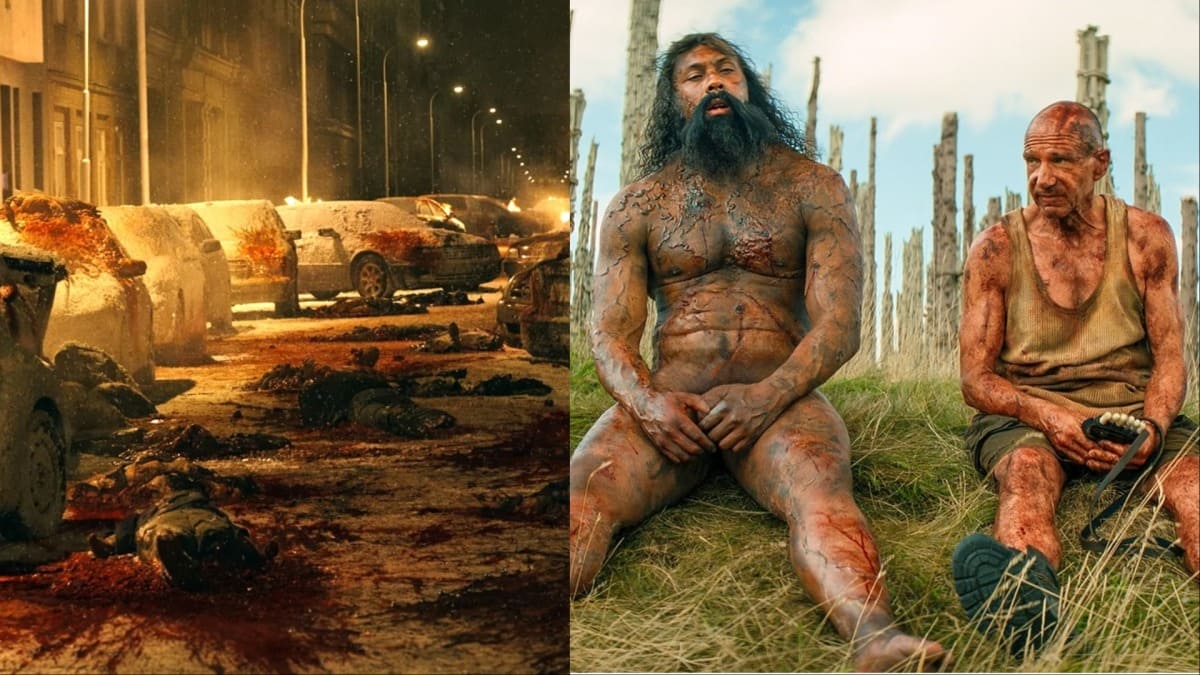
In the first major zombie movie to come out in 2026, a kind (if slightly kooky) doctor sees the humanity inside of a hulking, virus-infected man who has the strength to pull out somebody’s spine with his bare hands. The doctor tries to understand this so-called monster in order to save—even befriend—him, and he’s ultimately successful. Meanwhile, in the most recent zombie movie of the year, a scared little girl in the process of transforming into something horrible begs for help before her face splits open, revealing a single bloody eyeball and a ravenous maw of teeth. The protagonist instantly blasts her to bits with a shotgun; it’s one of the funniest moments in the film.
To say that 28 Year Later: The Bone Temple and Resident Evil represent two different approaches to zombies is an understatement. There are similarities, of course. Both are gnarly movies with gore, shocking scares, and most importantly swarms of people who have been transformed into flesh-eaters by a viral outbreak. (Their zombies are, technically, not undead, though they’re certainly zombies by any reasonable definition.) Zombies are one of the most versatile movie monsters; they can represent an intolerance of an “other,” prey on fears of infection, be a dark reflection of humanity’s own impulses, or they can just be a bunch of spooky bad guys that protagonists can mow down without feeling too bad about it, video-game-style.
It’s no surprise that Resident Evil, an adaptation that captures the experience of playing games like this better than basically any other before it, would depict zombies in this more mindless way. From the moment when the first victim of the t-Virus enters the movie, when she walks in front of Austin Abrams’ car, Resident Evil‘s zombies are treated like props. She’s scary, but she and the other zombies are played for laughs as much (if not more) than they are for horror. Before Bryan, Abrams’ unfortunate medical courier, realizes the true nature of the woman he’s hit, he’s exasperated by her. In her stunned state she reaches over towards Bryan to his annoyance and the audience’s uneasy chuckles. When a cop pulls Bryan over, they both treat her like a burden. As the t-Virus spreads, Resident Evil continues to deliberately ignore the humanity of the infected. They’re no longer individuals—literally, in the case of one multi-limbed monstrosity that fuses itself together with other zombies.
There’s nothing inherently wrong with this approach to zombies. As a disposable villain, zombies are great. They’re a ready-made, near-endless supply of targets; you don’t have to worry about the ethics of ending a life if the shambling creature you’re headshotting is already dead, right? Resident Evil is part of a rich tradition of this sort of zombie, as the original games helped revive the genre when it was struggling in the ’90s, and there are plenty of examples of gross-out walking dead flicks from the previous decade that weren’t exactly empathetic. Resident Evil isn’t even the only zombie movie of 2026 that villainizes the undead. Colony, from Train To Busan director Yeon Sang-ho, explicitly does away with any understanding that its zombies are (or were) individuals. Instead, they share a hivemind. By the time the man who unleashed the virus takes control of the horde, they’re further reduced, to just being a weapon.
Contrast this with The Bone Temple, Nia DaCosta’s brutal, beautiful follow-up to Danny Boyle’s 28 Years Later. It’s the latest in the long line descended from Boyle’s 28 Days Later, which came out the same year as Paul W. S. Anderson’s first Resident Evil movie. Even in 2002, 28 Days Later had a lot more to say with its undead than the loose, action-packed game adaptation did, but The Bone Temple takes it to another level. While plenty of zombie movies have jumped on the notion that it’s the living who are the real monsters, The Bone Temple does the humanizing work of actually showing how that might reasonably happen with Jack O’Connell’s Sir Lord Jimmy Crystal.
He’s a skin-flaying psychopath, yet The Bone Temple still manages to take audiences on a journey where they understand and even pity him. Dr. Ian Kelson (Ralph Fiennes) certainly tries as best he can to hear the broken little boy inside Sir Jimmy. He also sees through the crazed eyes of the nearly unstoppable “alpha” he’s taken to calling Samson (Chi Lewis-Parry). Kelson takes reasonable precautions with Samson, but he doesn’t view him as a monster to be killed; he’s just another human being. In fact, every skull making up his Bone Temple once belonged to a person. When Kelson starts getting high on opiates with Samson, dancing with the extremely stoned, extremely nude alpha, it’s the start of something profound. He was able to save Samson from a terrible fate; being a zombie seems as bad, if not worse, than being eaten by one.
Kelson saw the nobility and humanity that Samson fundamentally possessed even though he was a zombie. But is that what audiences want to see from their zombies? The Bone Temple bombed at the box office, making just $25 million domestic and putting the promised third 28 Years movie in serious doubt. Sure, The Bone Temple came out in January, just a year after the previous one, and audiences might have been fatigued—or not even realized that The Bone Temple was a new movie rather than a re-release. It also probably didn’t help that, despite having a deliriously entertaining set piece where Fiennes dresses like the devil and lip-syncs to Iron Maiden, The Bone Temple is not especially fun. It’s grueling and graphic; the violence not gratuitous titillation. Resident Evil, which turns a bisected body getting tugged along by intestines into a great gag, is a blast—and is predicted to make $80 million during its opening weekend. Again, there are other factors to consider when comparing undead apples to zombified oranges: Resident Evil is based on video game IP and Cregger is a hot horror director coming off of the massive success of Weapons.
Resident Evil almost plays like a theme park ride, and just as guests aren’t invited to consider the humanity of the animatronics on Pirates Of The Caribbean, they’re not asked to think about the t-Virus victims. It’s not asking any big questions about the worth of a human life, nor is it really asking the audience to think at all. Despite all the other mitigating factors, when it comes to zombies, it seems clear that this is what audiences want more than The Bone Temple’s thoughtful empathy.
It’s tempting to read too deeply into the troubling implications of that audience preference, but it shouldn’t be especially surprising that the popcorn movie that’s fun to see with an audience might draw a bigger crowd. But the failure of The Bone Temple, compared with Resident Evil‘s success, does take on an extra weight—even a bitter irony—because of another zombie movie that came out in September. Black Zombie, Maya Annik Bedward’s revelatory documentary, goes back to the Haitian roots of zombie folklore, exploring how the entire genre is based on a racist distortion of enslaved Africans’ metaphor for their terrible situation. Zombies have always had a human origin. The Bone Temple, at least, remembers this.


 Keep scrolling for more great stories.