The term “risk-taking” is not one that typically comes to mind when we think of The Walt Disney Company. The almighty House Of Mouse, one of the most unconquerable and overpowered media monopolies to ever exist, got to the top of the mountain through a ruthless commodification of its formula: fairy-tale re-imaginings with toe-tapping songs, adorable wacky sidekicks, nefarious villains, and happy-ever-afters. The release of Toy Story 5, the latest needless installment in a franchise that has already given us two “final” films, is proof that sticking to the status quo can reap immense commercial benefits. The current era of IP dominance has made Disney unstoppable, even if its reviews have gone in a different direction. But it’s easy to forget that the company partially got to this place by taking big swings and investing in projects that many executives thought were disasters in waiting—projects like The Hunchback Of Notre Dame.
People often whine that Hollywood would never make certain movies these days because of wokeness or whatever, but that has nothing to do with why Disney would never make The Hunchback Of Notre Dame in 2026. Frankly, it’s a miracle it got to the screen 30 years ago in 1996. “We want to adapt a Victor Hugo novel about the hypocrisy of the Catholic Church and the oppression of the Romani community, featuring an evil priest who wants to rape the heroine, but it will also feature singing gargoyles” is the kind of pitch that would get you fired, or tried in the town square as a witch. But amid the renaissance of Disney Animation in the 1990s, as the company experienced its greatest critical and commercial revival since the ’60s, they were willing to go there, and the end result is still one of the most startling and shocking family films ever made.
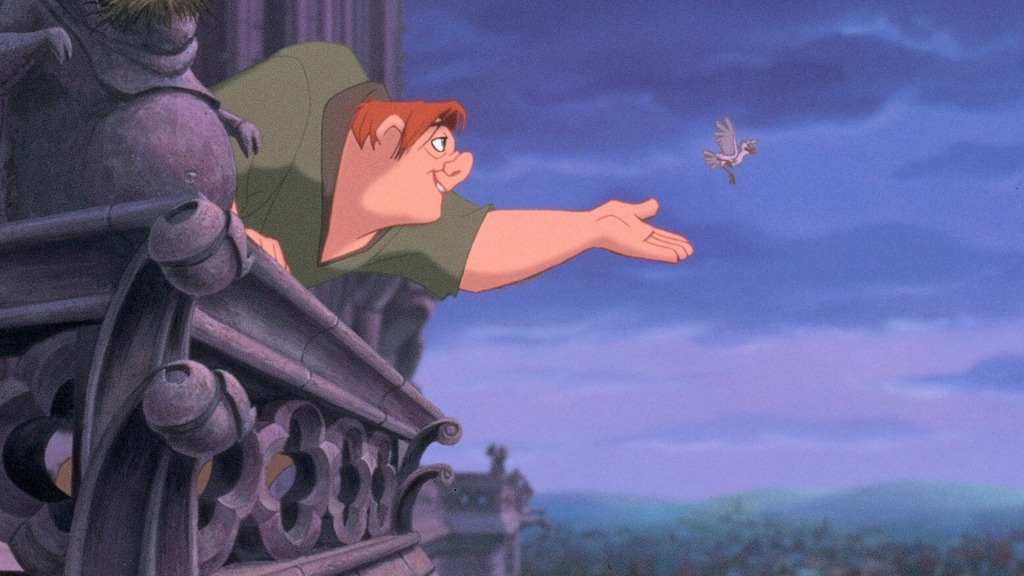
Directed by Gary Trousdale and Kirk Wise, in their follow-up to Beauty And The Beast, this adaptation is an undoubtedly Disney affair. Alan Menken provided some hummable tunes, there’s a handsome rogue who gets the girl, and goodness wins the day. Hugo purists were put off by these radical changes, a far cry from the book’s mixture of high misery and architecture porn (spoiler: in the book, practically everyone dies). Certain decisions play out as though a boardroom voiced concern about the lack of merchandising opportunities offered by French Gothic literature. Yet the core of the narrative remains: A hunchback named Quasimodo (voiced by Amadeus star Tom Hulce), a beautiful Romani street dancer named Esmeralda (Demi Moore), and the twisted Judge Frollo (Tony Jay) who controls the former and obsesses over the latter.
The sheer priestly grandeur of Hunchback is undeniably stunning. Menken’s score, full of organs and foreboding choirs, is overwhelming. The hand-drawn depictions of Notre Dame’s intricacies immerse you in a world of towering faith and ground-level humanity. While it’s not hard to see why many religious groups in America chose to boycott the film (for one, the overt sexiness of Esmeralda, one of the most sexualized women in Disney history), but The Hunchback Of Notre Dame is also a story with an earnest and nuanced take on faith. Belief is beautiful; appropriating it for your own selfish purposes is not.
Sure, the filmmakers added some singing gargoyles whose modern pop culture puns and wacky shenanigans hit like a stink bomb unleashed in the cathedral’s rafters, and the love story between Esmeralda and Captain Phoebus (Kevin Kline) never entirely works. But it is remarkable how much of Hugo’s fiery anti-establishment spirit remains intact. Disney’s filmography is populated with stories of outsiders and scrappy underdogs taking on cackling baddies, but seldom has the threat of the adversary felt as familiar as it does with Hunchback. It’s not merely that the bad guy is an Archdeacon in all but name (changed slightly from the book), imbued with both the powers of the Catholic Church and, so he believes, his maker; it’s that his ultimate goal is one of genocide against the Romani populace.
The Hunchback Of Notre Dame does not shrink from portraying this, even if it keeps the blood off-screen. The very opening of the story is one of Frollo murdering a woman, then fearing that God will strike him down for it. The introductory song doesn’t make it any more chipper. Then there’s “Hellfire,” perhaps the most disturbing of all Disney villain songs. There’s no obfuscation in the lyrics or animation: This is a man admitting to God that he doesn’t know whether to rape Esmeralda or kill her. You know, for kids!
Surprisingly, both then-Disney Studios chairman Jeffrey Katzenberg and CEO Michael Eisner loved the film. They were supportive of the filmmakers and their vision, although they did ask for a couple of very minor cuts to get a G rating. (And yes, the movie with the rape fantasy song is a nice soft G.) “You write the story you want to tell, and let us worry about our brand,” Eisner reportedly told screenwriter Tab Murphy. Somehow, it paid off with a commercial hit: $325 million from a $70 million budget.
Disney has never stopped hiring talented people and giving them striking opportunities, but the light of the ’90s renaissance has grown ever dimmer in the era of endless live-action remakes and Pixar’s pivot to sequels. Even a Hunchback live-action redo was announced, but mercifully stalled in pre-production. Perhaps it’s too much to ask for something as radical as The Hunchback Of Notre Dame in 2026, a time when the richest man alive starts online wars over movie trailers, but returning to the thrilling film only makes it more clear how little nourishment is to be found in the endless risk-averse regurgitation of nostalgic IP. How many more Frozen sequels do we need? But such is the business of Mickey Mouse, even if it wasn’t always this way.


 Keep scrolling for more great stories.