The ever-unpredictable TV landscape is about to become a whole lot more uncertain, unfortunately. And not to be all “let’s be thankful for what we have,” but there have been plenty shows worth celebrating over the last twelve months, including a grand return from one of the medium’s masters, delightful surprises, a lot of timely (at least thematically) conversation starters, a few stellar sendoffs, aesthetically exciting debuts, throwbacks, and some singularly weird and wonderful comedies. Read on for The A.V. Club‘s favorite series of 2025.
25. St. Denis Medical
In a world where old-fashioned network TV hits remain few and far between, it’s always a joy when one manages to break through. And NBC’s sitcom St. Denis Medical—which aired the second half of its first season and the first half of its second in 2025—is just what the doctor ordered. Set at a struggling “safety net” hospital in Oregon, the mockumentary doesn’t just highlight the heroic doctors who already get so much cred on our screens. It’s equally interested in the overworked nurses and underfunded administrators who actually make hospitals run. Like Abbott Elementary or the creators’ previous hit Superstore, that makes St. Denis a pointed, socially conscious series in addition to a delightfully wacky sitcom. America’s healthcare system is broken, and St. Denis doesn’t deny that. But it does argue that a dedicated team of oddballs—played by Fargo’s Allison Tolman, The Goldbergs’ Wendi McLendon-Covey, and legendary TV vet David Alan Grier—can still have a huge impact on their patients and each other. Whether it involves cutting an engagement ring off a penis, chasing an escaped cat around the hospital, or sneaking an unhoused patient into a VIP suite, it’s never a dull day in this refreshingly silly flip side to The Pitt. [Caroline Siede]
24. Dark Winds
AMC’s neo-noir Western delivers yet another thrilling ride in season three, which sees detectives Joe Leaphorn (a great Zahn McClarnon) and Jim Chee (Kiowa Gordon) trying to track down a missing teenager, with the investigation forcing the former to reflect on his ancestry and family trauma. This moving arc allows the Navajo Nation-set drama to continue exploring Indigenous traditions and mysticisms in ways hardly represented on the small screen. While taking place in the ’70s, this batch also feels quite relevant as Bernadette (Jessica Matten), who struggles to fit in at her new Border Patrol job, cracks down on a human-trafficking scheme. As both these cases inevitably clash, Dark Winds builds riveting tension and mystery. But at its core, the show’s success stems from unique characters and world-building. [Saloni Gajjar]
23. Étoile
In between her smash hits Gilmore Girls and The Marvelous Mrs. Maisel, Amy Sherman-Palladino made a cult classic ballet-themed TV show that only ran one season. Now Bunheads‘history is sadly repeating itself with Étoile, a ballet series Amazon originally ordered for two seasons but cancelled after just one. Still, within its short existence, the showmanaged to emerge as one of the most fascinating projects in Sherman-Palladino’s career. There’s always been a prickly, acerbic edge lurking beneath the whimsical, cozy aesthetics of her worlds. And Étoile brings that thorny intensity to the surface with its story of two renowned ballet companies (one in New York and one Paris) who decide to swap their top talent for a season. In other words, come for the dancing, stay for the cynical satire about the business of making art. Anchored by a fiery performance from French actress Lou de Laâge as a prima ballerina as well as Charlotte Gainsbourg and Maisel breakout Luke Kirby as beleaguered artistic directors, the seriesunderstands that the effortless beauty of ballet is only made possible by a whole lot of agonizing effort—both onstage and off. But for those who love the artform, that feeling of giving everything to the dance is the whole pointe. [Caroline Siede]
22. Game Changer
The premise of Game Changer has always been clever: a game show where the actual game is different every episode, and where contestants don’t know what they’re playing or how to play until the game begins. But over the past few seasons, the Dropout series’ impish host and mastermind Sam Reich—in collaboration with an incredibly talented team of writers and craftspeople, and with a contestant pool drawn from L.A.’s funniest improv comics—has realized that because the show’s a blank slate, there’s very little limit to what can be done with it. Season seven features some of the usual “Game Changer-ization” of conventional TV competitions (such as riffs on Who Wants To Be A Millionaire? and Shark Tank)alongside outside-the-box “game” ideas (like a political debate and a Mafia-inspired drinking contest). Nearly every episode though is ultimately about the emotional journey the players and viewers go on, as Reich and co. push the limits of what a game can be as the whole concept of “playing” evolves in real time. [Noel Murray]
21. 100 Foot Wave
Last month, Hunter Ingram made the case that Stumble, NBC’s new mockumentary, is, in spirit, “Friday Night Lights‘ first true successor.” It’s a convincing argument—the cheerleading comedy not-so-subtly tweaks the beloved football drama’s “Clear eyes, full hearts, can’t lose” mantra to “We can, we will, we must”—but if you’re looking for those tear-jerking, big-sports moments that FNL was so good at delivering, few do it better than 100 Foot Wave. The third season of this gorgeously shot, scored, and edited series from director Chris Smith (American Movie) is packed with them—particularly when Luke Shepardson, a lifeguard on Hawaii’s North Shore, surprises everyone by winning the prestigious Eddie Aikau Big Wave Invitational. As Nicole McNamara, the wife and manager of big-wave surfer Garrett McNamara (essentially the star of this show), puts it: “That was one of the most beautiful moments in surfing history. This lifeguard who was on his break after saving lives—like, my skin is tingling even talking about it.” But 100 Foot Wave also goes deeper, depicting a tragic fatality, new father- and motherhood, the frustrations of aging, and the toll going after that one perfect wave has on these surfers and the people they love. [Tim Lowery]
20. Hacks
When the third season of Hacks culminated in a face-off between newly minted late-night host Deborah Vance (Jean Smart) and her protégé, Ava Daniels (Hannah Einbinder), viewers couldn’t wait to see the fallout. Season four threw them right into the fire, as the two declared all-out war. Their bitter feud ended in a moving seaside reconciliation. If there’s one thing Hacks knows, it’s that the love they share transcends even the most vicious cruelty. When Deborah walked away from her dream job for Ava’s sake, it was a cathartic cri de coeur for the post-#MeToo era. It also confirmed what we knew all along: Whether their relationship is creative, platonic, amorous, or all three, this is the greatest romance in modern television. Four years in, Smart and Einbinder’s performances—not to mention their explosive chemistry—continue to evolve, and creators Lucia Aniello, Paul W. Downs, and Jen Statsky have never stopped upping the ante. [Jenna Scherer]
19. Asura
Hidden among Netflix’s vast streaming archive like a gem dropped in a bucket of jelly beans, Hirokazu Kore-eda’s Asura waits to be found and savored. Not just for all the delectable food on display—oh, the food!—but for the dramatically dense, years-spanning saga that unfolds across seven beautiful, eminently rewatchable episodes. Its generational story of the Takezawa sisters, bound by love and tested by the worthy and unworthy men in their lives, was quietly released in January but has since gathered a low, steady hum of critical praise. It should be louder. Adapted from the novel Like Asura by Kuniko Mukōda, this 1970s-set drama unfolds like the finest page-turners, opening with the gut punch of the family patriarch’s (Jun Kunimura) secret affair and the possible existence of a much younger half-sibling. From there, widowed Tsunako (Rie Miyazawa), steadfast but shaken Makiko (Machiko Ono, MVP), sharp-eyed Takiko (Yū Aoi), and buoyant Sakiko (Suzu Hirose) attempt to navigate the trajectory on which this revelation sends their individual lives spiraling. Kore-eda frames it all with meticulous, lived-in intimacy, with dialogue rising, falling, and overlapping. Alongside his remarkable cast, he captures life in its completeness, with all its human frailties and grace notes. [Jarrod Jones]
18. The American Revolution
While the Ken Burns approach to non-fiction television has become familiar enough to even be parodied, it feels like people are starting to take the intense effort it requires to mount one of these for granted. For more than a year, Burns, co-directors Sarah Botstein and David Schmidt, and regular writer Geoffrey C. Ward traveled the country, filming in many of the locations featured in this 12-hour history lesson. To that veracity, the directors add a murderers’ row of talent to read letters, journal entries, and more from the era, giving life to the words of our founders through the expression of actors like Laura Linney, Jeff Daniels, Morgan Freeman, Tom Hanks, Samuel L. Jackson, and Josh Brolin, who is so good at embodying George Washington that they should make a special Emmy for him. The American Revolution balances voice actors, footage, archival imagery, and a select group of experts to tell a timely story of resistance in a way that it hasn’t been told before. Framed for generations as a patriotic tale of fighting back against a dictatorial enemy, the American Revolution was as much a story of violent expansion across an already-occupied land as it was anything else. The roles of Indigenous people and slaves have never really been chronicled on film like this. And at a time when No Kings rallies are being held around the country and the very manner in which history is being taught in the United States is being challenged, The American Revolution doesn’t just feel like another TV production but an act of resistance. [Brian Tallerico]
17. Long Story Short
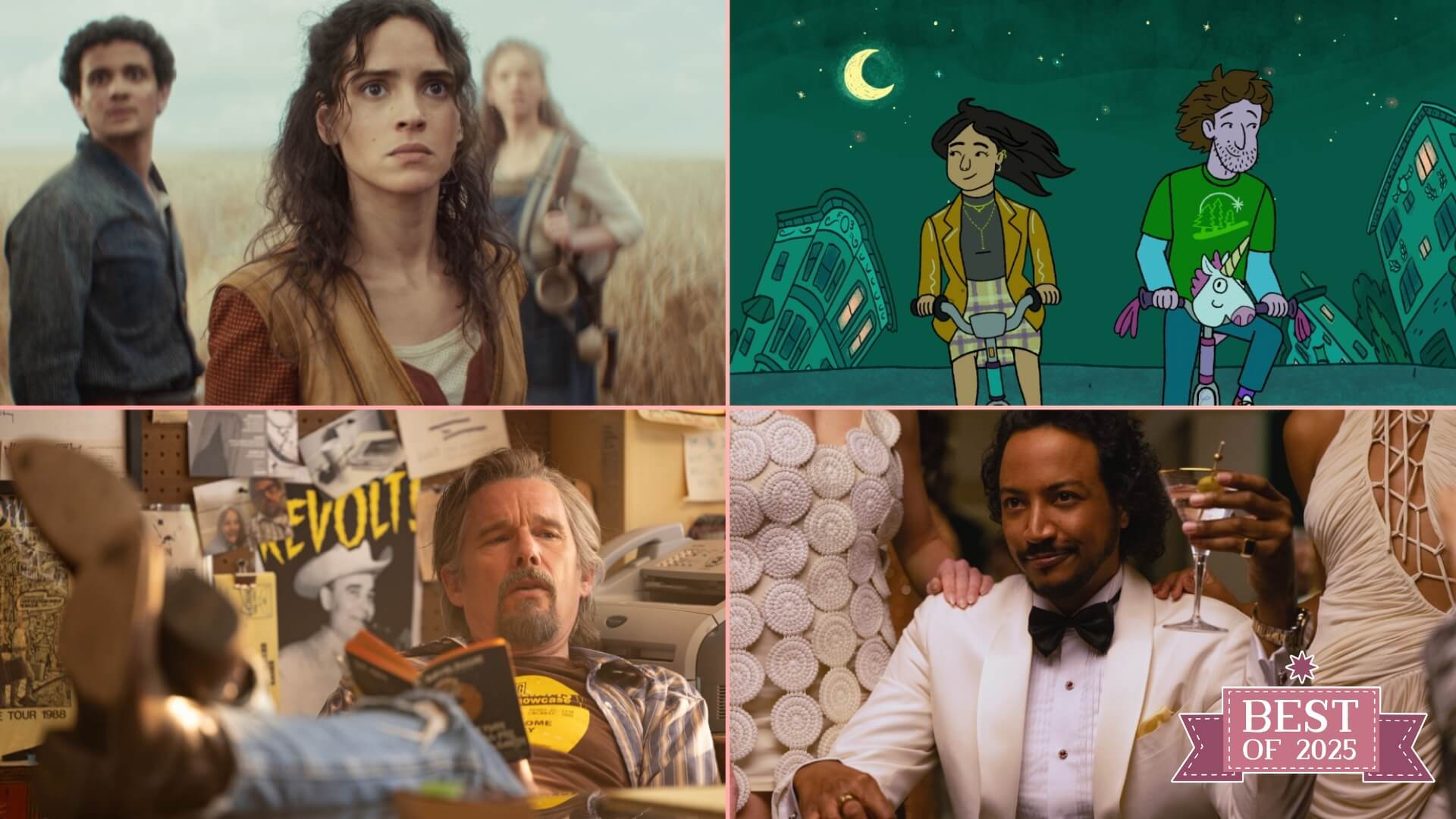
The story here shuttles back and forth through time to paint a multifaceted portrait of a Bay Area Jewish family across the decades. It’s both a delight and a tsuris to be swept up in the day-to-day lives of the Schwoopers, from boomer ex-hippies Naomi (Lisa Edelstein) and Elliot (Paul Reiser) to their neurotic millennial children (voiced by Ben Feldman, Abbi Jacobson, and Max Greenfield) and grandkids. Like Raphael Bob-Waksberg’s cult sci-fi series Undone, Long Story Short explores what gets passed down between generations. The show uses its nonlinear structure to demonstrate how the past is always alive in the present, no matter how far you try to run from it. If that sounds like a downer, rest assured that it’s also very funny. We’re talking exploding mattresses, a wolf-infested middle school, a purseful of corn on the cob, and more silliness from the mind that brought us BoJack Horseman. [Jenna Scherer]
16. Mo
The second and final season of Mo Amer’s eponymous comedy grows more elegiac by the day. It marks the end of this incisive take on immigrant life in Texas and, less officially, that of the broader genre of trenchant semi-biographical dramedies from comedians like Amer and Ramy Youssef (who co-created Mo and Ramy), the kind that once proliferated on FX and are now being supplanted on Netflix by dreck like Tiresand Bad Thoughts. The series finale, which lovingly depicts Palestine, has been made even more poignant by the ongoing destruction of the country. But Amer was able to capture moments in time that would slip through less-deft fingers. Along with series director Solvan Naim, he defied the Netflix house style to render gorgeous, vibrant portraits of all of the places—and people—he calls home. Even as the very nature of streaming becomes more fleeting, Amer can rest easy knowing he made something that will endure. [Danette Chavez]
15. Severance
Under the guise of an out-there sci-fi premise—slicing your memories in half to separate office and home lives—Severance offers a timely analysis of workforce problems. At the heart of Dan Erickson’s drama lie enticing moral dilemmas about present-day corporate culture and how it causes the dehumanization of labor. All this happens through stunning cinematography, direction, and acting—each a building block of the show’s delicately constructed puzzle. This atmospheric, heady thriller has high stakes that drive the momentum, even if answers come at a luxurious pace. Season two, which arrived with much anticipation after a mind-bending finale all the way back in 2022, stays true to this ethos as it expands on the Lumon agenda, Gemma’s (Dichen Lachman) kidnapping, and why the MDR folks are vital to the “mysterious and important work.” The performances, especially by Adam Scott, Britt Lower, and Tramell Tillman, are revelatory, with the show’s strengths compounded by Theodore Shapiro’s haunting score and a claustrophobic, mostly all-white office design. [Saloni Gajjar]
14. Mr. Scorsese
Sometimes it’s worth being reminded why the greats are the greats. And Mr. Scorsese, Rebecca Miller’s five-parter on the arguably the most celebrated living American filmmaker, certainly does that, acting as a captivating and—fitting, given its subject’s output—often exciting look back on an artist whose journey and work has been discussed so much over the decades. (The last Apple doc with this kind of goosebumps-inducing, cool marriage of footage and music—a Scorsese speciality—was Todd Haynes’ masterful The Velvet Underground.) “[He was] not very relaxed at all,” says editor Thelma Schoonmaker of her longtime collaborator with a smile. “I mean, he really had a mission and he was gonna get there if it killed him [laughs]. So he was sometimes not easy to be around.” And that is essentially the running theme here: that this guy’s remarkable drive to make these films about outsiders and get what he had in his head onto the screen was almost fatal, and that every time his career was considered over, the kid from the neighborhood would somehow fight his way back. [Tim Lowery]
13. The Rehearsal
Nathan Fielder rarely holds back when it comes to making his audiences uncomfortable, as seen with Nathan For You, The Curse, and The Rehearsal. In his second round of the latter, he sets a new bar for himself. Over six outings, Fielder lives out the life of pilot Sully Sullenberger (in a montage that’s tough to shake), brazenly depicts those at Paramount as Nazis, dupes folks into believing they’re in a reality competition, and seemingly flies a commercial airplane. It’s jarring to watch Fielder test his (and, frankly, everyone else’s) limits, with the result being an audacious and electric comedy experiment that lets him show off his deadpan style. And somehow, the finale’s payoff is equal parts stressful and profound. [Saloni Gajjar]
12. Mussolini: Son Of The Century
TV offered plenty of escapism this year, as is its wont, but if you were willing to look into the “void” of fascism, you were rewarded with one of the most gripping and stylish historical dramas of the last decade. Though set in post-WWI Italy, Joe Wright’s adaptation of Antonio Scurati’s M: Son Of The Century hit a nerve with viewers on either side of the Atlantic, depicting with great verve and accuracy Benito Mussolini’s rise to power. There’s nothing didactic about Wright’s approach, certainly not when the series’ touchstones include ’90s rave culture and My Fair Lady, and it’s soundtracked by Tom Rowlands. Luca Marinelli leaves other series leads in the dust as Il Duce, alternately thundering, charming, and wheedling to show the pathetic true nature of dictators. Audacious and acerbically funny, Mussolini: Son Of The Century proves history doesn’t have to be boring, while also offering its own unique brand of comfort: the bittersweet knowledge that “these times” aren’t unique, but they do eventually end. [Danette Chavez]
11. The Chair Company
Ron Trosper, the everyman-who’d-like-to-be-anything-but at the center of The Chair Company, is instantly recognizable as a Tim Robinson character: a guy constantly on the brink. But the rest of the series elides easy categorization: Some viewers see a pitch-dark office comedy, others a treatise on millennial men or a successor to Curb Your Enthusiasm. That’s what made the series from Robinson and longtime collaborator Zach Kanin such a welcome surprise. Instead of being a font of memeable moments à la I Think You Should Leave, it brought back Monday morning water-cooler talk. And like other sticky shows—that is, ones that linger long after “best of” lists are put to rest—The Chair Company understands that how it goes about its themes is just as important as what the show is about. There’s no stray detail; the lifeless office setting is a reminder of work’s life-sapping ability, and Robinson finds new levels of rage and despair as Ron unravels. The series actually lives up to the “Lynchian” descriptor, but in all that praise of its “quotidian” quest, we shouldn’t ignore how funny it is. Forget memes; after watching this, you’ll never hear “Have a nice day” the same way again. [Danette Chavez]
10. The Studio
Matt Remick sure knows how to make things awkward at the worst possible times, which is exactly what makes The Studio’s 10-episode first season so hilarious and biting. Centered on the recently promoted studio head, played by series co-creator Seth Rogen, Apple TV’s show pokes fun at the industry’s obsession with IP, artificial intelligence, and award ceremonies through broad comedy (pratfalls aplenty! hurled burritos! drug-fueled mishaps!). But it’s also surprisingly incisive and critical of the industry’s inner workings and very funny, with a parade of great celebrity cameos, as well as a maniacal turn from Kathryn Hahn, a breakout performance from Chase Sui Wonders, and lots of scenery chewing from Ike Barinholtz. Still, amid all its scathing and timely satire, The Studio clicks mostly because of its writers’ clear love of filmmaking. [Saloni Gajjar]
9. Pee-wee As Himself
How do you make a documentary about a man who was so private that he hid most of his identity behind a persona as memorable as Pee-wee Herman? That was the challenge facing Matt Wolf, and it’s foregrounded in his excellent Pee-wee As Himself as Paul Reubens essentially tries to control the narrative around his life in interviews. Could Wolf have made a traditional doc about the life and career of this underrated genius? Sure. But what separates this from other bio-docs is how much it merges the two halves of its focus, telling both Pee-wee and Paul’s stories at the same time (even if its subject doesn’t like it). Wolf spent 40 hours with Reubens at the end of his life. And while the project takes a chronological approach, it challenges the stories that have publicly defined Pee-wee and Paul, including his 1991 and 2002 arrests, which became late-night talk-show fodder, as well as coming out and going back into the closet. Pee-wee As Himself succeeds beyond its typically hagiographic form by presenting its subject as an imperfect person, allowing us to see the man and his creation in a new light. [Brian Tallerico]
8. Dying For Sex
Dying For Sex co-creators Liz Meriweather (New Girl) and Kim Rosenstock mesh comedic stylings with the crushing true story of BFFs/podcast hosts Molly Kochan (Michelle Williams) and Nikki Boyer (Jenny Slate), delivering a funny, titillating, and heartbreaking limited series. The FX show has a devastating death, but the eight-episode journey isn’t marked only by sadness, although plenty of tears will spill as Molly and Nikki deal with the former’s cancer treatment and the toll it takes on them. Through Molly’s sexual escapades and Nikki’s support of her pal, Dying For Sex explores the power of female friendships, open communication, and trying to find joy—and orgasms, of course—when confronted by mortality. [Saloni Gajjar]
7. Task
How fucking good is Tom Pelphrey in this thing? That might be a crude way to hail what is, at heart, a very sensitive show—Brad Ingelsby’s HBO follow-up to Mare Of Easttown is beautifully bookended, and the writer introduces his two main characters (Mark Ruffalo’s alcoholic FBI agent and Pelphrey’s garbage man/robber) with several dialogue-free minutes that still somehow get across exactly who these men are—but it is one of its big takeaways. If TV can still deliver star-making turns, his all-in portrayal of a complicated guy who thinks he’s doing right by his family should be one of them. Ruffalo is also quite good as a hollowed-out and hurt father, and, of the younger cast, Thuso Mbedu and Emilia Jones are excellent as a sharp task-force member and overwhelmed surrogate mother, respectively. The other takeaway is that we just haven’t seen a crime drama like this in a long time, one that can deliver an epic, gripping shootout where several main characters’ lives hang in the balance as well as meditative, quiet, pause-filled discussions about tricky subjects like faith and forgiveness. Here’s hoping we see more of them soon—but don’t hold your breath. [Tim Lowery]
6. Common Side Effects
Adult Swim’s funky causeways keep delivering inventive, visually distinctive work for the more cerebral doofuses among us, though Joe Bennett and Steve Hely’s Common Side Effects represents a real leap forward: With Alejandra Guevara Cervera’s surreal big-head designs and Nicolas Snyder’s aural soundscapes, this Mike Judge-produced series dives into the American healthcare system with fortified cynicism toward the structures built to keep us broke and unwell. Enter an unlikely hero: Marshall Cuso (Dave King), a gentle fungi expert whose discovery of a blue mushroom that seems to cure everything—including imminent death—sends the pharmaceutical industry into an existential panic. What follows is a psychotropic thriller and hopeful treatise for a better world, populated by Emily Pendergast’s disillusioned corporate lackey, two pinkie-promising DEA agents (voiced by series standouts Joseph Lee Anderson and Martha Kelly), Judge’s emotionally adrift pharma CEO , and a very chill tortoise named Socrates. Together, they explore complex questions: Is slow, steady compromise the only path to social betterment? Or is radicalism the cure-all for this sad, broken world? [Jarrod Jones]
5. The Lowdown
Reservation Dogs‘ Sterlin Harjo didn’t make it easy on himself by tackling a sprawling, comedic neo-noir that’s very much in the mold of The Long Goodbye and The Big Lebowski (you know, the amazing stuff) for his first solo TV creation. But after an episode or two, it’s easy to start looking past the clear references (sometimes detective novels literally brought up in conversation by Ethan Hawke’s bookstore owner/investigative journalist Lee Raybon, the Philip Marlowe of this particular Tulsa-set tale) and enjoying it for the pleasure that it is. Part of that is thanks to Hawke, who plays his character, the sort of guy who has some great warped country records in his shabby apartment and doesn’t think twice about drinking coffee after hours at a diner with his teen daughter (played by a very good Ryan Kiera Armstrong) on a school night, so naturally that the actor must have an affinity for him and his fuck-the-man worldview. (Many of the other characters here, particularly Keith David’s PI, are lived-in and charming too.) But more of it has to do with Harjo’s very clear sense of place and empathic purpose, which doesn’t fade in the background even as the conspiracy boils over, skinheads enter the scene, and the bodies pile up. [Tim Lowery]
4. Adolescence
One of the most chart-topping, critically acclaimed series of the year, it’s the filmmaking of Adolescence that first made it a sensation. Each of its four hour-long episodes are shot in mindboggling continuous takes, with the camera not just weaving in and out of rooms but sometimes jumping through windows, joining characters on car rides, and once even taking a drone flight across town. Yet for all the technical wizardry, it’s the actual substance of the Netflix series that made it linger. The first episode opens with sweet looking 13-year-old British schoolboy Jamie Miller (tremendous newcomer Owen Cooper) being arrested for the murder one of his female classmates—an accusation that seems as impossible to the viewer as it does to Jamie’s gobsmacked father (played by co-creator Stephen Graham). But as Jamie’s story unfolds, Adolescence paints a terrifying portrait of modern male teenagehood, where the gaps left by parents can be filled by rage-soaked online content that turns lonely young men violent before their brains are even fully developed. In fact, the best episode of the series downplays the one-take theatrics to simply zero in on Jamie’s harrowing conversation with the forensic psychologist (portrayed by Erin Doherty) assigned to understand how a generation of young men can be corrupted without ever leaving their bedrooms. [Caroline Siede]
3. The Pitt
In a TV landscape packed with medical shows, The Pitthas already cut through the noise to gain a lot of eyeballs and multiple Emmys. And it’s gearing up to return for season two in January. HBO Max’s show clearly resonates because it blurs the line between the good old days of network television and the streaming era. Beyond that, its real-time format strikes a chord when it could’ve come across as gimmicky. Thankfully, the blend of storytelling precision, tremendous technical work, and a refreshing cast pays off big time. By immersing viewers in a grueling 15-hour shift of ER employees, The Pitt portrays healthcare workers with empathy and authenticity. Despite a large ensemble, each actor gets rich material to play with and develop their characters. And the show’s commitment to tackling thorny issues (anti-vaxxers, abortion rights, mass shootings, violence against nurses) without being soapy might be its greatest feat. [Saloni Gajjar]
2. Pluribus
We are all Carol Sturka. In a time when it feels like the world has gone a little mad, when online hive minds regurgitate sound bites as one, and when it’s understandable to be a little skeptical of leadership, here comes Pluribus, a genre hybrid that feels both timeless and extremely of the moment. Vince Gilligan takes what he learned from Better Call Saul and The X-Files to create a visionary show that feels like it owes a debt to both as well as where we are in 2025. Rhea Seehorn is phenomenal as Carol, one of the only people on Earth not connected to an alien invasion that has basically turned the surviving population into a singular entity. Have you ever felt like you were the last sane person on the planet? That’s Pluribus. This show is layered with meaning, but it can also be enjoyed purely as a Twilight Zone-esque what-if scenario. Would you resist like Carol? Would you give into the potential of shared knowledge? What about having your every desire fulfilled? Seehorn is spectacular as she layers her performance with grief over the love and world she’s lost. Pluribus always feels like it’s one step ahead of the audience, as we breathtakingly race to keep up with it. [Brian Tallerico]
1. Andor
When Andor debuted in 2022, Star Wars disciples and even some agnostics quickly—and rightly—assessed it as one of the franchise’s peak achievements, largely unmatched in ambition, artistry, and sophistication. So when season two arrived, it wasn’t just competing with every other Star Wars property, it had to stand up to Andor season one. Damned if series creator Tony Gilroy and his team didn’t top themselves, widening and deepening their first run’s multifaceted, genre-bending saga of a reluctant revolutionary. Season two leans into the messiness of radical regime change, covering the sometimes competing and sometimes collaborating rebel factions, who first distrust, then exploit, then come to rely on shrewd smuggler Cassian Andor (Diego Luna). Set in the years immediately preceding the destruction of the Death Star (as seen in the 1977 Star Wars movie), season two’s twelve episodes thread suspenseful cat-and-mouse espionage plots through a larger study of how authoritarian governments atrophy as radical movements haltingly coalesce…and while both sides intentionally sacrifice their visionaries. It’s hard to deny the ripped-from-the-headlines implications of this show, and yet Andor’s greatness springs from its timelessness. The galactic rebels have “friends everywhere” because the universe is filled with the fed-up and stepped-on—in the here and now, and a long time ago in a galaxy far, far away. [Noel Murray]


 Keep scrolling for more great stories.