By practically any measure, season three of House Of The Dragon has been its strongest yet. With the Dance Of The Dragons in full swing, the plot is moving at a much faster pace. The action and violence are dialed up, as proven in the premiere’s depiction of the consequential Battle of the Gullet. The story also feels more streamlined, contained to a specific and key time in the war between Queen Rhaenyra’s faction (a.k.a. the Blacks) and Aegon II’s faction (a.k.a. the Greens)—a significant improvement on season one’s strangely paced time jumps and season two’s general narrative stalling. Most impressively yet, the series is pulling off a compelling redo of Game Of Thrones’ bumpily executed “mad queen” arc.
Rhaenyra Targaryen’s depth puts her in conversation to be one of the most complex characters in this franchise, up there with some of Game Of Thrones’ fan favorites. That’s a distinction shared by only one other character on this spin-off: Alicent Hightower. Setting aside Rhaenyra and Alicent, few individual characters throughout those first two seasons really leave an impression or provoke real emotional investment, a problem that hasn’t entirely faded in season three. Perhaps that’s why House Of The Dragon can’t quite earn that “better than Game Of Thrones” distinction, even now.
House Of The Dragon can nail the big battles and brutal character deaths, as the Battle of the Gullet proves. Even then, though, the consequences feel somewhat hollow. Take Prince Jacaerys Velaryon, whose death is artful in its brutality: he frees himself from a drowning Vermax, only to be shot by Triarchy marksmen. It’s a promising indication about the show’s willingness to keep the story moving and start axing major characters again. But what does losing Jace really provoke in the audience besides pity for Rhaenyra, who has once again lost a son? He’s just another falling domino that will knock over another and another until the Targaryens are left with an endless pile of dead humans and dead dragons.
The hollow characterization can feel even more apparent during the less eventful in-between episodes. This week’s “Tumbleton” is one of those classic transitional installments, low on bloodshed outside of newly introduced characters, and it’s useful for highlighting both the show’s continued flaws and also some of its genuine improvements. For one, this week features the return of Rhaena Targaryen, another dud character whose current emotional journey just isn’t very interesting. She’s hiding out with her wild dragon to avoid the potential wrath of Rhaenyra for their role in Jace’s death—Sheepstealer was going after Rhaena’s sister, Baela, and Jace got distracted trying to stop the attack—but the story is more about her father Daemon mitigating Rhaenyra’s reaction than anything else. It all ties back to the ever-present question of how low Rhaenyra will go in her pursuit of vengeance and power. Rhaena herself isn’t a well-defined character outside of her minor role in the history playing out in House Of The Dragon.
A standard transitional episode of peak Game Of Thrones coasted on patient character work and a sense of humor, two qualities in surprising abundance in the spin-off A Knight of the Seven Kingdoms. Less so in House Of The Dragon. But that may be starting to change, especially after two-and-a-half seasons of cumulative storytelling. The character of Corlys rests more on Steve Toussaint’s performance and some broad traits (loyalty, pridefulness) than anything else, but his newfound relationship with his bastard son Alyn of Hull makes the character more endearing. Ormund Hightower is a solid new addition who really comes alive in “Tumbleton,” funny and specific and loathsome yet charismatic. So far, Daeron Targaryen (Benjamin Evan Ainsworth) fits into a very basic type of young House Of The Dragon character—thoughtful, shy, resistant to violence, skeptical of ruling—but there’s potential if the show builds on his apprenticeship to Ormund and connection to his long-absent mother.
The series is slowly following Game Of Thrones’ example and building up its arsenal of memorable supporting roles. Still, all pale in comparison to Rhaenyra and Alicent, easily the most complex characters of the show both individually and together. It’s worth noting this bond wasn’t such a central part of the source material. In Fire & Blood, George R.R. Martin’s fantasy history, Alicent is roughly nine years older than Rhaenyra; in the series, they grew up as childhood best friends until Alicent married Rhaenyra’s father and everything changed. That shift may seem minor from the historical world-building perspective, but it makes all the difference when it comes to giving House Of The Dragon its soul.
In theory, this whole series is primarily a story about Rhaenyra versus Aegon. And Aegon has certainly gained new dimension since ascending to the Throne, showcasing a brand of stupidity and entitlement distinct from the cruelty of Joffrey Baratheon, Game Of Thrones’ child king and most detestable villain. In season three, the series is showing him in a slightly more sympathetic light: He’s on the run with Larys, witnessing the downstream effects of his own careless governing for the first time. Humbling Aegon seems like a way of setting up a sort of redemption arc where he will “come back to life” and usurp the half-sister who declared him dead.
But Aegon has never truly co-anchored this story the way his mother has. If anything, House Of The Dragon is hamstrung by its source material in this way: The show has too much on its plate to fully give itself over to Rhaenyra and Alicent’s friendship-turned-rivalry as the central focus, yet theirs is obviously the most vivid, rich dynamic in the series. That becomes clear whenever they’re on screen together.
In fact, most of the strongest, most emotionally complicated scenes of the show involve the twists and turns of Rhaenyra and Alicent’s unstable bond. The young Lucerys and Aemond aren’t very vivid in season one, but Alicent demanding an eye for an eye is riveting television, especially for all that it brings up between the two mothers—like Alicent’s age-old envy of Rhaenyra’s ability to pick and choose which customs of royalty best suit her fancy, and Rhaenyra’s resentment of her friend’s veneer of righteousness. Both women are hypocrites in their own ways, and that adds a fascinating layer to all of their interactions.
Season two suffers from Rhaenyra and Alicent’s estrangement, but their two reunions easily represent the peak of that season. During their discreet sept conversation, Alicent realizes she was mistaken about her husband naming Aegon as his heir, yet can’t grant Rhaenyra a path to peace; it’s too late to pull back from this war, even if it was built on a lie. By the finale, however, Alicent has made an incredible transformation. She isn’t merely ready to acknowledge the woman she is—someone frequently driven by jealousy but who ultimately just wants the time and peace to figure herself out, away from King’s Landing and away from all the plotting and maneuvering. But she’s ready to give her best friend the Iron Throne, even if it means letting two sons lose their heads.
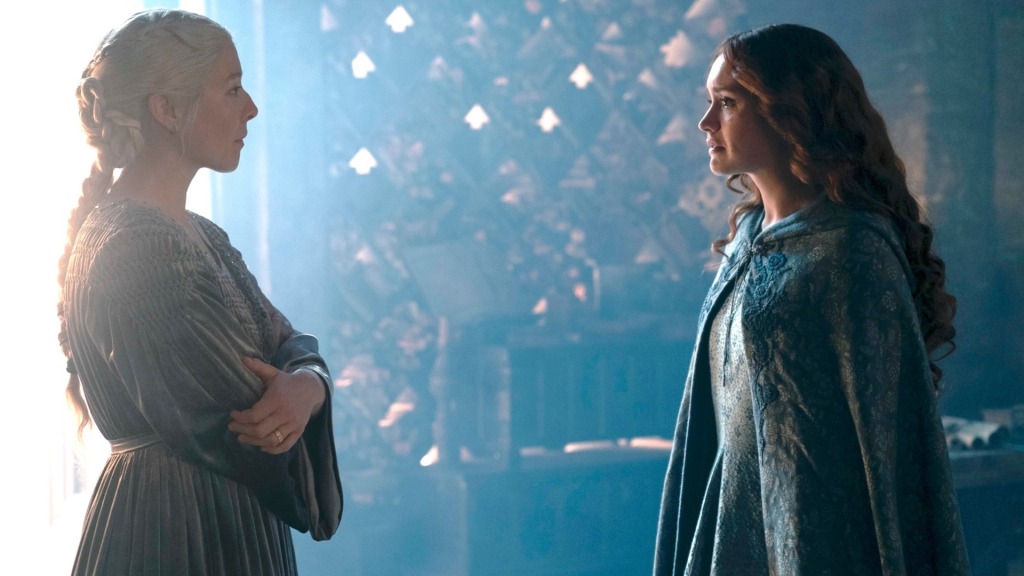
And in season three, Alicent has become an unlikely advisor on ruling, renewing a sort of camaraderie with her old best friend despite their new wildly unequal power dynamic. Olivia Cooke’s performance is more essential than ever here. At every moment, her face shows Alicent’s struggle to keep herself calm while arguing for her family’s lives—and accepting some shocking sacrifices to stave off further consequences. Rhaenyra has just executed her father, and there’s surely more suffering to come: After all, Daeron Targaryen is still a loose end, not to mention the child growing inside Helaena. Rhaenyra insists she would spare Daeron, but Alicent has no confidence in that.
Rhaenyra and Alicent’s bond is ever-evolving, and it’s not over yet. Aegon and Larys may be slowly plotting their grand return, and Ormund may have big plans for Daeron, and Alys may be nursing Aemond back to health, all of which will surely pay off with fireworks. But what will linger most is the bond between the two queens at the center of the show, a ruptured friendship that never withered away or lost love entirely.
“History will paint you a villain, a cold queen grasping for power and then defeated,” Rhaenyra tells Alicent at the end of season two. “Let them think what they must,” Alicent replies. “I am at last myself, with no ambition greater than to walk where I please and to breathe the open air, to die unremarked and unnoticed.” There’s plenty of flowery dialogue in House Of The Dragon, spoken in plenty of great halls and council meetings and abstract dream sequences. But little of it contains this level of poetry and character-specific meaning, based on this much context and this many competing desires. If only every discussion felt so urgent.


 Keep scrolling for more great stories.