In July 2019, Marvel Studios was the biggest game in town. Avengers: Endgame was still racking up its record-shattering $2.7 billion worldwide take. The Infinity Saga, built over three increasingly essential phases and a little bit of luck, was a phenomenon. And it was over. The Marvel Cinematic Universe was united, the founding Avengers took their bows, Thanos was defeated, and Marvel president Kevin Feige strode into a packed Hall H at San Diego Comic-Con to announce the studio’s future, which shone like a newly forged arc reactor.
What a difference seven years makes. Marvel Studios returned in force to Hall H this weekend, and the vibes were, in a word, sweatier. Feige, wearing a Doctor Doom baseball cap, focused exclusively on Marvel’s film slate, sidelining the television projects he’d once sold as indispensable to the MCU schematic. And the announcements stayed within the scope of his cap’s brim. Everything revolved around this winter’s Avengers: Doomsday, with few hints about its follow-up, 2027’s Avengers: Secret Wars, and even fewer about what the MCU might look like beyond it.
This narrowing of focus is predictable and necessary, and saps heat from a studio that once generated it through forward momentum. After years of underperformers, critical duds, and fumbled projects, Marvel enters its next phase in recovery mode. Look no further than the two announcements beyond the Doomsday hype: Ryan Gosling and director Shawn Levy will team up for Ghost Rider (after Star Wars: Starfighter), and Ryan Coogler will return for Black Panther III, with Alien: Romulus breakout David Jonsson as his star. These projects reflect the tension simmering within Marvel Studios. Ghost Rider and Black Panther III are, on paper, easy layups for the studio that once embraced risks like Iron Man and Guardians Of The Galaxy; one is a third sequel directed by an exhilarating filmmaker at the peak of his creative power, and the other is yet another Ghost Rider movie, this time made by Shawn Levy.
Marvel needs both to hit. Feige and Marvel’s bean counters are aware that the superhero genre no longer occupies the cultural position it did in Thanos’ heyday. Capes no longer reign over the box office; DC Studios’ Supergirl was buried amid surprise hits from the horror vanguard, Toy Story 5, and The Odyssey. And while this muted demand—hardly a new trend, as evinced by the ho-hum returns for last year’s Thunderbolts* and Fantastic Four: First Steps—has compelled Marvel to slow their output, it hasn’t fully abandoned the practices of the genre’s boom years. (In fact, the anticipated box office haul for next week’s Spider-Man: Brand New Day will likely reflect that halcyon era.)
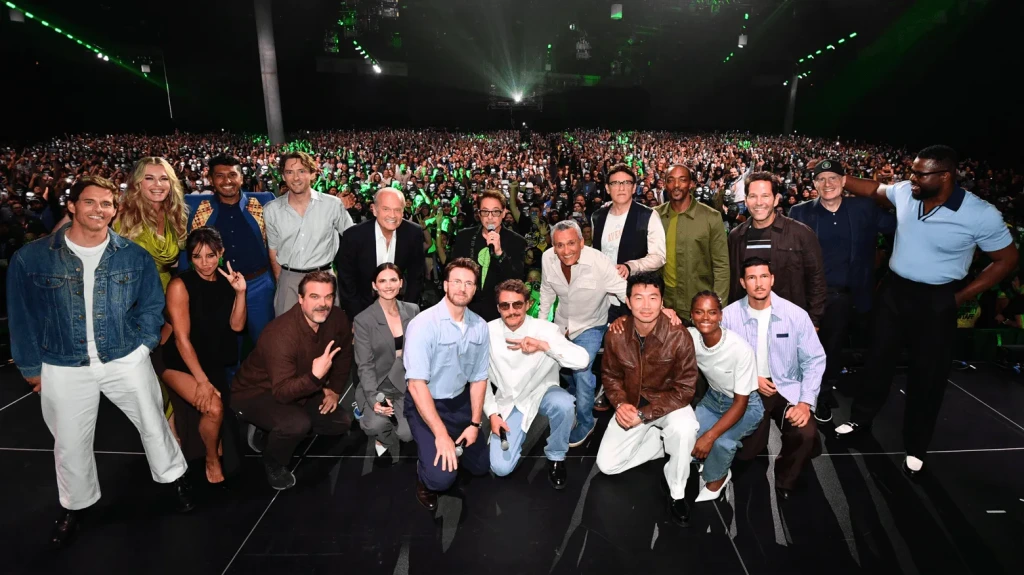
One moment during this year’s panel showed us that Marvel is actively trying to carry on like it’s business as usual. The Doomsday cast selfie might be the defining image of the studio in 2026: everybody’s back, or back again, or arriving from another universe entirely. It’s a united front of familiarity, one that might have looked victorious if the intervening years between 2019 and now had established a center while expanding outward. Instead, the post-Kang shuffle after Jonathan Majors’ assault conviction forced Marvel into the most consequential creative decision of the post-Endgame era: Either recast Kang and carry on, or reconfigure the studio’s plans around Doctor Doom, whose hotly anticipated MCU debut has already been hamstrung by Marvel’s cautious resistance to novelty.
While that reluctance didn’t shape the last three phases, it was there from the beginning. Phase Four launched with Black Widow, a prequel that looked backward at a moment when Marvel should’ve been looking forward. That film set the tone for the still-in-progress Multiverse Saga, a meandering narrative that has, if nothing else, been effective at parading out its veteran ringers: Tobey Maguire and Andrew Garfield thwipped alongside Tom Holland in Spider-Man: No Way Home; Hugh Jackman snikt’d around with Ryan Reynolds in Deadpool & Wolverine; and Patrick Stewart’s Professor X faced off against Doctor Strange And The Multiverse Of Madness and lost. Meanwhile, many of Marvel’s newest faces, like Simu Liu’s Shang-Chi, remain sequel-less years after their debuts, while their TV counterparts, like Tatiana Maslany’s She-Hulk, have been consigned to the Disney+ content heap.
Ironically, some of the MCU’s freshest moves have come outside the cinema. Form-busting TV shows like She-Hulk: Attorney At Law, Ms. Marvel, Moon Knight, Daredevil: Born Again, and Wonder Man embraced the individualized, eccentric cadence of solo comic series that the films have increasingly avoided. Instead of channeling that maverick energy into their big-screen efforts, Marvel’s last three phases have either botched the attempt (Eternals) or leaned into the continuity-heavy schematic that makes so much of post-Endgame Marvel feel like schoolwork (The Marvels, Thunderbolts*). When all these projects culminate with something as outwardly desperate as Avengers: Doomsday, it’s hard to feel as though the MCU has been going anywhere but in circles.
Still, there’s something poetic about Marvel’s return to Hall H ending with Black Panther III. Casting Jonsson as T’Challa’s son suggests a desire to move forward while paying respect to the past. It’s fitting; Coogler’s films have long made legacy and generational change their core theme, with a creative eye for the bigger picture and a cast willing to shoulder the scrutiny such change can bring. Before Marvel wrapped its 2026 Hall H panel, the studio that had simply been rummaging through the attic suddenly showed us a future beyond the familiar comforts of nostalgia. The question now is whether that step forward can make the MCU’s continued future feel inevitable once again.


 Keep scrolling for more great stories.