Prime Video’s Carrie and Peacock’s Crystal Lake share a narrative Achilles’ heel. It is, unfortunately and paradoxically, rooted in their premises and primary selling points: The promise of fleshing out and refreshing the lore of two legends of horror—Carrie’s titular telekinetic and original Friday The 13th slasher Pamela Voorhees (Linda Cardellini). Leaning on their popular and well-trodden source material, the shows overextend their respective universes and set up flimsy justifications for the monstrous actions of their. These troubles are not unique to bullied teens and vengeful mothers—to varying degrees, they’ve plagued contemporary TV extensions of franchises as varied as IT, Psycho, and The Addams Family.
To take the big-picture view, this is a symptom of a risk-averse Hollywood scraping the bottom of its IP barrels. It’s studios, cable networks, and streamers chasing built-in audiences, allowing producers and writers little room for creativity and experimentation within the well-defined lines of stories that already had their heyday on the big screen or on the page. How many more menacing figures are we meant to empathize with or understand better over the course of eight episodes? (Please don’t ask Ryan Murphy this question.) And yet, horror cinema is currently as popular as it’s ever been with critics, audiences, and (most shockingly of all) the Academy Of Motion Picture Arts And Sciences, and that’s due to inventive projects like Obsession, Backrooms, Weapons, Undertone, When Evil Lurks, Oddity, The Substance, Teenage Sex And Death At Camp Miasma… the list goes on. Why hasn’t that novelty transferred to TV to the same extent?
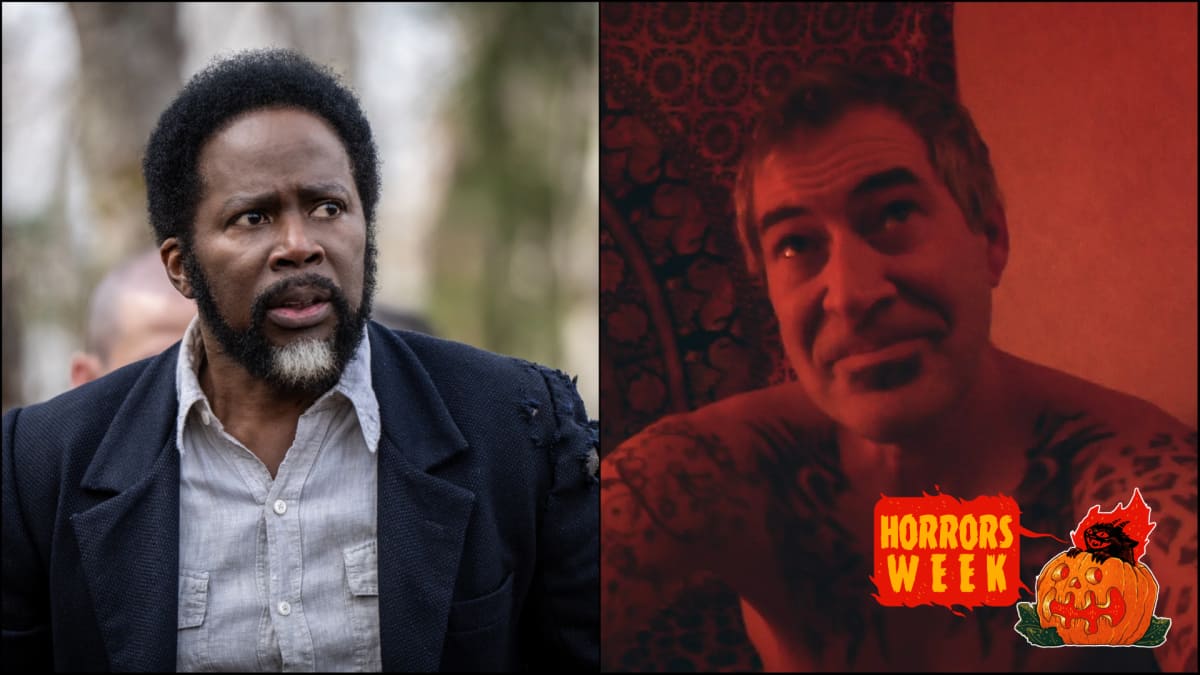
“Original ideas are tricky,” The Creep Tapes‘ Patrick Brice tells The A.V. Club. Brice speaks from the Carrie/Crystal Lake side of things: Three seasons into the absurdly entertaining anthology he co-writes with star Mark Duplass, he now has sharper insight into the horror landscape than when he made 2014’s Creep and its 2017 sequel. Bringing the movie’s found-footage conceit to TV starting in 2024, The Creep Tapes depicts recordings made by the serial killer who calls himself Peachfuzz (played by Duplass); each episode captures his interactions with a different victim, allowing for a long roster of guest stars who’ve included David Dastmalchian, Chris Gethard, and Terrifier 2‘s Elliott Fullam.
“A few factors allowed us to do what we did,” Brice shares. “From a strategic production and concept standpoint, it is very important right now, since so many shows are being made, to find that sweet spot where your concept is asking much less than a bigger show, but is enough to make something effective, scary, and visceral.”
The other factor: They’re pretty much making each episode of The Creep Tapes the same way they made Creep and Creep 2. “Despite the temptation to make things bigger, one of the things that makes this show special and unique is that we maintain a sort of poverty model of filmmaking,” Brice says.
A horror TV show can thrive without following the blueprints of a cult-favorite movie or a spooky bestseller, though. The Creep Tapes streams alongside originals like Hell Motel and the competition series The Boulet Brothers’ Dragula on Shudder. Apple TV’s ingenious horror-comedy Widow’s Bay made history at this year’s Emmys; Paramount+’s feral Yellowjackets, despite its ebbs and flows in quality, has drawn 10 Emmy nominations across its run. Stranger Things is one of only a handful of Netflix series to become a full-blown pop-culture phenomenon, and after it ended at the beginning of 2026, the streamer added the eccentric Something Very Bad Is Going To Happen and creature-feature Below to its lineup. But even when an original horror concept resonates with subscribers, it might not be shown the same patience or respect as a counterpart with IP backing—just ask Netflix’s canceled-too-soon The Boroughs.
And sometimes, a fresh take on the genre languishes in relative obscurity until it’s given a bigger platform. From has garnered a small-but-passionate following across four seasons on MGM+, but that following has already grown considerably since the show came to Netflix in mid-October. Created by John Griffin, From takes place in an unnamed, creepy small town that traps residents and anyone who enters. Shape-shifting creatures lurk in the woods surrounding “The Township” at night, forcing everyone who now lives there to team up to find a way out—or die. The show’s puzzle-box mystery and plentiful jump scares have kept audiences hooked since its 2022 debut. Still, Griffin tells The A.V. Club that, after he initially wrote the pilot in 2016, he didn’t go around selling it as “some great new horror show.”
“I got the same response about how it was a great script, but there’s no show there,” he says. Once executive producer John Pinkner and producer-director Jack Bender—both of whom, like From star Harold Perrineau, are veterans of Lost—signed on, the show’s unsettling, character-driven, and long-term premise snapped into focus: “a giant Twilight Zone episode,” as the trio put it.
“It was a good starting point for that sustainability to make a show that would be about reality being stripped away and your life turning into a nightmare,” Griffin says. “We can roll back the layers of that horror so it evolves season after season for the characters we’ve known.”
Bender notes that every episode has a point where the writers stop and ask themselves, “How do we make this scary? “But we’re not starting with that,” he says. “We use horror as a metaphor that makes a human story pop.”
From‘s slow-burn, atmospheric dread remains intact as mystical trees and supernatural beings are added to the mix, with season four firmly focused on the paranoia and psychological trauma of being confined. “My favorite shows have always been where I get to live with the characters like in Six Feet Under or Lost. So it’s rewarding to do that within the scope of this particular nightmare in the horror space,” Griffin says of From‘s serialized approach, which sets it apart from single-season horror dramas and anthologies—like AMC’s The Terror and Syfy’s Channel Zero— that followed in the wake of American Horror Story.
The Creep Tapes splits the difference between these approaches, tracing the further, gnarly misadventures of its antagonist, but matching each new victim to a different satirical target or another: A horror cliché like the final girl one week, the explosion of true-crime documentaries another week. “We think of what situations might be interesting to see this particular character in, and seeing which six of those are diverse enough in subject matter and how it fits into the season overall,” Brice says. “In that way, we can have a laser target on our audience and a dedicated fan base, and get to hit subgenres within horror.”
As for those bigger shows or platforms, Brice says that being on Shudder potentially allows The Creep Tapes to cultivate a fandom in a way that the show might not have on a higher-profile streamer. Still, he notes: “It’s one of the beautiful things about this genre that there are larger entities, but we can co-exist, and they can feel like peers.” To wit, he points out that Kate Siegel guest-starred in a season three episode this year because she and her husband and frequent collaborator, Carrie showrunner Mike Flanagan, reached out as fans. “Mike asked to be a victim at some point and to come and join us. We said, That would be great, but can we cast your wife first?” Brice jokes.
Meanwhile, From EP Pinkner posits that the reason these shows—IP-based or not—still work, ironically, is that “Horror feels safer. You can turn it off when it’s over, unlike the real world. And if the marketplace supports itself in these circumstances, people are going to chase that success.” Perhaps that’s why From has kept itself going in the current climate. Griffin acknowledges he still has to remind himself of the good fortune of getting to keep playing in this sandbox, particularly because the show arrived amid the uncertainty of the COVID-19 pandemic. It’s why Griffin says he didn’t give the whole “original” talk a lot of consideration at the time, but adds, “In retrospect now, it’s very rewarding to have an original piece out there that has the type of following it does.”
Saloni Gajjar is The A.V. Club‘s TV critic. To make sure you’re seeing more of her writing about the TV worth watching, add The A.V. Club as a preferred source on Google.


 Keep scrolling for more great stories.