Move over Yu-Gi-Oh!: there’s a new card game in town that involves sending people to a strange version of hell.
That game is Death Howl, a self ascribed “souls-like deckbuilder” with tactical grid battles à la Into the Breach and XCOM. You play as Ro, a grieving mother who, unable to accept her son’s death, has entered the spirit realm in a desperate attempt to save his soul before he fully crosses over. To do so, Ro must go to the four corners of this afterlife and fight the great spirit of each region to bring it back to its senses, before she can trek up the Howling Mountain.
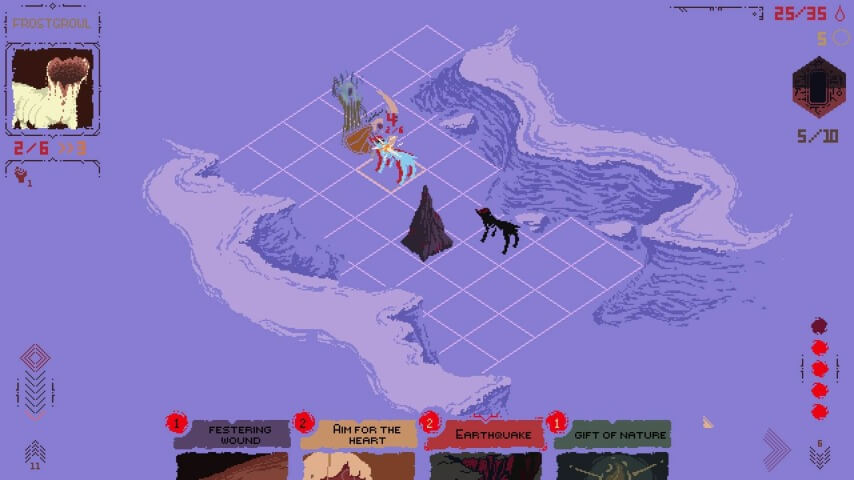
In Death Howl’s iteration of the tactics genre, you have a deck of up to 20 cards. You draw a new hand each turn, and have five mana to move around the grid and cast cards to defeat all the enemies in an encounter. There are also totems you can equip, and additional combat abilities that can be acquired from each location’s exclusive skill tree. The game seems to have attached itself to the souls-like genre through the use of the literal souls you collect, the enemy respawn mechanics, and the game’s equivalent of bonfires (called sacred groves). Each time you defeat a group of enemies, you collect each of their souls, which are the titular death howls. You also collect a number of natural materials after each fight—mushrooms, beaks, shells, etc. These can also be found lying around to pick up as you explore, and are the resources used to unlock and craft new cards; the death howls, meanwhile, are also used to earn teardrops to level up the branching skill tree.
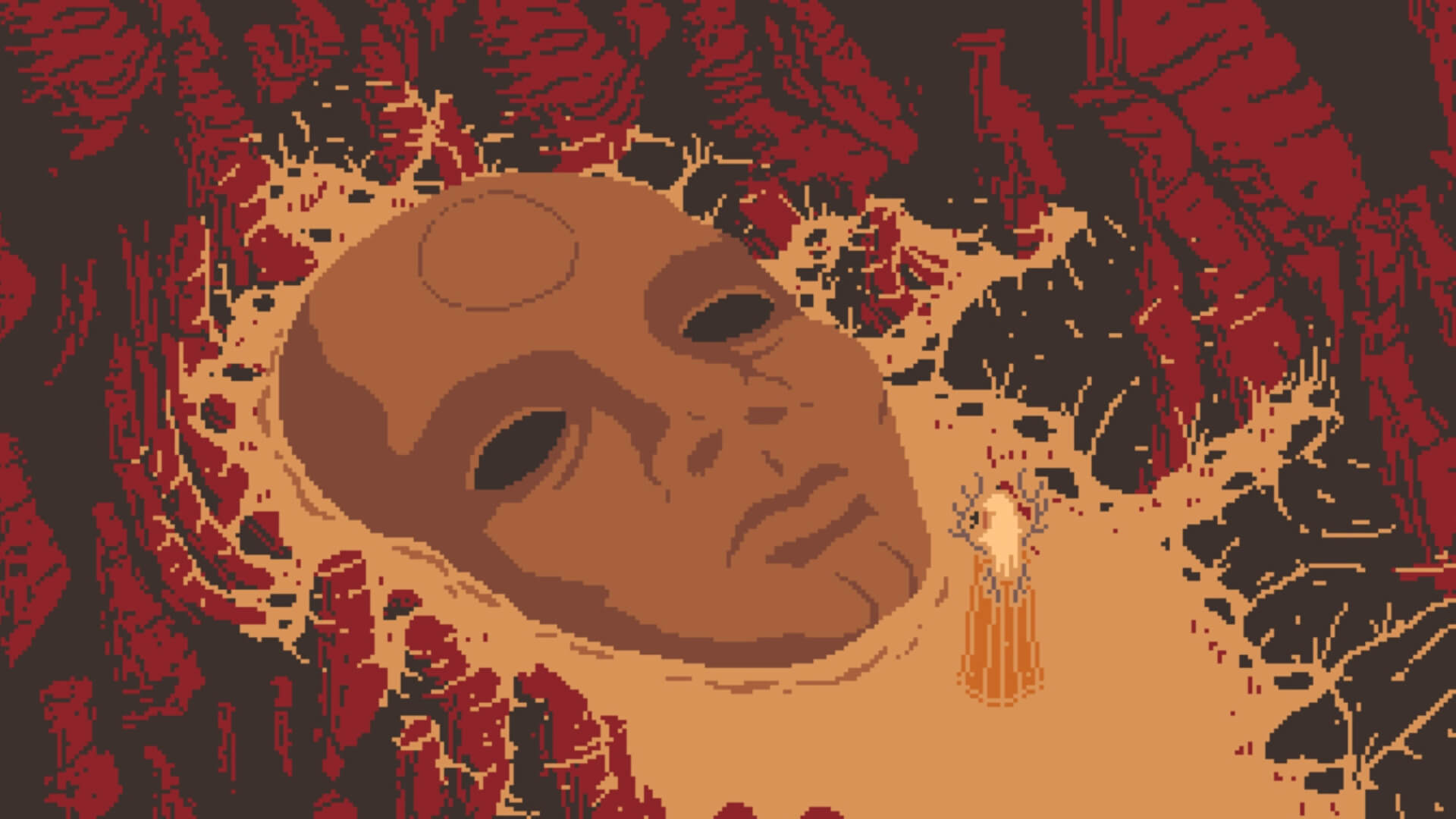
The game’s visuals and sound design are its greatest strengths. The various realms you traverse in this vision of the afterlife remain hauntingly beautiful even while they’re dying. Scenic forests, snowy hills, suffocating swamps, and harsh deserts are all populated with ghostly flora and fauna, rendered in beautiful pixel art. The four primary bosses especially stand out; they’re grotesque and extreme creatures who are as formidable in battle as they look. And the subtle but vivid audio fidelity is another pleasant surprise. Bewitching click sounds play alongside eerie breaths and moans as you pick up items and traverse the landscape, creating a haunting ASMR on your journey through the underworld.
That evocative world and satisfying combat gets Death Howl off to a strong start, but its pacing becomes a problem. Expect repetitive hours of grinding, in part due to its “souls-like” commitment. Most games of this genre offer a clear progression upward, where your character grows increasingly powerful, but each new area features enemies ready to meet you at your latest peak. In Death Howl, rather than becoming stronger as you progress, you enter each new area slightly nerfed. Cards from previous realms cost one more mana to use than usual, a significant debuff given your slim mana pool that will completely unbalance the deck you’ve set up. While your progression in other realms is maintained whenever you return to them, there is also an entirely new skill tree to level up from scratch each time, and you do not have access to your combat abilities from other locations.
This is all meant to incentivize you to build new decks using the cards that are specific to this region, but in order to do so you must scrounge together a subpar deck with your current collection, killing the same enemies over and over in order to unlock the new cards and materials needed to even begin crafting them in the first place. This “three steps forward two steps back” approach to increasing difficulty is flummoxing to say the least, as leveling yourself back up to the point that you can complete the area is often more monotonous than anything else. A discerning card game player will be able to tell which previously unlocked cards are still useful despite the inflated mana cost, but it is an adjustment they will have to make multiple times before rolling credits.
The hours of grinding inherent to the gameplay loop isn’t just an issue of challenge or dullness. It feels incongruent with the urgency of the grief narrative the game is telling. Dialogue throughout the game emphasizes that Ro must get to the Howling Mountain as soon as possible, or else her son’s soul will have fully crossed over and it will be too late. Ro herself gives voice to this distress constantly, as she is in the throes of her grief and seeking to conquer anything necessary in order to finally climb the mountain to bring her son back. The padded out runtime of the game, filled with picking up items, crafting cards, and repeating the same encounters, gives the sense that there is no real rush. Contrary to what we’ve been told, death does seem to wait for someone.
Despite these issues that can cause lulls in the experience, there is something meaningful about the game’s tactical design that might make you willing to trudge through these slow spots. Figuring out a powerful deck makes you feel like a genius, and taking a particularly optimal turn simply scratches an itch in your brain like no other. The surreal images of death and decay surrounding an otherwise wondrous world full of creatures worthy of being cherished truly strike a chord, allowing for an emotional story about accepting the change that comes with loss to emerge. If you can get over the humps, there is something great waiting at the top of this mountain.
Death Howl was developed by The Outer Zone and published by 11 Bit Studios. It is available for PC.


 Keep scrolling for more great stories.