Political symbols are everywhere now—on our streets and our screens

On TV, the symbols are clear and direct, if heavy-handed. In film, broad political signaling takes their place.

Political symbols are everywhere now—on our streets and our screens

Silent women in the bloodred cloaks and white bonnets of The Handmaid’s Tale held a protest outside of the Broadview ICE facility. A cheeky inflatable frog galvanized a movement in Portland. Whistles, often bright orange, have become a tool of resistance against immigration raids in Chicago. These symbols—though they sit on a broad spectrum of relevance, seriousness, and efficacy—stand in stark ideological contrast to the political propaganda that the Department Of Homeland Security posts on social media: John Gast’s “American Progress,” a personification of manifest destiny; Morgan Weistling’s A Prayer for A New Life,” eerily mistitled as “A New Life In A New Land;” a pinned post of a pointing Uncle Sam, captioned, “America has been invaded by criminals and predators. We need YOU to get them out.

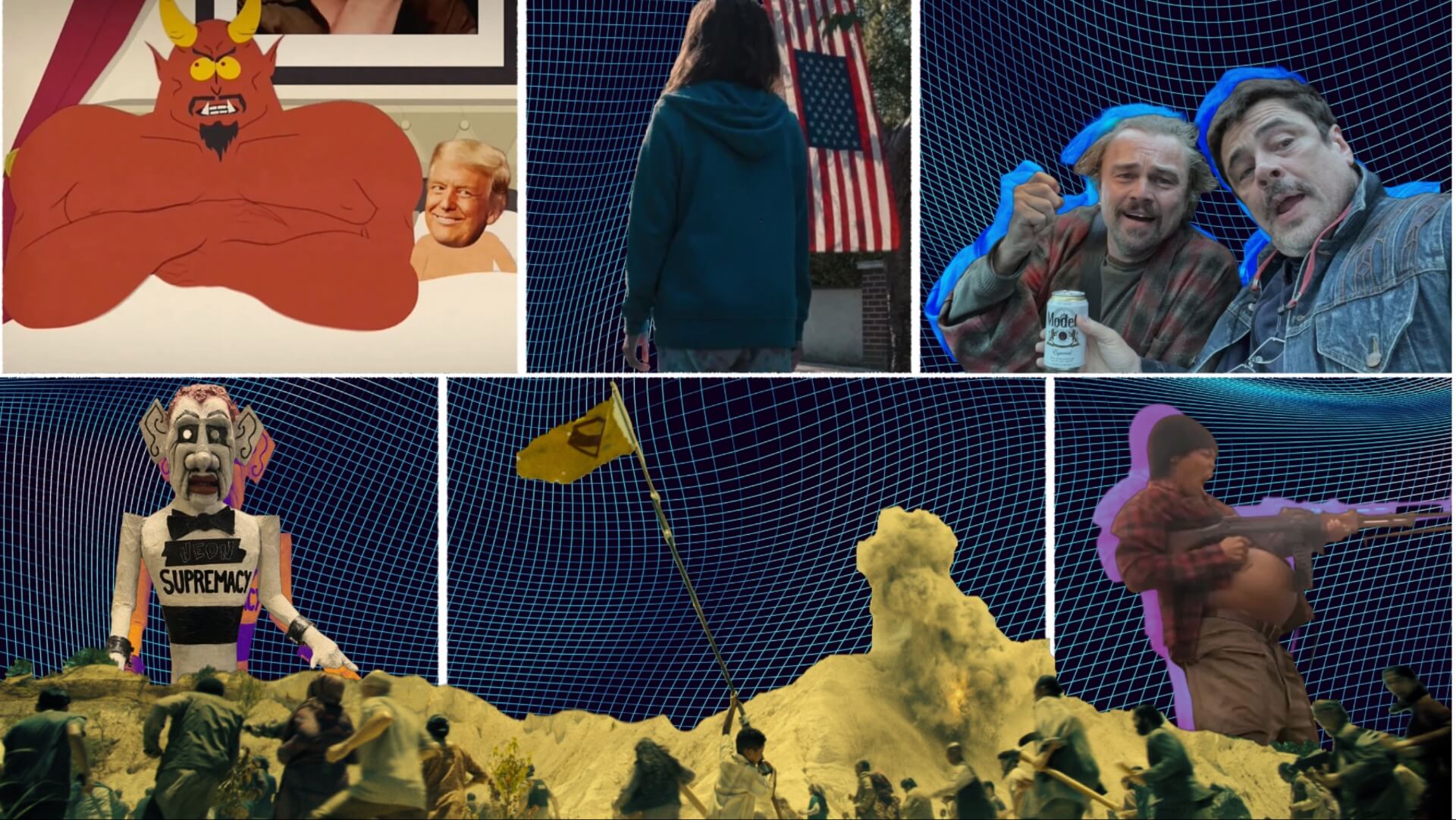
Overt political symbols are everywhere now. They’re all over our screens, too, as is political signaling. This feels like a response to—or at least in conversation with—the manifest propaganda and symbolism of the second Trump administration. (Is there a more potent political symbol in recent memory than the scarlet MAGA hats?) On TV, the symbols are clear and direct, if heavy-handed. In Peacemaker, in a parallel version of the U.S., a swastika replaces the stars on the American flag. (Especially ghastly given that, three weeks after that episode, an American flag, altered to include a swastika, was found in a Republican congressman’s office.) In South Park, Donald Trump is quite literally having a baby with Satan himself, horned and cloven-hoofed. And in The Savant—slated to come out this fall, but postponed indefinitely after Charlie Kirk’s death—stars and stripes abound, as does white supremacist imagery.

In recent films, broad political signaling largely takes the place of these specific symbols. One Battle After Another contains a little of each: The far-left revolutionary group The French 75 (the most memorable image of which is a pregnant Black woman firing a machine gun) blows up bombs to announce their presence. Community leader Sergio St. Carlos, on the other hand (the most memorable image of which is the humble Modelo), evacuates a group of immigrants through a hidden passageway. Superman gestures more vaguely toward political signaling, as do Anniversary and Eddington. But as mealy-mouthed as this signaling is—and as painfully on-the-nose as these symbols are—will we see this again? Or are we in a unique moment in which writers and artists feel comfortable talking loudly about politics? And how long can it last?

But let’s back up a decade. Remember the golden escalator? On June 16, 2015, in New York’s Trump Tower, Donald Trump slowly descended a golden escalator all the way to the basement, where he launched his 2016 presidential campaign on a lie. This gold-plated ostentation and obsession with imagery is a hallmark of Trump, the person and the politician. He is, at heart, a businessman, and he knows how to sell a brand. There’s the MAGA merch, of course, and the mugshot for which Trump posed carefully (he showed his aides facial expression options beforehand), which spurred fundraising. Then there was the speed with which Trump turned a bullet to the ear into a photo op, the King Louis XIV-ification of the Oval Office, and the demolition of the White House’s East Wing for a $250 million ballroom.

In both his aesthetics and his politics, Trump gravitates toward spectacle (including that infamous image of him as a king, gilded crown and all). That extends to the belligerent immigration enforcement campaign that has shaped the first year of his second term. The official social media accounts of governmental departments and agencies are now plastered with heavily edited, gritty-filtered video compilations of ICE and CBP agents: They’re blowing up residential doors, rappelling from a helicopter, pulling people out of cars, pointing guns at sleeping residents, slamming civilians into the ground. These sizzle reels focus on hawkish details—helmets, guns, armored vests, insignias, camouflage fatigues—and are set to what can only be described as bad action movie montage music. They are propaganda spots, designed to elicit immediate emotional reactions, recruit new Border Patrol and ICE agents, and portray American cities as at war with the federal government.

And so, in a second Trump administration that, even more than the first, orbits around propaganda and iconography, it makes sense that the opposition might respond in kind. Sure, The Handmaid’s Tale holds little relevance to the inhumane living conditions inside the Broadview ICE facility. Yes, the inflatable animals bouncing around Portland could be insensitive to undocumented people facing actual threats. And no, the crossed-out crown of “No Kings Day” didn’t really back any actionable demands. But then there are the plastic orange whistles, black-and-white keffiyehs, and 17-cent ice scrapers, which send a clear message and serve a real purpose. The through-line here is apparent: A large contingent of Americans does not agree with current federal actions and policies, and they want to make that resistance unequivocally visible. And although scripts are often finished long before we see a project, it does seem like symbols and signaling have spilled over onto our screens.

On TV, those symbols can feel clumsy but ultimately effective—not unlike Peacemaker himself. The second season of the superhero’s eponymous show follows Peacemaker into his perfect parallel universe, in which his family is still alive. But in this world, ​​as we come to find out, Nazi Germany won World War II, and everything comes at the expense of “outsiders” (people of color, LGTBQ+ people, religious minorities), forced into work camps. Inside A.R.G.U.S., a fictional government organization, swastikas replace stars on the American flag, Mein Kampf sits on every desk, and a mural of Hitler covers the wall. “The sad part is,” Adebayo (Danielle Brooks) tells Judomaster (Nhut Le), “I’m not so sure this Nazi world is as different from our own world as we wish it was.” James Gunn (who wrote this and all other episodes of Peacemaker) is hitting us over the head here, but, as Adebayo tells Judomaster about Peacemaker, “You’ve just gotta open your mind up a little and get past the parts that are cheesy.”

Once you do, you can embrace the full-on fever dream that South Park’s creators (Trey Parker and Matt Stone) have concocted for this year’s Seasons 27 and 28. Animation as a medium lends itself particularly well to cartoonish caricatures, and Parker and Stone have no holds barred. Jesus—glowing, halo floating—is actually in the schools under Trump. Trump is, of course, in bed with Satan (and later, a baby-faced JD Vance). DHS Secretary Kristi Noem shoots puppies unprovoked. Unqualified ICE agents tackle Dora The Explorer and literal angels in heaven. Clyde, hair pompadoured, receives the “Charlie Kirk Award For Young MasterDebaters.” As for The Savant, I can’t say much, given that Apple TV+ postponed it indefinitely three days before its premiere date, two weeks after Charlie Kirk’s death. (Hardly a spoiler: The show opens on a streamer character spouting the “The Great Replacement” conspiracy theory.) But as a story that follows an undercover investigator as she infiltrates online hate groups, flagrant white supremacist imagery is everywhere—behind screens and inside homes. (Red, white, and blue make an appearance, too.)

Popular cinema, on the other hand, has the opposite problem: It’s still talking politics, but rather than screaming symbolism, the big screen waves broadly in the general direction of commentary. Of Wicked: For Good, an allegory for the fascist radicalization of a nation, The New York Times’ chief film critic writes, “like most studio movies, Wicked blunts any overt political message; it’s about right and wrong more than left or right.” One Battle After Another, while also guilty of this, at least offers a sustainable, community-grounded alternative to the ostentatious antics of The French 75. In the midst of crisis, Sergio St. Carlos, who leads some “Latino Harriet Tubman shit,” reminds Bob, a former French 75 explosives expert: “We’ve been laid siege to for hundreds of years. It’s not your fault. Don’t get selfish.”

Superman, too, comes close to saying something: The movie is framed around the imperial nation of Boravia invading the oppressed neighboring country of Jarhanpur, in what felt to many like a refreshing metaphor condemning Israel’s genocide in Gaza. Writer and director James Gunn, however, sapped Superman of its political potential by repeatedly disavowing any connection between the two. (He did the same for Peacemaker, distancing the show from current events.) Anniversary gets even hazier, brandishing half-baked ideas about encroaching authoritarianism. Its necrotizing fascism is neutered by the name “The Change” and referred to as merely “radical,” eschewing any specifics. And Eddington bites off too much—COVID, mask mandates, Black Lives Matter, police brutality (and inefficacy), “antifa” (or lack thereof), paid agitators, AI data centers—to digest anything at all.

On one hand, why bother with grand gestures—ominously redesigning the American flag (Anniversary) or scrawling “white supremacy” across the chest of Zozobra (Eddington)—if you don’t have anything particularly incisive to say? On the other: At least they’re trying. We don’t know how long this moment will last, or what will come in its wake. On South Park, Eric laments that, after NPR is canceled, “woke is dead.” It’s not, not yetit’s alive, though clumsy and blundering. As blunt as it is, a swastika on an American flag onscreen is a resounding answer to an administration that seeks to declassify swastikas (and nooses) as hate symbols. “It’s not that we got all political,” the South Park creators told The New York Times. “It’s that politics became pop culture.”

 
Join the discussion...